Wilbur and Orville Wright, in 1903, through their dedication and extended ingenious efforts, demonstrated that powered flight in a heavier-than-air machine was not only possible, but proved to be the focal point in the revolution of transportation. Unfortunately, the historical flight by the Wright Brothers was only casually received, and with much skepticism, here in the United States. As the Wright’s improved their aircraft through further development, they were enthusiastically received in Europe, especially in France. Shortly thereafter, the Wright’s became involved in legal proceedings against Glenn Curtiss as to a type of wing control for aircraft. This legal conflict resulted in the advancement of aeronautical knowledge progressing slowly in the United States as compared with the countries of Europe.

Photograph of display in Wright Brothers Museum at Kitty Hawk, NC.
With the outbreak of World War I in 1914, the progress in the design and development of aircraft as fighting machines proceeded at a rapid pace, leaving the United States far behind. Until 1917, with our entry into the Great War, aerial activity involved exhibition flying at expositions and county fairs, or where a large assemblage of people might be gathered. Dangerous stunt flying was popular, such as flying over Niagara Falls or over New York City. This resulted in a tremendous amount of publicity for these adventurous pilots, but did little to further progress in this new method of transportation. Even before
World War I there was high interest in aviation in our area as shown by the ad, displayed below, and placed in the Cumberland Daily News in 1912.
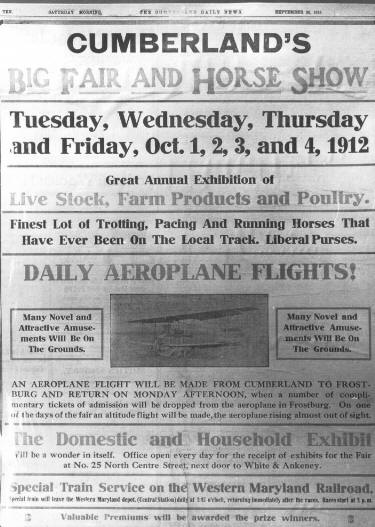
This extract from the Cumberland Daily News of September 24, 1912, displays the early interest in aviation in the Cumberland area.
At the time of the United States entry into WW I, no fighting aerial machines existed. Aircraft construction in the US consisted of primary trainers, primarily the Curtiss JN-4 ‘Jenny’, the J-1 Standard, and the DeHavilland DH-4 observation plane produced by special arrangement with the DeHavilland Company of England. The Jenny and Standard were usually powered by the Curtiss OX-5 engine. The war dictated the training of American pilots at a feverish pace, with some even training overseas. With the war’s end in 1918, a surplus of aircraft existed that could be purchased at low cost. With this situation numerous pilots developed a love of flying, with many attempting to make their living through barnstorming efforts.
* * * * *
 Wings Over Cumberland