Charles William “Bill” Armstrong, Lt. Col., USAF, Retired
In 1997 Doctor Bob Poling and I were ‘volunteered’ to co-chair a committee to organize and implement the placement of historical data pertaining to items of interest within a visitor’s gallery in the upper level of the newly constructed terminal building on the Cumberland Regional Airport. That turned out to be a two year effort with the results, I believe, that are quite satisfactory to all. I have known Bob Poling for several years but it was through this work on the airport gallery that I became fully aware of his intimate knowledge of local aviation history.
‘Doc’, as he is affectionately known to most, is a walking reservoir of aeronautical happenings in the greater Cumberland area. Having spent most of his life in Cumberland, he possesses the unique ability to recall nearly all that has occurred locally in the aviation field. His home is full of notebooks containing weathered news clippings, old photographs, hand written notes of conversations, and personal interviews with old pilots and others. This source of information continues to increase to this day.
When I retired in 1992 (the second time) after serving as airport manager of Cumberland Airport, there was an opening on the Potomac Highlands Airport Authority. I recommended that Bob Poling fill that slot, a recommendation I hope he has not held against me. As the only active pilot among the Airport Authority membership, Doc has tried to represent the small aircraft owners and the sport and pleasure pilots.
When the project of a local aviation history was discussed by the two of us, I knew Bob had the resources and the mental recall for the job. Having recently published a book I authored, ‘Into the Wild Blue Yonder Gently’, I was in position to offer some guidance on the methodology of putting together a manuscript. This book, a rather small epistle, relates my farm upbringing, nearly twenty-three years of military duty, and some follow on aviation experiences. My service was during the ‘cold war’, that long period eventually won due to the United States’ perseverance and military might. I am unquestionably proud of my Air Force service and although there were some down sides, the treasured experiences have, over the long view, been pleasant and enjoyable.
I spent the majority of my military duty flying high performance jet fighter aircraft. Those included the Lockheed T-33 ‘Shooting Star’, Republic F-84E and G ‘Thunderjets’, Republic F-84F ‘Thunderstreak’ (a totally different craft), North American F-86F ‘Sabre’, North American F100C, D, and F ‘Super Saber’ models, and the Northrop T-38 ‘Talon’. My first duty assignment following stateside gunnery training was in Korea in 1955 in the follow on police action. It was there that I joined the Caterpillar Club, those that have had to make a life saving parachute jump (silk paneled, hence the name of the club), after my F-86 Sabre Jet had a horrific and disabling engine failure. I served as a flight instructor in a long tour in Arizona flying F-84’s and F-100’s where the duty was teaching the necessities and techniques in bombing, gunnery and aerial engagement to students to become fighter pilots. During that period I was most fortunate to be selected to attend the Fighter Weapons School at Nellis AFB, Nevada. That elite school is the Air Force’s equivalent of the Navy’s, perhaps better known, ‘Top Gun’ school. The competition in the Fighter Weapons School was fierce and I was able to attain top scores in several categories. Later in England, following the Cuban missile crisis, I spent three
years in an F-100 squadron with the prime function of nuclear alert in possible response to an all out war with Russia. Other following assignments were as a member of an Inspector General team that passed judgment of the capabilities on numerous stateside tactical units and a tour of duty in Vietnam. While there in 1966-67 my prime function was duty in a war time command post disseminating information to the fighter squadrons. I was able, however, to gain flying time in a variety of aircraft, including a few missions in F4C ‘Phantom’ aircraft during close air support and bombing missions. Following that Vietnam experience I spent five years at Randolph AFB in Texas in a T-38 unit. Flying that beautiful high performance aircraft was a joy. Eventually, as a Lieutenant Colonel, I became the Chief of Operations and Training, a Wing level position overseeing the training of already rated pilots to become instructors.
I have flown high and fast, and low and fast, in the jet fighter aircraft experiences, with a great deal of flight time in that type endeavor in a variety of aircraft. Now I fly only low and slow in my 1946 Aeronca 7AC ‘Champion’, which is quite a contrast to be sure. When I now cruise at speeds (80 mph) that is but one-half of what I previously flew on final approach in jet fighter landing speeds, I do admit to musing on occasion of the irony of the differences.
When hired for the position of airport manager of the Cumberland Airport, I had no actual previous managerial experience of civilian airfields, although I certainly had exposure to a multitude of military and civilian airports. However, those past Air Force experiences certainly presented me with people management and oversight control responsibilities.
Although my military years kept me away from this area for a period of time, my local interest remained. Aviation has been for me, as it has for Doc Poling, a huge part of my life. I have continued flying since Air Force retirement and have kept my own aircraft at the Cumberland Airport for many years. Although far from an expert in this field, my function in the formulation of this manuscript has been to edit the work and to add later chapter inputs, since I was in position to observe a great amount of change at the local airport during my days as manager. Ably assisting in those efforts has been my son, Mark, a student of history.
It is my sincere wish, and also that of Doc Poling, that this compilation of local aviation history is of interest to many, pilots and non-pilots alike. Aviation will continue to be a major influence on our local area, and like any historical work, the written word should not be lost, but should become a worthwhile source to all that follow to reference and enjoy.
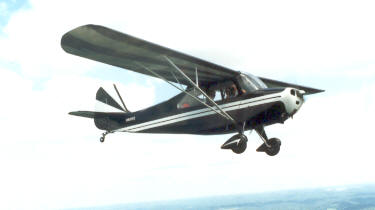
Bill Armstrong’s Aeronca 7AC ‘Champ’ – N81855
 Wings Over Cumberland