A cold strong weather frontal system drove through the Appalachian Mountains on September 3, 1925. The violent thunderstorms generated by this front caused the destruction of the US Navy dirigible ‘Shenandoah’. This occurred at three o’clock in the morning in an area north of Marietta, Ohio. A short time later the same weather system drove through the area and a Curtiss Jenny was blown from its tie down station and was destroyed by the strong winds that swept across the Mexico Farms Airport.
Later in September of that year a DeHavilland DH-4, with a harsh miss-firing engine was watched intently by Alex Rankin and his son, Glen, as the aircraft circled the Mexico Farms Government Field. It was obvious the DH-4 was in distress and was looking for a suitable place to land. Alex and Glen, heartbroken by what had happened to the Curtiss JN-4 ‘Jenny’ aircraft at Mexico Farms, were at the field salvaging parts from the nearly totally destroyed craft. This Jenny, owned by the Aero Club, was the plane that Alex had previously flown extensively and had soloed under instruction from Sam Huff. Alex Rankin was probably the very first pilot to complete his initial solo locally, which occurred in 1916. As a result Alex Rankin was made a member of the unique organization known as the ‘Early Birds’.
The DH-4 made its landing approach at the grass field still with sounds of an improper operating engine. The Army Air Service airplane was marked with the insignia on the fuselage that indicated the sole occupant was of high rank. When the aircraft was parked, and the pilot shut down the discordant Liberty engine, the Rankins were surprised to see General William ‘Billy’ Mitchell crawl from the cockpit of his favorite DH-4, named the ‘Osprey’.
General Mitchell was a high profile military individual who was frequently visible in the news of the day. Mitchell was relentless in his efforts to convince Congress and the Armed Forces that the method of fighting wars in the future would drastically change and that the use of aircraft would play a major role. His demonstration of the effectiveness of aerial bombing of obsolete warships still had not convinced the US Navy to change their fighting techniques. On the day of his unplanned stop at Mexico Farms, Billy Mitchell was on his way to inspect the crash site of the US Navy’s dirigible, the Shenandoah, that had been destroyed while attempting to fly through a thunderstorm in Ohio earlier in September. Mitchell had been highly vocal of his criticism of both the Navy and the War Department in their handling of the Shenandoah and the flight orders that resulted in its tragic destruction.
Mitchell was fortunate in the site of his emergency landing in that Alex Rankin was an aeronautical engineer and an expert mechanic. Alex felt he could use parts of an OX-5 engine to repair the failing magneto on the DH-4’s Liberty engine. The Rankins drove the General to the Fort Cumberland Hotel for an overnight stay, but on the drive a local bootlegger was contacted who provided liquid refreshment for the impromptu guest. Rankin, working well into the night, was successful in his efforts to repair the Liberty magneto. The next morning the father and son picked up General Mitchell at the Fort Cumberland Hotel and made an early return to the Government Field. Alex quickly had the 450 hp V-12 engine running smoothly, to the great satisfaction of the General. In short order Billy Mitchell departed Mexico Farms and headed for Ohio.
In 1985, at a Mexico Farms OX-5 Aeronautical Society gathering, Glen Rankin related the above details. He also added that at the time government money was scarce and General Mitchell could not financially reimburse the Rankins for their service on that 1925 September day. However, to show his profound appreciation for Rankin’s repair of his aircraft General Mitchell gave Alex and Glen each a set of his pilot’s wings, taking one from his flight suit and one from his uniform. Glen further relayed that he still possessed and treasured the pilot wings that came from a notable and historically significant General, one whose ideas fostered the founding of the United States Air Force.

Glen and Alex Rankin with their company produced Rankin aircraft.
Alex Rankin’s certificate indicating that, as a member of the Early Birds, he soloed prior to 1916.
During the last weeks of World War I, General Billy Mitchell had commanded 1,500 French and US aircraft, the largest concentration of air power assembled by that time. After that war Mitchell fought for a separate Air Force, claiming the airplane would eclipse the battleship in the next war, which he predicted would be with Japan. His sometimes bitter criticism of higher authority led to his court martial for insubordination. Billy Mitchell died in 1936 and did not live to see many of his prophecies fulfilled later in WW II, among them strategic bombing and airborne operations. His prediction of war with Japan, made seventeen years before Pearl Harbor, proved astonishingly accurate, even as to details. The Japanese would employ flying off the deck of transports carrying 50 airplanes each. Mitchell predicted the Japanese would attack Ford Island and Clark Field on Oahu, Hawaii at 7:30 in the morning. In fact, the Pearl Harbor attack began at 7:55 AM. One of Mitchell’s outstanding qualities was his ability to intelligently forecast the future. His great service to aviation was in visualizing what aviation could do when it would be supplied with the necessary equipment. He knew that aircraft of some nature would be developed that would achieve the effectiveness of the B-29 and thus, be able to dictate the outcome of the war. After WW II the US Congress honored General Billy Mitchell for his service and farsighted observations, restored his rank, and dismissed his guilty court martial verdict.
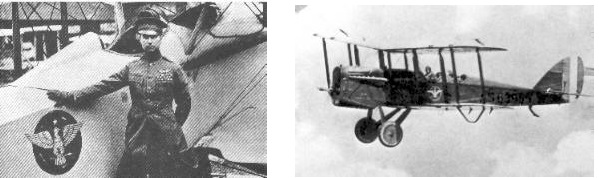
Photo of General Billy Mitchell from Air Force magazine February 2001.
The DH-4 ‘Osprey’ airborne.
* * * * *
 Wings Over Cumberland