The Curtiss OX-5 engine, a familiar power plant for many local aircraft in Cumberland’s early aviation history, was originally designed for motorcycle racing. An engine designed by Glenn Curtiss powered the motorcycle in which he set a world’s land speed record in 1907. Later that year Dr. Alexander Graham Bell persuaded Curtiss to join his Aerial Experiment Association as that organization’s engine expert. The early motorcycle engines were either two or four cylinder and were air cooled. From that experience Glenn Curtiss developed an eight cylinder Vee-type power plant for aircraft use.
The first Curtiss engine to power a heavier-than-air machine was a duplicate of one supplied earlier to Captain T. S. Baldwin for his airship. That same design, developing 40 hp at 1,800 rpm, powered the first three aircraft of Bell’s Aerial Experiment Association (AEA). This design proved unsatisfactory as it overheated quickly and lost power so that flight had to stop until it cooled. Curtiss then developed a water cooled, 90 degree Vee engine with a 3.75” bore x 4.0” stroke that powered the Silver Dart, the most successful of the A.E.A. aircraft. This power plant was the forerunner of a long production of water cooled engines which led to the OX and the OXX series.
Curtiss’ Model O engine was displayed in New York at the Grand Central Palace in 1912. An improved version featured a new valve gear and was introduced in 1913. That version was intended to be called the 0+, but the + sign was inadvertently turned 45 degrees and forever after that engine was known as the OX. The OX-5 version, marketed with a rating of 90 hp at 1,400 rpm, became the widely used engine that remained unchanged throughout its long life. Nearly 13,000 were built during World War I but few were actually installed in aircraft. The Willys-Morrow plant produced the greatest number of the OX-5 engines. Most wound up on the surplus market following the war and thus became widely available for installation on a variety of post war aircraft. Simple, easy to maintain, and reasonably reliable, it was an ideal engine for the gypsy barnstormers of the 1920’s and 1930’s. Thirty-two different manufacturers designed and built airplanes for the OX-5 engine and it became the most widely used power plant during that era.
The majority of the resident aircraft based at Mexico Farms and the surrounding area were powered with OX-5 engines, and some of those were flown into the 1940’s. The OX-5 was certainly not the most powerful or necessarily most efficient but, with the wide availability and low cost, became widely used and historically significant in the progress of aviation.
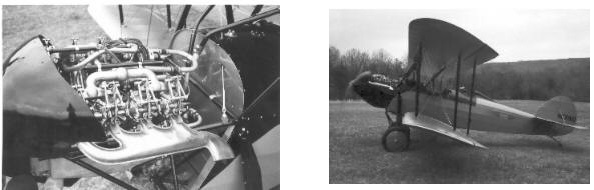
The OX-5 engine in Harold Armstrong’s Waco 10.
There remains an organization dedicated to the remembrance of the famous OX-5 engine. The ‘OX-5 Aviation Pioneers’ is a national organization dedicated to perpetuate the memory of pioneer airmen, their sacrifices, accomplishments, and contributions toward the development of civil aviation, and to honor those who ‘pioneered’ aviation during its infancy. Chapters of the OX-5 Aviation Pioneers are located throughout the country. Harold Armstrong is an acknowledged expert concerning the OX-5 engine, having rebuilt several and installed the old power plant on his antique aircraft projects. Armstrong and other local individuals are members of this memorable and worthy organization.
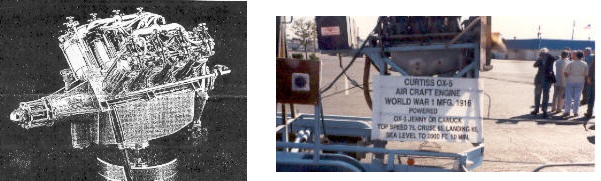
On the left is a detailed photo of an OX-5 engine. On the right is a running Curtiss OX-5 engine on display at the OX-5 Aviation Pioneers Convention in Midland, Texas.
* * * * *
 Wings Over Cumberland