The Greater Cumberland Regional Airport (GCRA), known for years as the Cumberland Municipal Airport, has served as a transportation focal point for the tri-state area of Western Maryland, the adjacent bordering areas of West Virginia, and the southern portion of mid-Pennsylvania for nearly six decades. It is well known that prior to the construction of the current Cumberland Airport in the mid 1940’s, on the plateau adjoining Wiley Ford, WV, the historic Mexico Farms Air Field was available. Mexico Farms was established in 1923 as a Government Air Field and its use has continued to this day. The Army Air Services use has long become a footnote to its history. Only old-timers can recall that, for a short time, there existed another Cumberland Airport, one which began in 1929. That airport, a grandiose plan by a local entrepreneur, was located east of US Route 220, adjacent to the small town of Pinto, MD, located about eight miles southwest of Cumberland.
The background of this early Cumberland Airport can best be traced through an article that appeared in the Cumberland Times publication of April 29, 1929. The article, reprinted in its entirety, follows:
MODERN AIRPORT ASSURED – Cumberland Evening Times – April 29, 1929
Purchase of a 75 acre farm on the McMullen Boulevard at Pinto for the establishment of a fully equipped, modern airport for Cumberland, was announced today by Harold Krimm, managing director of the annual Pittsburgh and Philadelphia Aircraft Shows. Mr. Krimm, a native of Cumberland and the son of Mr. and Mrs. Noah R. Krimm, 322 Avirett Avenue, made the announcement after a series of conferences with local landowners, real estate companies, and Cumberlanders interested in the advancement of commercial aviation in this section of the state.
The new Cumberland Airport, Mr. Krimm revealed, will give Cumberland one of the finest, largest and best equipped landing fields of its kind and will compare more favorably with airports established in other cities as large as and larger than Cumberland. Although no official statement was given out regarding the cost of the farm, formerly the property of N. S. Yoder, a prominent Pinto farmer, it is understood that Mr. Krimm and the financial interests supporting him in the project have paid $20,000 for the site of the new airport. Between $20,000 and $30,000 will be spent within the first year at the airport for drainage, removal of a knoll at one corner of the field, construction of modern aircraft hangars, an administration building, fenced off automobile parking areas, and other improvements.
Selection of the Yoder farm, formerly the old Rawlings farm of thirteen years ago, as the site of the new airport, will give Cumberland one of the most centrally located landing fields in the country according to Mr. Krimm. He was delighted at the natural advantages the property affords for a modern airport, not only within its own boundaries but also in the surrounding level countryside and the unusual lack of obstructions. A natural site such as this farm is unusual in the aviation business, he added. Krimm commented further, “It will provide at the very outset one runway of 2,100 feet in the direction of the prevailing winds. It will provide, with very little drainage and with absolutely no leveling required, two other runways of between 1,600 and 2,000 feet. Within a year or two we will have one runway in excess of 3,000 feet.”
At the Philadelphia Airport, where Mr. Krimm has been associated since its inception three years ago, the longest runway now being used is smaller than the runways that will be available at little cost at the Cumberland Airport. Flying operations at the new Cumberland Airport will not be undertaken until July or August, Mr. Krimm estimated, but work on draining the lower sections of the field and on hangars and the administration building will be started at once.
Advantages of the new airport have been outlined as follows:
1. It is within eight miles of the downtown section of Cumberland, on the McMullen Boulevard at the intersection of the Pinto Road. It is easily accessible and centrally located.
2. It will require less expenditure for its development into a first-class airport than any other site that is available in or near Cumberland. This factor was determined after a survey of two months by local and visiting pilots.
3. It has a frontage of 1,465 feet on the McMullen Boulevard and a frontage of more than 2,000 feet on the Pinto Road. A large area will be available for the convenience of motor visitors, aerial passengers and the transaction of the every day business of a modern air terminal.
4. The surrounding countryside is admirably suited for airport development. There are no obstructions that would hinder flying operations from the field proper.
5. The majority of the seventy-five acres comprising the field are level and will require very little work to make them available for immediate flying if the occasion demands.
6. The field will be easy to drain after hard rains.
Ronald Landis, veteran Cumberland pilot, who, with several other fliers, has been operating from the government’s emergency landing field at Mexico Farms, has thrown his enthusiastic support behind the new project and has pledged his cooperation toward making the new field a success. “We have been seeking such an airport and up-to-date field in a good location for the past three or four years”, he said. Landis added, “Everybody at the Mexico Farms field is delighted that Cumberland is to have a modern air terminal that will take care of the city’s air traffic in the future and our own immediate pressing needs for an efficient landing field. We have been somewhat handicapped in the past through lack of an adequate field and when Mr. Krimm came to us with the suggestion of a new airport, an airport designed to handle Cumberland’s aircraft problems of the future and our own problems of today – we gave him every encouragement. We are surprised and delighted that he has turned the deal so quickly and, just as soon as the new airport is in shape for flying operations – which I understand will be within a month or two, the commercial flyers at the present Mexico Farms field will move immediately to the new airport. Personally, I expect to erect the first private hangar at the new field and there should be several others doing the same thing before the summer is over. We are back of Krimm 100 percent on this new Cumberland Airport.”
The contract for draining the lower portions of the field will be awarded within the next week, Mr. Krimm stated. Certain portions of the airport could be made available for flying operations within two weeks, he said, but no attempt will be made to rush the work. Krimm added, “This will be no hasty proposition. It will be done right. We have put too much time and effort on it to risk rushing the field through. We have conferred with officials of the largest contracting firm in Cumberland regarding the drainage and other necessary work and we are confident that this firm will furnish us with one of the finest airport surfaces it is possible to secure.”
The new airport is within two or three city blocks of the Triple Lake development on the McMullen Boulevard and all city conveniences are available within a few hundred feet of the field’s boundaries. The airport will be adequately lighted for night flying operations late this summer, but no night flying will be permitted with passengers until the entire seventy-five acres comprising the airport are placed in first class shape.
The field will be operated under regulations prescribed by the Aeronautics Branch of the United States Department of Commerce in Washington, and every safeguard will be taken to assure the highest efficiency of planes, equipment, pilots and the field. Each plane will be required to undergo regular inspections as prescribed by the Department of Commerce. The field will be operated under a policy of Safety First as explained by Mr. Krimm. He further stated, “Nothing will be left undone to provide safe air travel and safe field operations. There will be a rigid ban on ‘stunting’ and no spectacular flying will be tolerated. Stunting has done more to terrify the average citizen than any other single phase of aviation. It has built up in many minds the impression that flying is unsafe. We will attempt, by safe and sane flying operations, to convince even the most skeptical scoffer that flying is no more dangerous than railroad travel and a great deal safer than motoring on highways jammed with heavy traffic.”
As the Cumberland Times article highlighted, it was obvious that there existed a great deal of planning and enthusiasm for this new Cumberland Airport. But what followed? It is unknown exactly when development or actual flying operations began. It is known that for a few short years there was some of activity at the Pinto site. Two runways, rather than the planned three, were laid out. The first ran roughly perpendicular to US Route 220 highway in an approximate east-west direction. The second angled north of the over-looking knoll and was oriented northwest-southeast, ending at the intersection of McMullen Highway and the Pinto Road. A fueling facility was installed near the base of the knoll and an administration building constructed somewhat further up the hill. It was here that Herb Wentz, one of the early well known pilots in the area, attended a ground school that led to his long flying career. No hangars were ever built and the field was never equipped for night lighting as planned.
It would appear that the flamboyant planning for this endeavor was based on the fact that here was level terrain, of which little is available in our mountainous area that could be easily acquired and developed into a site conducive for airport operations. Located at the northern end of the open Potomac River valley, the site had on three sides rising terrain. This siting would never be considered in current day planning since the need for long, clear open approaches is necessary for instrument landings in bad weather. It should be pointed out that in 1929 instrument flying in low clouds and bad weather lay in the future. In any case the new Cumberland Airport was in operation for but a brief period of time.
Harold Armstrong, a veteran local pilot, recalls that a KR-31 ‘Challenger’ and a Waco 10, two early bi-planes, were based on the field and were tied down on the north side of the knoll. On weekends other aircraft flew in and offered sight seeing flights. Travel Airs, Waco ASO’s, and Curtiss Robins were other aircraft utilizing the field for hopping passengers, an activity that was quite popular and gave numerous individuals their first opportunity to enjoy the freedom of flight.
There were a few mishaps. A KR-31 went down just after clearing the railroad and river, and ended up on its back in the Washington Bottom farm (the current site of ATK Tactical Systems, Inc., formerly known as the Allegany Ballistics Laboratory or Alliant Tech Systems plant). A Waco had engine trouble and turned south to land just beyond the railroad, wiping out its landing gear and causing other damage. A Berliner, while taxiing close to the fuel pump, got too close to the embankment and dug up dirt and gravel with its propeller.
A Ford Tri-Motor, owned by the Monarch Foods Company, was there for a period and served as a ‘flying grocery store’, with both sides of the large cabin lined with shelves displaying the company’s entire array of canned foods. It is most likely that the display cans were empty to save weight, although the Ford Tri-Motor, with its three engines and unique corrugated metal structure, was capable of carrying great loads.
Flagpole sitting for extended periods was a fad prevalent during that time. One such youth made his appearance at the new Cumberland Airport at Pinto. The pole was erected at the highest point on the overlooking knoll and this adventurer perched there for several days. Although not confirmed, it is speculated that this young man was probably Albert Stengle, of Cumberland. Earlier, 15 year old Avon Foremen, in a self-promoting act, roosted atop a 22 foot pole for over ten days near Baltimore and had invited Albert to join him in his adventure. It is known that Stengle’s efforts to undertake a pole sitting in a local park had been denied but, while dampened, his enthusiasm remained. Although unnamed in the newspaper articles of the time, it was undoubtedly the youthful Albert Stengle, with his self-promoting adventurous spirit, that assumed the bird man position on the pole overlooking the Cumberland Airport at Pinto in 1929.
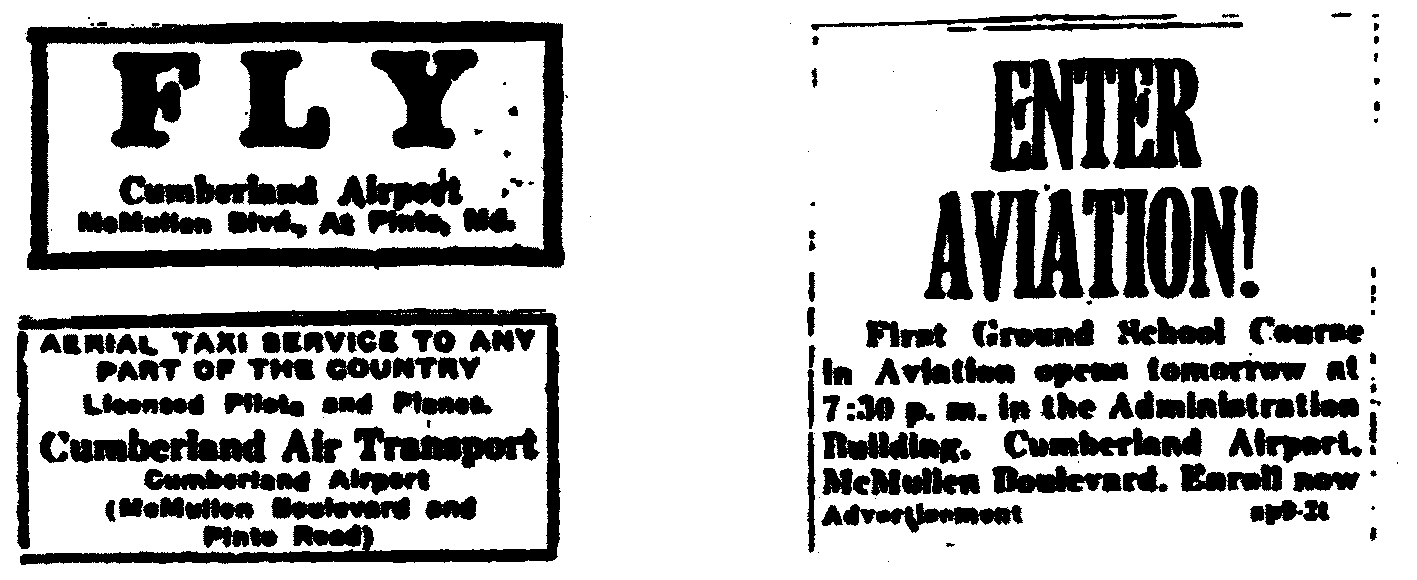
Many advertisements were placed in the Cumberland Evening Times promoting the New Cumberland Airport. One announced the opening of Aviation Ground School to be held in the administration building. Another provided ‘Aerial Taxi Service’ to any part of the country by Cumberland Air Transport. One small ad appeared quite frequently during July and August 1929 with only the word FLY in large letters followed by Cumberland Airport, McMullen Boulevard, Pinto, Maryland.
SPEND SUNDAY AT THE NEW
CUMBERLAND AIRPORT
McMULLEN BOULEVARD at PINTO ROAD
*************
Flying by Experienced Pilots
Drills on the new field by
Veterans of Foreign Wars Fife and Drum Corps
******
Picnics on the Knoll–Protected Parking Areas
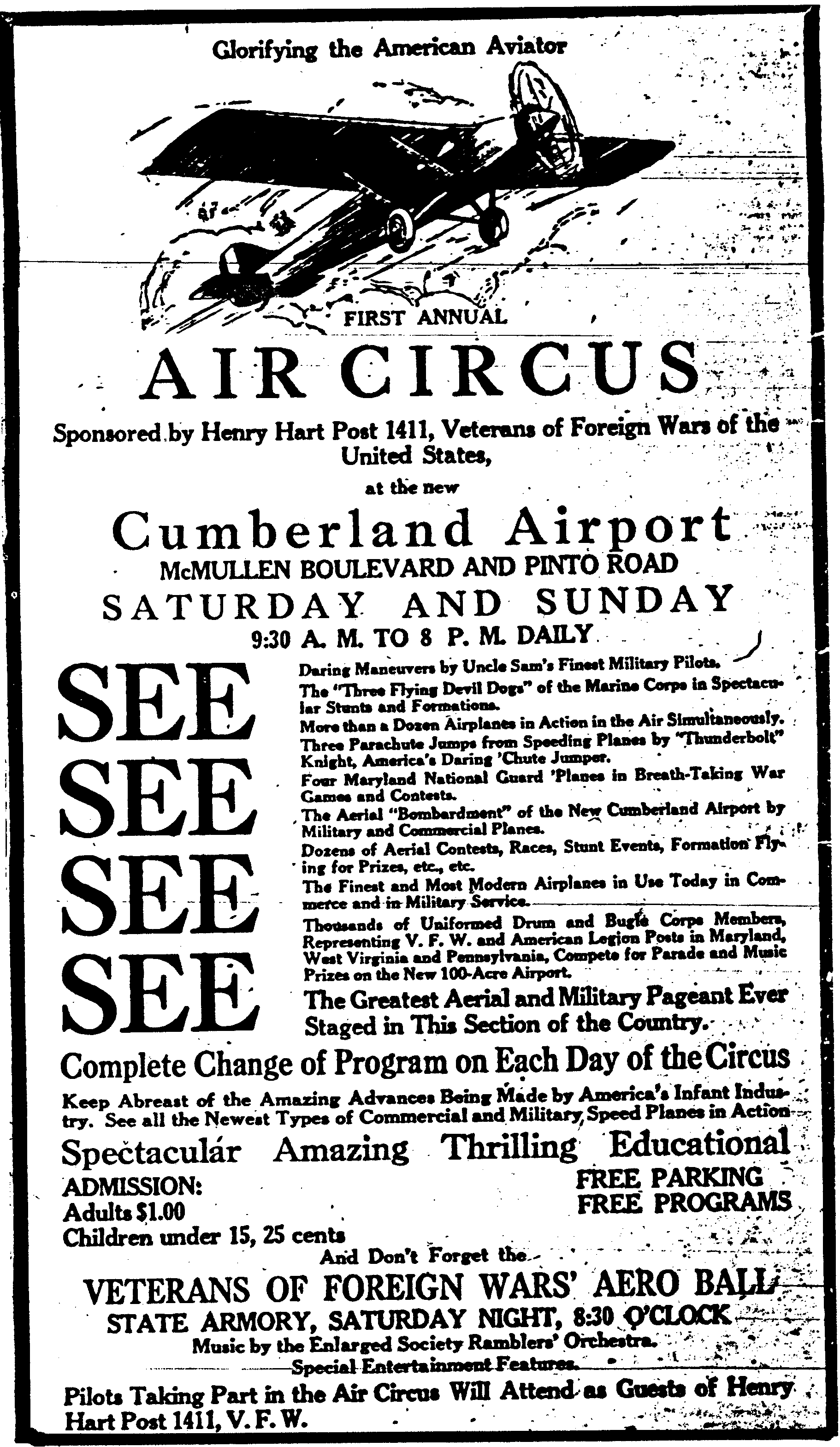
AIR CIRCUS FLYER for AIR SHOW Activity held on August 10 & 11, 1929
On August 9, 1929, a large poster advertisement appeared, announcing the ‘First Annual Air Circus at the New Cumberland Airport.’ This event was scheduled for the next two days, a Saturday and Sunday, and was well attended. Featured was a trio of Marine pilots flying Boeing F-4B4 bi-plane fighters, who performed aerobatic maneuvers in a tight formation. Powered by a 525 hp Pratt & Whitney Wasp engine, their performance was extremely noisy and quite spectacular. Four Maryland National Guard planes took part in ‘Breath Taking War Games and Contests’ and the ‘Bombardment of the New Cumberland Airport’ to entertain the viewers. To conclude the festivities the Veterans of Foreign Wars sponsored a follow-on ‘Aero Ball’ that Saturday evening at the state armory in Cumberland.
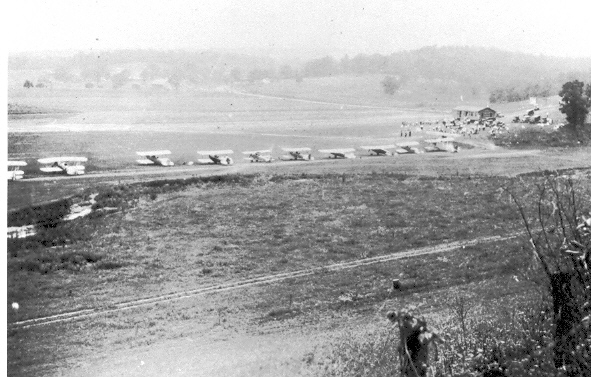
Old photo taken from what is now the Pinto Road showing mostly Boeing bi-plane fighters at the Air Show. This is a southwest view down the Potomac Valley, with US Route 220 at the top of the photo.
There is little recorded history of activity at Pinto during the remainder of 1929 and early in 1930. Apparently no further development followed. It appears that the promoters either decided that the airfield would not become a viable endeavor, or lost the financial capability to continue their grandiose plans, and quietly terminated their efforts. However, the airfield was utilized by a few local aviators.
Tragedy struck on October 2, 1930 when a KR-31 ‘Challenger’, owned and flown by William Skelly of Cresaptown, crashed and burned after taking off from the Pinto field. Two passengers, Fred Lease and Glendon Hoff, both of Cumberland, along with the pilot were killed in this crash. This unfortunate aircraft accident, with three fatalities, signaled the end of the ‘New Cumberland Airport’.
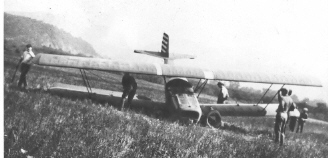
A photo of Torque Landis’ Pitcairn, who crashed while looking over the site of the fatal Skelly accident.
During the late 1930’s the Yoder farm site was again used as a flying field by several local pilots. Among those aviators were Joe Brown, ‘Curly’ Darr, Leon ‘Buck’ Knotts, and William Keiling. Herb Wentz and Harold Armstrong also used the site for brief periods before and after World War II.
Thus the grand plans of Harold Krimm for the New Cumberland Airport were never fully completed. The Pinto location was, for a brief time in 1929, a blossoming flight operational site, and was later used sporadically during aviation’s early days. Pinto airfield was a stepping stone in aeronautical progress for our area. The memory of its use and history is totally unknown to most local residents. When driving by the site today, and viewing the currently existing farm fields, one can only wonder and dream of the time when it was in use as an operating airfield. For those surviving aviators that took off and landed there in their early flying machines, the New Cumberland Airport at Pinto is a source of bittersweet memories.
* * * * *
 Wings Over Cumberland