The Cumberland Times-News reported in 1932:
That due to the growing interest in aviation and the demand locally for aircraft instruction, transport pilot William ‘Curly Bill’ Johnson, a well known, capable aviator, has started the Allegany Flying School. He has had experience in barnstorming and exhibition flying. He started flying in 1925 and has accumulated over 700 hours in the air, with experience in 27 different types of airplanes, including auto gyros and gliders. Mr. Johnson has the highest aviation license obtainable and is reported to be one of the most careful flyers registered with the United Stated Bureau of Aeronautics. Stunt flying and the taking of useless chances are taboo with him. He has drilled it into several of his local pilots and he has instructed that aviation does not necessarily mean reckless abandon in the air. The school which Johnson conducts teaches also the various requirements of aviation, other than the mere handling of the control stick. The student is prepared to pass the examinations of the Bureau of Aeronautics and is equipped to qualify for a position as a licensed aviator.
Floyd Johnson stated that Curly Bill Johnson was a no-nonsense type instructor who did things by the book. He was very tough and unsympathetic with his students. Before the era of the Gosport Tube type of communication between the front and rear open cockpits of the airplane, often times airport bystanders could hear him hollering to his students both in the air when the engine was throttled back and on roll out after landing. He used the OX-5 powered Fairchild KR31 until it was destroyed in a crash. He then obtained an Aeronca C3 Collegian. Johnson would have been the FAA’s ideal instructor pilot of today as he brought aviation stability to Mexico Farms airport during a poorly regulated period before the advent of close government supervision of aviation.
Johnson was also instrumental in attempting to form an airline connecting Cumberland with Baltimore, Pittsburgh, Hagerstown, Frederick, and Washington, DC. A corporation was formed, known as the Johnson Airlines, Inc., by a group of local Cumberland businessmen and airmen, to furnish flying service to these points. The plane provided for this purpose was a Stinson 5-place cabin airplane, propelled by a 9 cylinder Lycoming engine. This aircraft is similar in type to those used by the Century and Luddington Airlines of 1934 and was built for safety, comfort and speed. The plane was available for chartered flights of any distance flying from the Cumberland Airport. Airline service was to begin on April 15, 1933.
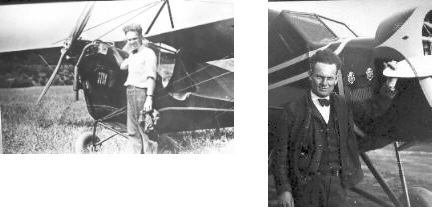
Curly Bill Johnson with his Aeronca C-3 Collegian on the left, and with his Stinson Junior in 1932.
The Stinson ’Junior’, model SM-8A, was a high winged spacious cabin monoplane with comfortable and well appointed seating for five passengers. It had a sound proof cabin with shatter proof roll down windows and cabin heat. The aircraft was the first resident airplane at Mexico Farms with an electric starter for its engine. The ‘Junior’ also featured low pressure tires, wheel brakes and a large tail wheel. It was powered by a nine cylinder Lycoming radial 215 hp engine, a speed ring cowling, and an adjustable metal propeller. This enabled the aircraft to attain a cruising speed of 105 mph with a useful load of 1134 pounds and a range of 500 miles. The SM-8A Stinson ‘Junior’ sold for $5,775 in April 1930. At the time the Stinson was considered an outstanding aircraft.
At the time of this writing, Summerfield Aviation of Cumberland was proposing to use a single engine eight passenger Cessna Caravan turbo prop airplane as the basis for an airline connecting Cumberland and Baltimore-Washington International Airport at Baltimore. Perhaps things have not changed that much after all!
* * * * *
 Wings Over Cumberland