Ronald ‘Torque’ Landis, along with friend Wilbur Webb Gaither, entered the United States Marine Corps during WW I and graduated from the US Naval Aviation School, Class of 1920, at Great Lakes Training Center in Illinois. At graduation they both became aviation mechanics with the rank of sergeant. Landis was one of those individuals possessing unsurpassed mechanical talent and later superb flying capabilities. He attracted the attention of General William ‘Billy’ Mitchell, which is amazing since this was at a time of intense inter-service rivalry between the Army and the Navy. Somehow Landis and Gaither were assigned to the command of General Mitchell by detached service from the Marines to the Army Air Service. Landis and Gaither were part of a team that supported the Army Air Services in their participation in the Pulitzer Prize Air Races, the Schneider Cup Air Races, and other record-setting attempts of the early 1920’s. Landis and Gaither also participated as air crew members, with the US Army Air Service under General Mitchell, in the attempt to prove aerial bombing effectiveness to a skeptical US Navy. This was accomplished by bombing captured and obsolete WW I German warships in the Chesapeake Bay by Army Air Service bombers dropping crude, hastily produced, and restricted experimental bombs. The Cumberland Times reported that Landis was injured in the Chesapeake Bay crash of a Martin bombing plane during this time. For some unexplained reason the bomber was ditched in the bay and Landis was thrown through one of the wings in the crash, landing some distance from the machine. All of the occupants on board the bomber were injured, but managed to climb to the tail of the machine which remained above the water. They clung to the aircraft until rescued by a speed boat.
At the completion of his Marine service, in about 1923, Landis learned to fly at Robertson Field, St. Louis, Missouri. According to Gene Kelley, local aviation historian and friend of Torque Landis, Torque met Charles A. Lindbergh, an air mail pilot at the time flying between St. Louis and Chicago. Landis also knew Bud Gurney, Lindbergh’s fellow air mail pilot and close friend. Landis and Gaither returned to Cumberland, where Landis obtained employment at the B&O Railroad facility where Landis was admired for his mechanical ability as a machinist. Landis was active in the newly formed Cumberland Aero Club flying its Curtiss Jenny and instructing student pilots. About 1925 he acquired a Standard J-1, followed by a Curtiss JN-4 Jenny, and a Swallow bi-plane, according to the Times-News. The pride of all the aircraft Landis owned was the Pitcairn acquired in 1929. All these craft were open cockpit bi-planes powered by the still popular and inexpensive WW I surplus Curtiss OX-5 engine.
In the years 1925 to 1931 Pitcairn Aircraft, Inc., of Philadelphia, PA, manufactured aircraft suitable for carrying the mail on their federally subsidized air mail routes. The Pitcairn PA-4 Fleetwing II, manufactured in October, 1927, saw only limited air mail service due to its low powered 90 hp OX-5 engine. Other more suitable Pitcairn aircraft were later produced for air mail service. With its excellent flying characteristics the PA-4 Fleetwing was ideal for training and, with a cruising speed of 87 mph and a top speed of 102 mph, could be entered in stock airplane racing, popular at that time. Allen K. Owen of Reading, Pa purchased a PA-4 and in September 1928, with Albert C. Carl as co-pilot, and with the city of Reading, PA as sponsor, entered a transcontinental air derby. In big lettering, the ‘City of Reading’ was painted on both sides of the Pitcairn. Thirty-eight planes began The Transcontinental Air Race at Roosevelt Field, New York, which ended five days later at Los Angeles, CA. After much trouble with weather and mechanical problems causing several forced landings, Owen and Carl finished 20th in the race when they touched down at Mines Fields, Los Angeles, CA. The Chamber of Commerce said ‘Reading, PA has been advertised as it has never been advertised before.’ Owens and Carl then participated in another race, competing with 17 other planes, from Mines Field to Cincinnati, OH. Engine trouble and bad weather caused a forced landing damaging the Pitcairn slightly and scrubbing them from that race. At the EAA Convention Fly In, at Oshkosh, WI in 1991, Steve Wittman, a famous race pilot, recognized the Pitcairn, on display at the air show. Wittman stated he remembered racing against the Pitcairn Fleetwing in 1928. In March1929, according to Gene Kelley, Ronald B. Landis purchased the Pitcairn Fleetwing, but only after renegotiating the price since it was represented with a metal propeller and now had a less efficient wooden propeller.
Research revealed a student pilot’s license was issued to Landis on June 7, 1932 that was little more than evidence of a medical examination allowing for dual instruction. When signed by his instructor, this allowed Landis to solo within the confines of the landing field under the instructor’s supervision. The medical certificate listed his physical characteristics as dark hair, brown eyes, five feet four inches in height and weighing 132 pounds.
Landis was physically of small stature, but quick and agile. He had an intense look about him, especially from his eyes, was quick mentally as well as physically, and was known as one who accomplished things promptly. Like all former US Marines, he was patriotic and proud of his service in the Corps. Landis had the US Marine Corps logo adorning both sides of the Pitcairn fuselage.

A photo of Landis’ Pitcairn with his personal emblem on the fuselage.
He was a dapper dresser and when at the local air field dressed in the style of early aviators with a leather helmet, goggles, leather jacket, jodhpur trousers, and lace up knee high boots, always arriving in a flashy Chrysler roadster. He was one of those rare individuals with both superb mechanical craftsmanship and excellent ability as an airplane pilot. (Harold Armstrong, present owner and restorer of the same Pitcairn Fleetwing, is considered in this superb category). Landis was a colorful individual, a daredevil, and a mischievous pilot at a time when aviators were much in the public eye. Those were days when families would drop everything and run outside to peer anxiously into the sky anytime an airplane was heard passing overhead. He knew all of the flying techniques that have been forgotten and some that would be frowned upon today.
In the early 1960’s, E. A. ‘Pete’ Goff, was a colorful former Civil Aeronautics Authority Inspector for this area for many years prior to WW II. He came to the Cumberland Municipal Airport terminal to demonstrate an aircraft simulator. After his demonstration, the meeting became a reunion of old Mexico Farms pilots. This became an amusing, reminiscent story telling time, with Pete leading the tale telling. He related that on his first visit to Mexico Farms as he walked towards a hangar, he heard the sounds of conversation from a group of pilots. He was promptly challenged by a short man with a pistol in his hand. After a discussion of why he was there, Goff finally convinced a skeptical Torque Landis that he was not a revenuer seeking out illicit alcoholic activities (this was during the prohibition period). Landis finally admitted Goff to the hangar. According to Gene Kelley, Goff was at the time authorized to offer pilot licenses to those deemed qualified, as well as Airframe and Engine mechanics rating to select individuals. At that time he bestowed an A & E license to Virgil Parker. Goff knew of Landis’ capabilities and that he was qualified for both a pilot’s license and mechanics rating. He attempted to persuade Landis into accepting both official authorizations. However, Torque Landis did not want the restriction and personal control that he thought the licensing would entail, arguing that he had done well thus far without them.
The Pitcairn was a sprightly performer for an OX-5 powered airplane but, according to George ‘Slim’ McBride, a close friend of Landis, Torque wanted more power to compliment his flying, especially while performing aerobatics. It is thought that after the Everline crash of the Fairchild KR 34 airplane, Landis was able to acquire the Comet engine and landing gear of the wrecked Fairchild. By this move the two weak points of the Pitcairn could be eliminated. The old WW I OX-5 engine was replaced by the more modern 165 hp Comet radial engine and the primitive spreader bar type landing gear was replaced by a modern landing gear with wheel brakes and low pressure tires.

PA-4 Pitcairn before modification on left and after modification with Torque Landis in front.
In the fall of 1932 Landis landed the Pitcairn in a field near the Mapleside area of Cumberland at about the location of present Ames Department Store on Industrial Boulevard near the Chessie System Railroad Yards. It was at that site that a nine year old Bob Poling observed as jaunty looking Torque Landis worked at dismantling the ship. The Pitcairn conversion to the Comet radial engine and Fairchild landing gear plus some other modifications began. The front cockpit controls and instruments were removed and the rear cockpit throttle was now mounted on the right side. Torque preferred to fly left handed, in contrast to most airplanes with stick controls that are flown right handed. A more efficient ground adjustable, metal propeller was also installed on the Comet engine.
Floyd Johnson related that when Torque first test flew the Pitcairn after the rebuild, upon breaking ground, Torque raised both hands and arms above his head to show on- lookers the stability and his confidence in the Fleetwing’s modification by flying with his hands off the controls. Landis now had an airplane suitable to his flying desires and capabilities, and fly it he did.
The Cumberland Times-News reported the following article in 1934 concerning a record flight flown by Landis:
Ronald ‘Torque’ Landis, well known local airplane pilot, accompanied by Mr. and Mrs. Robert Deffibaugh, returned yesterday afternoon from the World’s Fair in Chicago. He landed his ship at the Cumberland Airport at 4 pm after making the 550 mile flight in three hours and forty-five minutes traveling at a speed of 147 mph. Local fliers commenting on the time of the flight stated this morning that Landis has established a record for the trip from here to the Illinois city for commercial ships of the same class and horsepower. Landis said weather conditions were most favorable and flying conditions were ideal for the return trip. Landis had visited the Fair last fall flying his own plane. He was accompanied last year by Edward Lippold and Eugene B. Stein.
Landis surrounded himself with beautiful female friends and remained a bachelor until after WW II. Gene Kelley stated that a friend of his was talking to two young ladies at Greenspring, WV, when Landis flew over and landed the Pitcairn in a nearby field. Torque motioned to the girls who left the friend, ran to the plane, jumped into the front cockpit, and then Landis took off with the girls, without shutting down the engine. He was held in awe by all from children to adults, and was envied for his devil-may-care way of life. In spite of that attitude, Landis was a knowledgeable aviator interested in promoting aviation and was one of a local group acting in an advisory capacity for elected officials on aviation matters.

Torque Landis with a girl friend in 1932 in front of his then OX-5 powered Pitcairn.
In Torque’s hands the Pitcairn was an excellent aerobatic plane. When traveling aerial circuses came to Mexico Farms, Landis’ display of aerobatics was always better than their featured and usually famous performer. A highlight was his ‘squirrel cage’ act when he flew a series of barrel rolls around a straight flying second aircraft. Landis’ air show landing, at the conclusion of his show, was a fitting finale to his high class performance. He would position the Pitcairn high over Knobley Mountain to the west, dive down at high speed, fly low over the east runway with roaring engine and whining propeller, and pull up in a vertical climb over the railroad tracks on the east end of the runway. Torque performed a hammerhead stall turn and when heading straight down would side slip the Pitcairn so as not to gain excessive speed. While still side slipping he would then round the Pitcairn out for a perfect three point landing, straightening the ship out of the side-slip just before the wheels touched the ground. This was an awe inspiring sight to say the least.
Landis made parachute jumps at locally promoted air shows. His friend, Catherine Shreve, gained notoriety when she jumped with him on one occasion.

Catherine Shreve in parachuting gear, with Torque Landis.
The Cumberland Times-News reported that they also gained notoriety when Mrs. Catherine Shreve, George McBride, and Ronald B. Landis, were arraigned in Peoples Court on charges of assault, and released under bond of $100 each. The trio were taken into custody upon the request of Prosecuting Attorney A.G. Bolton of Tucker county, WV. Authorities state the three are charged with going to Davis, WV a week ago, to the home of Mrs. Catherine Shreves’ divorced husband, Paul Shreve, and taking the couples five-year old daughter from the Shreves’ home, and bringing the child to Cumberland. Mrs. Shreves stated that her ex-husband, on April 7, came to her home, and under the pretext of giving their small daughter a car ride, and took the child to Davis. On April 12, Mrs. Shreves, accompanied by Landis and McBride went to the Shreve home in Davis, and the mother proceeded to ask her ex-husband if she could talk to their daughter. After being admitted to the house, Mrs. Shreves went to the child’s bed and started to carry her from the home. Paul Shreve claims he attempted to prevent Mrs. Shreve from taking the infant away, and the two men who accompanied her interfered. There are counter charges regarding the assault, as Mrs. Shreves states her husband tore her clothing, and the two men came to her assistance. In Peoples Court this morning the three refused to return voluntarily to West Virginia. They were represented by Edward J. Ryan, attorney.
Torque once won a bet with a visiting pilot over whose ship would be higher when departing the west runway climbing straight out over Knobley Mountain. Folklore has it that Landis once looped the Pitcairn around the steel bridge over the Potomac River, between Cumberland and Ridgeley, WV. Earl Humbertson said he saw Landis at one time fly the Pitcairn the length of Baltimore Street through the center of Cumberland, down in between the buildings, in a knife edge manner, with the wings in a vertical position. Torque installed a wind driven siren on the lower wing and would spin the Pitcairn down from altitude with the siren blaring. Word came back to Mexico Farms that a plane had terrorized the congregation of a country church in Hampshire County, WV during Sunday night services. An unlighted airplane with siren blaring had buzzed the church several times, but was unidentified due to the darkness of the night. Trees along the Potomac River bordering Mexico Farms at the time were small and Landis would say he needed to wash the bottom of the Pitcairn. He would fly low enough over the Potomac River north of the west runway to wet the bottom of the airplane by running the wheels in the water.
Floyd said his father, Jerome ‘Bogus’ Johnson, in addition to aviation gasoline kept a supply of automobile fuel in the oil house. The price of aviation gasoline was 20 cents per gallon and auto fuel but 15 cents. Torque would often find one or two individuals with a dollar and a half and then have Floyd, a slightly built young boy, lug two five gallon cans of auto fuel to the Landis hangar. After fueling the Pitcairn with the 10 gallons of gas, purchased with the dollar and a half, he could then fly for an hour plus, taking the two paying passengers in the front cockpit. Many people had airplane rides by this method and Landis became well known and extremely popular in the Cumberland Area.
Landis had friends at a cottage along the South Branch of the Potomac River just southeast of Oldtown, MD and would spend leisure time there with the Pitcairn, landing in a nearby field. Floyd Johnson said Landis would often return after dark and he would often not be able to visualize the Pitcairn until it had landed and taxied to the Landis hangar. Landis knew the railroad tracks well from Oldtown, MD to Mexico Farms and in poor visibility would fly low over the tracks and simply turn left at the rail road signal pole at Mexico Farms and land on the west runway.
Torque was a superb craftsman. On one occasion when the crankshaft of the Comet radial engine broke, Landis procured a large chunk of suitable metal and machined a new Comet engine crankshaft that functioned as well as the original, according to a story relayed by Gene Kelley.
Landis learned to fly during the early 20’s when a pilot was expected to be able to perform any maneuver within the aircraft’s capabilities. Little if any regulation governing the quality of pilots or airplanes existed. He maintained his airplane in good condition and knew he was a good pilot. As times changed and legislation was instituted governing pilots and aircraft, Landis resisted succumbing to licenses and inspection of his airplane. The Pitcairn was never licensed nor had a government inspection when owned by Landis, according to the present Pitcairn owner, Harold Armstrong. However, Torque did register the ship annually with the CAA. Landis never possessed a pilot’s license until 1942 when he realized he would not be able to serve in the Air Force until he had a proper certificate. Torque also was a gun enthusiast and possessed a large collection of rare and exotic firearms. The author stated that at one time he was almost in Landis’ line of gun fire after suddenly stepping around a hangar as Torque and friends were having target practice on the driveway behind the hangars.
Landis had a room attached to his hangar and would often entertain there. Floyd Johnson said that his mother, Blanche, a fine person who was respected by everyone, knew of Torque’s nocturnal activities as it was necessary for Landis to drive past the Johnson residence to reach his hangar. She would chastise him about his entertaining, and Landis, who addressed her as Mrs. Bogus, would try to deflect her criticism with charming talk and small gifts.
At 4 o’clock in the morning on more than one July Fourth, Donald Johnson related the Jerome Johnson household would be suddenly awakened by an explosion. Except for scaring every one no damage was done and no one was in sight but, it was apparent that dynamite had been detonated in a nearby vacant field. The Johnson’s just knew Landis was behind the incident. After a last aerobatic flight on a Saturday afternoon in April of 1941, Torque sold the Pitcairn to Thomas Barton. Tom was a member of the so called outlaw ‘Pinto Airport Pilots’, and brought Herbert Wentz along to fly the Pitcairn to Pinto. Except for Newton Crumley and Torque no one else had flown the Pitcairn since its modification in 1932. There were no dual controls in the Fleetwing available for a check out flight by Landis. Wentz asked Torque how the Pitcairn flew, especially with the throttle on the right side which normally required the pilot’s left hand on the control stick. Landis’ answer was, if you can fly a Waco 10 (which Herb owned) you can fly the Pitcairn. Herb said he flew it cross handed, reaching across his body with his left hand and with his right on the control stick. Barton and Wentz kept the Fleetwing in the air that summer of 1941, accumulating flying hours operating from the Pinto Airport.
In 1941, with the US entry into WW II, Landis was in no danger of being drafted because of his middle age. He could have made a major contribution to the war effort with his knowledge of mechanics, and possibly accumulated excess money in the process. As a patriotic former US Marine during WW I, he dearly wanted to be a pilot in this war. Torque appealed to the person who knew best his aviation background, Inspector ‘Pete’ Goff of the CAA. It must have been difficult for Landis to appear at the CAA offices at Allegheny County Airport, Pittsburgh, for an evaluation to obtain the very ratings he had refused for so long. According to Gene Kelley, Landis was required to take a flight test flying a 220 hp Continental powered Waco UPF-7 open cockpit bi-plane. A young Civil Aeronautics Authority inspector was assigned to give Torque the evaluation check ride. Communication between the open cockpits was poor but Torque thought he gave the inspector a good ride. But the young inspector wanted maneuvers performed in a prescribed government manner and flunked Landis. Goff realized what had happened, and proceeded to intervene and on the spot awarded Torque a Commercial Pilots License and Instructors Rating. All of his previously recorded flying time was now legal, and shortly thereafter Landis secured a service pilot’s rating in the US Army Air Force with the rank of 1st Lieutenant. Ironically, Jack Delagrange, one of Torque’s students, had entered the Army Air Force as a service pilot a year previously. While waiting to be called to active duty Landis was able to instruct students at the Mexico Farms air field, now doing so legally.
Landis went on active duty in the summer of 1942 and in late fall the residents of Mexico Farms were surprised to see him return for a visit flying a US Army Air Force Stinson-Vultee O-49 Vigilant observation airplane.

The US Army Force Stinson-Vultee O-49.
This aircraft was powered by a 295 hp Lycoming radial engine and was a rather large plane, with huge wings with slots and flaps, and a large cushion type landing gear. It would be labeled as short field take off and land (STOL) airplane today. The Army used the 0-49 for artillery spotting, rescue operations, aerial ambulance, and as a tow plane for training gliders. Apparently Landis stayed several days at his friend’s cottage on the South Branch River and must have hidden the plane while there. Jerome ‘Bogus’ Johnson received phone calls regarding a missing O-49 airplane, with the inquiring Army person asking if it was on the airport. Johnson did not want to offer any more information than asked and would say, “No, I don’t see it on the airport”. Landis returned to Mexico Farms flying the Vultee on a couple of occasions, and was now in the company of a recent female Fort Hill High School graduate. Floyd said Torque departed in the O-49 after several days. The Mexico Farms community speculated as to how Torque got leave time so soon after entering the Air Force, how he was able to bring an Army plane with him, landing at Mexico Farms, a non-military civilian airport, then land at an off-airport farm field while carrying a civilian passenger. All of this occurred during war time when Army Air Force authorities did not know the location of the O-49 or Landis. How Landis pulled this off is unknown, however, when entering the Army Air Force his rank was 1st Lieutenant and when he left the service three years later his rank was that of a Captain. Perhaps during his previous service in the Marines, as an enlisted man in WW I, he learned how to cope with military policy. By his actions and flying ability Landis was the idol of many young pilots.

Torque Landis in his US Army Air Corps uniform in 1943. On the right is Landis in the cockpit of a YC-76.
The Cumberland Times-News reported on January 24, 1944 that relatives had received word that Lt. Ronald B. Landis underwent an operation for internal injuries received in a plane accident. At the time he was serving as a pilot in the Army Air Service Command at Spokane, Washington. No details of the accident were received, but his condition was reported as good.
Ronald B. Landis married the former Hilda Mullen after WW II and they had a son, Ronald B. Landis, Jr. Torque was not involved in flying after the war but furthered his hobby of collecting weapons by creating a private gun museum at his residence at Spring Gap, MD, south of Cumberland along Route 51. His extensive and valuable collection included a complete series of Winchester repeating rifles which dated back to 1860, Springfield rifles, Kentucky ‘home rifles’ of Revolutionary War days, Civil War carbines, and hand guns, several of historical importance, plus many others.
Landis was enticed to go for a glider ride by Franklin ‘Bud’ Young in the Cumberland Soaring Group’s Schweizer 2-22 in 1962. Bud really did entice Torque as he agreed to sell Landis a gun Torque desired if he would honor Bud by joining him on a glider flight. Bud knew of Torque’s experience with training gliders in WW II and was attempting to encourage Torque to join in the Cumberland Soaring Group’s flying activity. However, Torque did not join the club and it was believed the glider ride was the last flight for Landis.
Landis continued his career as a machinist with the Baltimore and Ohio Railroad after separation from the Army Air Force and became involved in duty repairing immobilized locomotives that had broken down while on the road away from the B&O repair shop facilities. The Cumberland Times-News reported that after performing repairs on a locomotive near Paw Paw, WV on April 16, 1964 Landis was killed when struck by a B&O fast moving freight train. Landis’ funeral services were conducted at the St. Pauls Lutheran Church by a minister who, appropriately, had a background in OX-5 powered airplanes. The grave site services had a mass fly-over by eighteen airplanes, flown by local pilots, who then dipped their aircraft in a last salute to Torque Landis, known as Cumberland’s ‘Mr. Aviation’.
Ironically, Landis’ father was killed when struck by a B&O engine on the Baltimore Street crossing in Cumberland in 1940, as was his uncle when hit by a B&O locomotive on the Harrison Street crossing in Cumberland in 1945.
The demise of Ronald ‘Torque’ Landis, Cumberland’s most fiercely independent and courageous pioneer pilot, seemed to signal an end to an aviation era. On dark nights if one listens closely one can hear the purr of Torque’s Comet powered Pitcairn following the railroad track to Mexico Farms.

Torgue Landis, as most would remember him, in front of the modified Pitcairn. This is the aircraft in which Landis performed numerous outstanding (some would say outlandish) maneuvers.
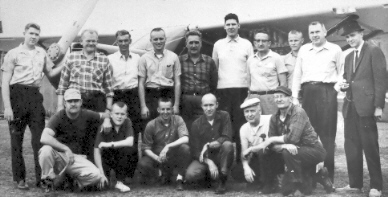
This group of local pilots made a joint flyover in honor of Torque Landis at the funeral grave site in 1964. From left to right top are: John Caldwell, Bud Young, Floyd Johnson, Chuck Davy, Porky Meyers, James Steele, Roger Smith, J. I. Abe, Rip Carder and Mike Riley. Lower row from left: Ray Walker, Bud Young’s son, Jim Abe, Charles Davy, James Messick and John Nash.
* * * * *
 Wings Over Cumberland