With the advent of WW II Thomas Barton was forced to dismantle the Pitcairn for storage. After a succession of owners, during which the Pitcairn had been cannibalized and partially restored, Harold Armstrong was able to acquire the aircraft in 1970. Armstrong was still serving in the US Air Force. While unable to begin the restoration of the Pitcairn, he diligently researched the aircraft and accumulated airframe and OX-5 engine parts. After retiring from the Air Force in 1983, Harold began restoration of the PA-4, a process that would require several years and over 4000 man-hours. Harold was assisted in this undertaking by his son, Bob, now an aviator in his own right who shared his father’s unique interest in projects such as this. The years of storage had taken its toll and the once proud Pitcairn was now a basket case. All of the missing parts were fabricated; the rebuilt framework assembled, covered with grade A cotton fabric and painted in the original black and yellow colors and markings. A 1918 Curtiss OX-5 engine was built up from collected parts and in the spring of 1990, the restored aircraft was finally assembled at the Cumberland Airport, exactly as it was when it left the Pitcairn Factory in 1927.
Following an inspection by local FAA Mechanic Bill Pancake, FAA Inspector E. Karl Dierksen journeyed to Cumberland to inspect and pass judgment on the Pitcairn Fleetwing. Inspector Dierksen, a long time member of the Federal Aviation Administration, was a veteran at thoroughly probing and prodding and questioning the owners of many varied aircraft ranging from war birds, imported aircraft, homebuilts, replica aircraft, antique planes and new airplanes before granting a license. The original license number of C3261, displayed on the wings and tail and, without the usual prefix letter N, was a cause for concern by Armstrong. However, on this day Dierksen was awed by Armstrong’s magnificent restoration of the Pitcairn and overwhelmed by his assembled voluminous documentation pertaining to the Pitcairn, which when displayed covered two six foot long tables. He walked around the aircraft a few times and only asked Armstrong if he possessed the original type certificate. Harold immediately produced the certificate and with that Pitcairn PA-4 Fleetwing II, Serial #5, Registration #C3261, was issued a Standard Airworthiness Certificate by Inspector E. Karl Dierksen, for the first time in over 61 years.
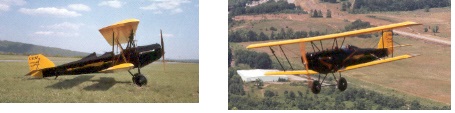
The restored PA-4 Pitcairn photographed by Gene Kelley on the ground, and by Bob Poling in the air.
On May 8, 1990 the Fleetwing was test flown at Cumberland by Harold’s son, Robert K. ‘Bob’ Armstrong, bringing a tear to the eyes of several of the old timers present. In 1991 Harold and Bob flew the Pitcairn to the Experimental Aircraft Association annual fly-in convention at Oshkosh, Wisconsin. The author and Dave Long flew an Aeronca ‘Champ’ along side the antique as a chase plane during the journey. This flight of the Pitcairn was no small feat of airmanship by the Armstrongs since the aged aircraft had to land on grass runways and always into the wind, as it has little cross wind capability, no wheel brakes, and a tail skid rather than a tail wheel. The OX-5 engine required periodic maintenance and flew on unleaded gasoline. With no onboard radio for communication, navigation was by pilotage and sectional charts with only a ‘whiskey’ compass for heading guidance. The Fleetwing has a range of two to three hours and required frequent stops. At Oshkosh it was judged Grand Champion Antique and awarded the prestigious Lindbergh Trophy. At the judging the Pitcairn scored a perfect score for the first time in the history of aircraft judging at the Experimental Aircraft Association, producing high praise for Harold and Bob’s craftsmanship. This beautiful pristine antique aircraft is presently hangared in a 1920’s style hangar at Bob Armstrong’s private High Rock Airfield, a grass strip east of Route 220 at Black Oak Road, 16 miles southwest of Cumberland, MD.
After the 1991 trip to and from Oshkosh covering over 25 hours of flight time the Pitcairn was hangared at the Cumberland Airport. The engine is water cooled, with a radiator mounted in the nose cowling of the engine. No anti-freeze would be added to the cooling system, and therefore the water must be drained during the winter. To illustrate the thoroughness of Armstrong’s work on the old engine, as the water was drained into an open container, the liquid was observed to be perfectly clear, appearing lucid and good enough to drink.
After over 70 years since its manufacture, the famous Landis Pitcairn, is still proudly flown over the skies of Cumberland. What a rare treat and privilege it is for one to observe the starting technique of hand propping the long eight and one half-foot wooden propeller of the OX-5. The sound of the V-8 engine, with its short exhaust stacks, is unusual and wonderful to hear. On take-off with the low revving engine (1400 rpm), the aircraft just seems to float from the ground as it ascends into the air.
When this magnificent and famous antique aircraft flies from Mexico Farms Airport, one’s imagination can easily be returned back in time to 1929 – and how aviation was in bygone times, as Cumberland’s earliest pilots displayed their art. Then, as now, some old timers may turn their heads to shield others from seeing their eyes filling with tears. A debt of gratitude is offered to Harold and Bob Armstrong for the restoration of this aged and beautiful aircraft.
* * * * *
 Wings Over Cumberland