Although the Pinto Airfield had ceased formal flight activity in the early 1930’s there was some continued use of that field along with other remote farm field strips that were the scene of some interesting incidents.
Herb Wentz owned a WW I era Standard J-1 in 1932 and based the aircraft on his family farm near Rawlings, MD. Herb had attained a few hours of dual instruction and was awaiting the arrival of his instructor on an October evening. Wentz had the OX-5 engine warmed up and running well, but the instructor failed to appear. Enthusiasm and overconfidence overshadowed caution and Wentz decided to fly the aircraft alone. The ensuing wreck of the Standard by Herb resulted in the aircraft never flying again. Wentz was unhurt in the crash.
In 1937 Wentz purchased an OX-5 powered Waco 10 at Congressional Airport in the Washington area and had Torque Landis fly it to Mexico Farms. Herb related that he had difficulty in obtaining flight instruction in the Waco, undoubtedly due to the fact that the front cockpit had no instruments. This situation required that Herb received his instruction while in the front cockpit, knowing that when he later soloed the aircraft it would have to be from the rear cockpit. This was obviously from a much different perspective. Finally a flight instructor agreed to offer instruction from the front, allowing Herb to occupy the rear. Communication between the cockpits was difficult, requiring much hollering and waving of hands and arms for signals to Wentz. The passing of these visual signals became so violent that the instructor broke the front cockpit windshield. With these cumbersome methods Herb finally soloed successfully at Mexico Farms and later moved the Waco to the family farm at Rawlings.
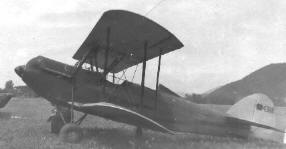
‘Little Alice’, Herb Wentz’s Waco 10 on the family farm at Rawlings, MD. Photo courtesy of Harold Armstrong.
Harold Armstrong related the story of a time when he and Wentz planned to fly the Waco together, but the OX-5 engine was acting up. Troubleshooting revealed that the Berling magneto breaker mechanism was not functioning properly. They then discovered that the Bosh magneto on Harold’s Indian motorcycle had a breaker that would fit the Berling magneto. After installing the Bosh breaker, the OX-5 engine ran well and the pair of eager young pilots went flying. At the completion of their flight the procedure was reversed so Harold could ride his Indian motorcycle back home.
On another occasion Harold and Herb took off on a flight to Thomas, WV, where Wentz had a girl friend that he desired to visit. In the Waco 10 they flew over the high Allegheny Front mountain range to Red House in Garrett County. They found a suitable farmer’s field and landed. The two then hitch-hiked on Route 219 south to the small town of Thomas and after the visit reversed the procedure. Shortly after returning to Rawlings the OX-5 engine suffered a major engine failure and Wentz was able to make a forced landing on the family farm airstrip. A major overhaul of the engine was necessary and the engine was removed from the Waco. Heavy rains weakened the security of the tie down stakes and subsequent strong winds caused the destruction of the Waco. Thus, in December 1940 Herb Wentz’s second aircraft was eliminated.
Even though he was an outlaw pilot as far as the Civil Aeronautics Administration was concerned, Herb Wentz was an excellent aviator. He was the leader of the Pinto pilots, most of whom were novice flyers. Wentz aided Tom Barton, offering him flight instruction in the Pitcairn that Barton had acquired from Torque Landis. Later in 1940, Herb was the flight instructor who taught Harold Armstrong to fly in Harold’s Swallow bi-plane, also equipped with an OX-5 engine.

Herb Wentz and a photo of Herb in the rear cockpit of his Waco UPF-7, with Dave Long in front. Photo of Wentz courtesy of Harold Armstrong, and of the Waco UPF-7, Dave long.

Wentz’s UPF-7 is still flying today, used for towing banners in Key West, Florida. Photo courtesy of Harold Armstrong.
Gene Kelley recalled a time when visiting Mexico Farms he saw a lanky pilot, later identified as Herb Wentz, position two passengers in the front cockpit of his Waco 10 and then departed the airfield. Gene watched as the aircraft climbed south of the airport and suddenly entered into a tail spin, descended out of sight below the tree line. Kelley proceeded to inform a nearby Torque Landis of his observation and pointed in the direction of the crash. Torque listened intently and calmly stated, “No, the engine is still running so he must still be flying”. Within a short time the Waco returned and landed on the grass field. Herb Wentz at a later time confided in Harold Armstrong about the incident. The Waco had a light fuel load and this provided Wentz with an opportunity to take the two passengers aloft. However, this heavy load of two passengers in the front cockpit produced an aft center of gravity which was cause for the stall and subsequent spin. At one thousand feet of altitude the aircraft was turned to the left but with the Waco’s over banking tendency Herb recalled holding top aileron to prevent a further increase in bank. With the aft center of gravity and the decrease in speed, Wentz had maneuvered the Waco into a spin. Although Herb had never before experienced a tailspin he did recall from his ground school training the recovery procedure. He quickly applied the technique feeding in opposite rudder and forward stick movement. The Waco 10 was safely recovered from the hazardous condition after a full turn in the spin and was back under control at about four hundred feet of altitude by the now further experienced Herb Wentz.
In 1939 at the Wentz family farm were two aircraft, a Heath Parasol constructed by Chuckles Keiling and Joe Brown’s Longster.
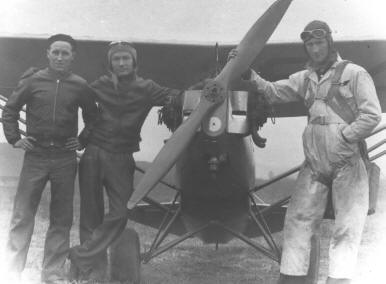
From left to right: Joe Brown, Dick Joyce, and Chuckles Keiling in front of the Heath Parasol.
On one occasion Herb Wentz shoe-horned his tall frame in the extremely small cockpit of the Longster, started the engine and took off to the north. Almost immediately the engine began to lose power and altitude and the Longster mushed into a field of tall corn. Harold Armstrong was among the bystanders who rushed to the aircraft and found that the ship had little forward travel due to the corn stalks and had contacted the ground, breaking the right landing gear and loosening the wing rigging. The plywood seat had broken allowing Wentz to come to rest almost sitting on the sod in the corn. By the time the onlookers arrived on the scene Herb had crawled out and was calmly smoking a cigarette. The Longster was carried out of the corn field, a wooden splint placed on the gear frame, the rigging re-tightened, the engine adjusted by Joe Brown, and the Longster was again a flying machine.
Later the Longster and a Baby Ace were moved to the Pinto Field and joined a Taylor E-2 Cub owned by Curly Darr. Darr took off from Pinto in the E-2 when shortly after departure a rudder cable broke. An observing Harold Armstrong felt Darr was simply holding excessive foot pressure on the rudders. After the rudder cable broke the ship did a wingover and crashed into the ground nose first. The Cub was extensively damaged and was never rebuilt.
Most pilots have pleasant memories of their flight instructor during their student and pre-solo days, much as Harold Armstrong had of his experiences with Herb Wentz. Later during WW II, Harold had graduated from the Army Air Force Aviation Cadet program as a member of Class 43-H. Herb had become a legal pilot instructor in the Civilian Pilot Training Program at Elkins, WV, having received a civilian draft deferment. In January 1944, the Civilian Pilot Training Program was terminated and Wentz was drafted into the Army. With the rank of Private he underwent Army Recruit Basic Training at Shepherd Field, Wichita Falls, Texas. Harold at that time was a First Lieutenant, having advanced to instructor pilot in the Twin Engine Advanced Training School at Roswell, New Mexico. Armstrong contacted Wentz and flew to Shepherd Field, informing Herb to meet him on the flight line. Harold taxied the Cessna AT-17 Bobcat twin-engine trainer up to the waiting Wentz and without shutting down the engines, motioned Herb to the aircraft. Having recently endured hours of military courtesy during his recent Army basic training as a Private, Herb was cautious as to how to approach his old friend who was now a First Lieutenant. Herb slowly saunters behind the right wing, opens the door and say, “I guess I am suppose to salute you?” Harold replied, “Stop that nonsense and get your ass in this airplane.” The old friends enjoyed flying that afternoon and Herb received his first twin-engine flight instruction from his former outlaw student pilot. Within a short time Wentz was commissioned as an officer and received his wings as an Army Air Force Service pilot. He would go on to serve overseas in Africa and Europe flying Douglas C-47 Dakotas, Curtiss C-46 Commandos, and North American B-25 Mitchells.
Following WW II Herb Wentz owned a beautiful Waco UPF-7 open cockpit bi-plane, the same type aircraft that he had instructed in at Elkins during the Civilian Pilot Training Program. Wentz served as the manager of the Keyser, WV airport for many years and was later a designated FAA Flight Examiner and a corporate pilot. Herb Wentz was a unique individual, a superb pilot, and one that will be long remembered.

A Cessna AT-17 ‘Bobcat’ similar to that flown by Wentz and Armstrong at Sheppard Field, TX. Photo courtesy of Harold Armstrong via the Air Force Museum Library.
According to Joe Brown, E. A. ‘Pete’ Goff, the designated Civil Aeronautics Authority Inspector for this area, would occasionally visit Pinto. Pete would caution the Pinto pilots not to haul passengers, give flight instruction, or do any commercial flying. Goff knew that they were outlaw pilots that were simply beyond his control, and he was only warning the pilots to be careful. There were several ‘outlaw’ pilots at both the Pinto field and at Mexico Farms who, once they had soloed an aircraft, felt that now they were sure-handed pilots. This exuberance resulted in accidents, fortunately usually with no injuries. With modern FAA regulations and strict control and the rapid reporting of any accident, outlaw flying has all but been eliminated. This has resulted in the protection of unsuspecting passengers and increased safety of all pleasure and business activity has been greatly enhanced. The strict rules in existence today has been cause for many prospective flyers, in order to avoid the guiding regulations and expensive training now necessary to become a pilot, to gravitate to the ultra-light aircraft sector. The ultra-light flight activity is in large part self regulated but not without FAA oversight and guiding regulations.
Joe Brown had learned to fly at Mexico Farms, having received instruction from Torque Landis in the Tony Taylor Cub. Brown lived in Cresaptown close to Pinto and based his first aircraft, a Longster, at the Pinto site. The Longster had an unreliable engine using motorcycle engine cylinders which proved most unsatisfactory. Brown’s next aircraft was a 1920’s vintage Monocoupe powered by a seven cylinder 60 hp Velie radial engine.
Brown related that he was employed at the nearby Celanese Corporation plant when a fellow worker casually remarked that he had always wanted to wing walk on an airplane while it was in flight. Other co-workers heard this conversation and from then on never let him forget the remark. They eventually got to the point of badgering saying he could not possibly have enough nerve to do such a thing as aerial wing walking. Finally, he could take the badgering no longer, approached Joe Brown, and requested Joe fly him for this activity. Brown’s Monocoupe was a high wing aircraft with no lower wing. It was decided to tie a rope onto the landing gear so the worker could climb down and hang onto the rope high above his so called friends. Joe and his co-worker drove to Pinto and untied the Monocoupe. Using the weather beaten tie down rope, with its untested strength and durability, the pair secured one end of the rope to the landing gear and stowed the rest of the coiled rope in the cabin. They took off from Pinto, flew to the Celanese factory.
The worker proceeded to climb out on the landing gear and then slid down the rope, waving to the group on the ground below. The underpowered Monocoupe was cause for Brown to barely be able to maintain altitude, especially with the drag of the underhanging individual swinging below. The stunt was performed at minimum speed, barely above a stall. After climbing back into the cabin, Brown and his intrepid passenger flew on to Westernport where the feat was again performed for other ground observers. By this time the worker was so physically exhausted that he had extreme difficulty in returning to the cabin. Joe expressed deep concern how he would have handled the situation had the exhausted individual not been able to return to the confines of the aircraft.

Joe Brown’s Monocoupe, the aircraft that carried the dangling passenger.
Joe Brown’s next aircraft was a single seat cabin Corben Baby Ace powered by a 45 hp Szekely three cylinder radial engine. This was an extremely small but fast airplane that Joe owned up until WW II. Following the war Brown owned an Aeronca Champion and in succession two modern Mooney four passenger aircraft. These low wing, retractable gear, sophisticated aircraft were based at the Cumberland Municipal Airport. Joe would frequently fly his family to and from Myrtle Beach, SC, where he now resides.

A young Joe Brown standing by his Corben Cabin Baby Ace, with a Szekley engine.
It is noteworthy that Joe Brown was one of the very few one-eyed pilots. This handicap did not prevent Joe participating in the joy of flight. In his youth he performed strange and unusual flying stunts as indicated by the hanging rope incident, but in more mature days Joe Brown was a dedicated airman and a safe pilot, whose flying exploits are fondly recalled.
* * * * *
 Wings Over Cumberland