The Cumberland Times-News reported on December 19,1939 the following:
Fighting strong unforecast head winds, two Army Seversky P-35 fighters made forced landings near and at Mexico Farms Airport after dark on Sunday, December 17, 1939. Taking off from Boston on a flight to Pittsburgh strong headwinds took a heavy toll on their fuel, with the result that the two planes were running short as they fought their way over the mountains of Central Pennsylvania. Rather than risk forced landings in the densely populated Pittsburgh area the two pilots decided to veer south and take a chance on the Cumberland Airport. Both planes roared over Cumberland shortly after dark, circling repeatedly looking for the airport beacon (Mexico Farms had no beacon or runway lights). Unable to locate the airfield, the pilots dropped two flares that lighted the area. The pilots said they then sighted the landing field but they despaired landing right-side up on the unlighted field. Meanwhile, a group of Cumberland pilots who were holding a meeting at the field heard the roar of the planes, saw a flare, and realized at once that the pilots must land quickly.
Rising to the occasion, the aviators at the airport under the direction of Ronald Landis, drove twelve automobiles on the field, aligned them so that the headlights would be played over the airfield to best advantage. Lieutenant J. J. Vander Zee, skimming dangerously close in an effort to see, tangled up with a high tension line which damaged his propeller and landing gear. Righting his plane, the steel nerved pilot landed his racing plane still traveling at over 90 miles an hour, swept through a cornfield and came to a stop in a barley field, in an area known as the Swan Pond (just east of the present Cumberland Airport). Meanwhile Lieutenant J.R. Watt successfully landed his plane at Mexico Farms Airport with the aid of the automobile headlights.
Both officers, members of the 94th Pursuit Squadron, were stationed at Selfridge Field, Michigan, had planned to fly their planes on to Michigan. William Rannells, a Cumberland flying instructor, took the two pilots in tow and Mrs. Jean Rannells, who at first thought that her husband’s plane had wrecked, cooked them a chicken supper. Meanwhile, hundreds of people in Cumberland and vicinity who had seen the planes and flares or heard about them drove to the airport. The broken wires, two carrying 66,000 volts and one 33,000 volts put out lights in Romney, Greenspring, Paw Paw, Springfield, and Spring Gap in West Virginia, and at North Branch and Oldtown, in Maryland. ‘Fate was riding in our laps when we brought those planes down,’ Lieut. Watt commented.
It is thought that the Seversky P-35 racing-pursuit airplane was the
fastest, hottest, and highest performance airplane to ever land at Mexico Farms Airport. Frank Fuller in 1937 and
Jacqueline Cochran in 1938 both won the
Bendix Trophy Air Race, each flying the Seversky P-35. It is considered amazing that
the strange field night landing by Lt. Watt was successful with
only the aid of automobile headlights for illumination of the grass
runway. A day later, according to
Wallace Walker, a Mexico Farms resident, the Seversky P-35 flown by Lt. Watt departed the Mexico
Farms Airport proceeding to Pittsburgh.
Lt. Watt would long remember
his previous night’s precarious landing at Cumberland and the assistance
provided by the rapid response of the local aviators to the plight of the
pilots.
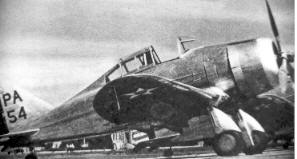
The US Army Air Corps Seversky P-35.
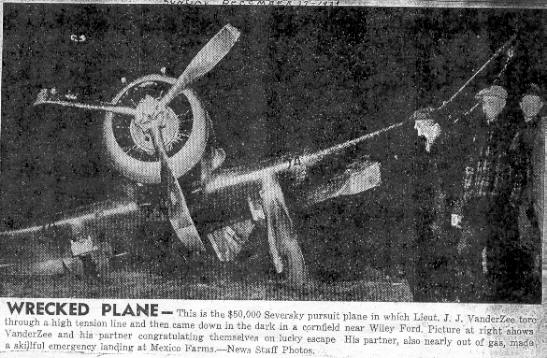
The photo and newspaper clipping of the P-35 following the crash at Mexico Farms.
* * * * *
 Wings Over Cumberland