August 4, 1946 was the day of a professionally staged air show at the new Cumberland Municipal Airport that drew many aircraft flown into Cumberland and joined the based airplanes. The air show attracted thousands of spectators. John Chapman, manager of the airport, was a pre-war barnstormer pilot who had many contacts in the air show community and provided outstanding performers for the show at Cumberland, in addition to performances by skilled local pilots.
The Souvenir Program listed events as follows; formation aerobatic flying by Harry Flook, Bill Duncan, and Lawrence Wagner flying Fairchild PT-19 ‘Cornells’, Dick Millar performing parachute jumps, the transfer from a speeding car to an airplane by Harry Flook, and the hand starting of a dead engine aircraft in flight by John Chapman. The airshow also included championship aerobatic flight featuring Woody Edmondson in a clip wing Monocoupe, a comedy air act by Charles Bing, aerobatic flying by National Championship expert Beverly ‘Bevo’ Howard in his Clipped Wing Cub, and North American P-51 Mustangs flown by US Army Air Corps pilots. (It would be the following year that the Air Force became a separate service and distinct from the previously identified Army Air Corps).
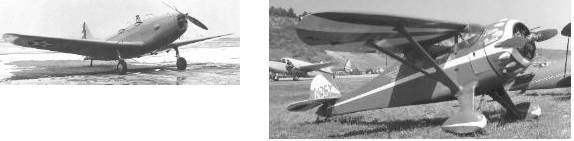
On the left is a PT-19 Cornell, and on the right Woody Edmondson’s Monocoupe, ‘Little Butch’.
The Clipped Wing Monocoupe flown by Woody Edmondson, named ‘Little Butch’, was produced in the 1930’s as one of a few 110 models with a 145 hp engine. Edmondson replaced the 145 with a 185 hp Warner engine with pressure carburetor and an aeromatic propeller making the little Monocouope a very speedy and powerful aircraft. Woody’s air show performance consisted of high speed aerobatics using most of the exhibition area in front of the hillside to the west of the airfield, where spectators were seated. Later while flying ‘Little Butch’, Edmondson won the World Aerobatic Championship at Miami in 1948, beating out famed aerobatic pilot Bevo Howard, by performing 32 maneuvers in six minutes. Few pilots could handle the Clip Wing Monocoupes and very few could fly ‘Little Butch’ without eventually wrecking. To say it was a hot airplane is putting it mildly. The famous Monocoupe was later restored by John McCulloch, who flew it several years, and then donated it for display at the Smithsonian Institution’s National Air and Space Museum in Washington, DC.
The Clip Wing Cub flown by Beverly Howard was the first truly aerobatic Piper Cub. Modified by the Piper Aircraft Factory, the Cub was powered by a 75 hp Continental Engine with an aeromatic propeller that provided the ability to change prop pitch and improve aircraft performance. This Piper Cub was the basis for the Reed Clip Wing aerobatic conversion of standard Cubs. Bevo’s show performance was outstanding, beginning with a slow roll on take-off and inverted climb to his aerobatic altitude. His routine consisted of Cuban Eights, rolls while performing a 360 degree turn, and all the standard aerobatic maneuvers which Bevo performed perfectly. In preparation to land he would shut down the engine, roll inverted, make a dead stick approach, and with the last remaining bit of altitude roll the Cub upright as he made a one wheel landing, coming to a stop in front of the applauding crowd of spectators.

This photo taken at Cumberland is of Bevo Howard’s Clipped Wing Cub.
Early in his air show career, Charlie Hilliard flew this famous Cub in his aerobatic performances and at one time was refueled by Edward Koch on a stopover at Cumberland’s Municipal Airport. Later Hilliard became leader of the renowned Red Devils and Eagles Aerobatic teams.
The formation PT-19 aerobatic team performed well as local non-professional aerobatic pilots. One maneuver thrilled the crowd by flying in an in-trail formation with each pilot, in turn, performing a loop. The third Fairchild flown by Larry Wagner had everyone holding their breath when he nearly flew into the ground as he recovered from his loop.
Harry Flook performed a spectacular transfer from a speeding automobile to a rope ladder suspended from a low flying Piper Cub and then proceeded to climb the ladder and into the aircraft. A high altitude delayed parachute jumps by 18 year old Dick Millar was crowd pleasing. The flight of a US Army Air Corps helicopter was the first of that kind in the post-war era.
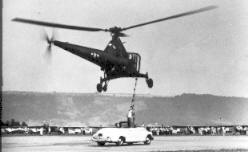
This photo show a human transfer from an automobile to the helicopter at the 1946 air show. This is believed to be the first helicopter to make an appearance at Cumberland.
John Chapman’s cranking a dead engine in mid-air was a unique maneuver enjoyed by the spectators. The engine and propeller of the Piper Cub was stopped, and while another pilot flew the plane, John Chapman would climb out, stand on the landing gear, and hand prop the propeller to resume engine power. Chapman did exhibit poor taste, in the eyes of many of the spectators, when he dropped a human appearing form from the plane, drawing gasps from the crowd who had assumed John had fallen to a sure death.
* * * * *
 Wings Over Cumberland