The Avro Avian was an interesting 1920’s airplane with differing characteristics that became a noteworthy presence locally in the 1940’s. Built by the Whittlesey Corporation, the Avro Avian was of English origin and was powered by a four cylinder air cooled inline English Cirrus Mk III 85 hp engine. Noticeable features were automatic operating wing leading edge slots for improved low speed operations and wings that folded along the fuselage for compact storage. The Avro Avian and the DeHavilland Gypsy Moth were finalists in the English Royal Air Force primary trainer fly-off competition in the 1920’s, with the Gypsy Moth winning by a small margin. An Avro Avian was brought to Mexico Farms during the late 1920’s by William Whitehead. It was believed that he came to Cumberland from England to assist in the operation of the Celanese Corporation. Famous aviatrix Amelia Earhart obtained an Avian in 1928 from Lady S. Mary Heath after Lady Heath set several light plane records in solo flights between England and South Africa. Earhart’s Avian was brought to the US by ocean liner after Earhart’s participation as a crew member in a Fokker Tri-motor flight to Ireland in 1928. Earhart then flew the Avian throughout the United States. This cross country flight by Earhart was duplicated by a California woman in 2001, Carlene Mendieta. Mendieta made the trip in a renovated 1927 Avro Avian in three weeks as apposed to Earhart’s two months sojourn. In the late 1930’s Thomas McMillen owned an Avro Avian which he housed in a hangar he constructed at Mexico Farms.
Bernard Miltenberger related that on one occasion he and McMillen were flying to Winchester, VA, inadvertently entered clouds, and suddenly were flying blind having lost all reference to the natural horizon for control of the aircraft. The Avro Avian had only bare visual flying instruments and neither Bernie nor Tommy was instrument flight capable. Bernie said after a few minutes they broke out of the clouds in a tailspin (probably a spiral since it was a bi-plane with lots of drag from the numerous struts and flying wires and the aircraft had not yet reached an excessively dangerous speed). After righting the ship they were greatly relieved and then recognized US Route 50 which was followed to the Winchester airport. They conscientiously avoided all clouds on the remainder of the route.
Later Dick Fazenbaker acquired the Avian from McMillen and, with Harold Armstrong, flew the Avian to the Winchester Airport in an effort to get credit for their accumulated illegal or outlaw flying time hours. Most of their accumulated previous flying was from the Pinto Airport. It was their desire to become legitimate private pilots. It was a beautiful Sunday afternoon and the Winchester Airport Manager had an eager crowd of people waiting for sightseeing rides and airplane rentals. The field manager, who was also an instructor pilot, was busy making money satisfying the passengers. When Dick and Harold tried to discuss the possibility of obtaining their private pilot’s license from the manager, he became extremely angry at the interruption and told them to get that piece of airplane junk (meaning the Avro Avian) off his airport and never come back. Armstrong stated it was the only time in his long flight career he was ever ordered to leave an airport.
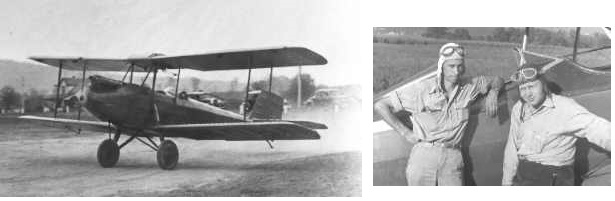
Avro Avian with the English Cirrus engine. Harold Armstrong and Dick Fazenbaker.
* * * * *
 Wings Over Cumberland