Woodrow Rayburn, a veteran pilot, owned the hangar at the south east corner of the south runway at Mexico Farms. He owned an Aeronca C-3, later an Aeronca K, and then a Lambert powered Monocoupe 90 A. Rayburn passed away in 1939.
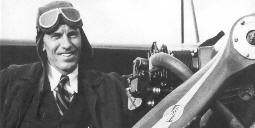
Woodrow Rayburn with his Aeronca C-3 at Mexico Farms.
At Christmas time in 1940 Virgil Parker, and associates from Queen City Neon Sign Company, rigged an OX-5 powered Waco 10 with a lighted neon type sign below the lower wings and flew it over Cumberland during darkness for advertising purposes. This same Waco 10 flew at Mexico Farms after WW II and finally was put to rest in a junk yard located where Brewski’s Bar is now situated on River Avenue in Cumberland.
Cumberland’s close proximity to the Fairchild Kreider Reisner Aircraft plant in Hagerstown resulted in several Fairchild KR-31’s, OX-5 powered, airplanes being sold and based at Mexico Farms at one time or another during the 1930’s. The out buildings of the Harvey Johnson residence on the west side of the south runway wound up containing two KR-31’s and assorted parts of others. One KR-31 was sold to a group from Baltimore in 1941. In 1942 with the uncertainty of WW II the other Challenger was simply moved out of the hangar and left to the elements. The remaining assorted parts have long since disappeared.
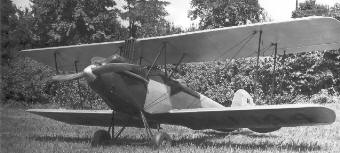
This photo is of the Fairchild KR-31, owned by Fidel Miltenberger and Ed Koch, at Mexico Farms.
Ellsworth ‘Rosie’ Rosenmerkle had soloed in 1938 under instructor Bill Rannells and wanted to obtain additional flying hours in order to qualify for an instructor’s rating. ‘Rosie’ purchased a unique 1931 single seat, open cockpit mid-wing Buhl Pup aircraft for his use in building flying time. The fuselage was of all metal monocoque construction and fabric covered wooden wings which were wire braced to the fuselage. Unfortunately it was under powered with its unreliable 45 hp Szekley three cylinder radial engine. The Szekley engine emitted an unusual sound. After Rosie sold the Buhl Pup the new owner had John Nash, a local mechanic, replace the Szekley with the Franklin engine from the Cumberland Flying Club’s fire destroyed Cub.

A winter time shot of the Buhl Pup at Mexico Farms.
One of the members of the Vandergrift family purchased a new Luscombe airplane, basing it at Mexico Farms. After an accident on take off, Torque Landis and Ben Franklin repaired the craft in the former Woody Rayburn hangar (now owned by Joyce Johnson). After completing the repair Torque demonstrated the excellent flying characteristics of the Luscombe with an aerobatic show ending with a super buzz-job down the north-south runway. Shortly afterward, Torque, on a day so windy that wing walkers had to hold the wings before take-off, flew the aircraft to the Luscombe Factory in New Jersey. The aircraft was inspected following the repair and was declared a new ship. The Luscombe had only a few hours flying time prior to its damage, and the fine workmanship of Landis and Franklin was affirmed by the factory inspectors.
Also during this time Bob Diggs purchased a 65 hp Continental powered Luscombe 8A, which proved to be a superior performing perky airplane with good aerobatic qualities.
It is interesting to note that during this period when open cockpit airplanes were being replaced by closed cabin airplanes, it became fashionable for commercial pilots to wear army officer type dress hats to indicate that they now did not fly open cockpit aircraft but had graduated to the closed cabin airplanes of a more modern type. Bill Rannells, Jack Delagrange, Torque Landis, and Herb Wentz followed this trend. Now, the pendulum has swung back and pilots at sport events are proud to wear helmet and goggles to indicate that they fly open cockpit airplanes.
Charles Patterson soloed on December 7, 1940, exactly one year before the attack on Pearl Harbor. He subsequently enlisted in the Aviation Cadet program and served as instructor pilot during WW II. Patterson served a full career in the post war Air Force and retired after twenty years.
* * * * *
 Wings Over Cumberland