Kenneth Jewell, the ninth of twelve Jewell children, grew up in the Cumberland Valley Township in the Lake Gordon area of Pennsylvania, to the north of Cumberland, Maryland. Two friends, twin brothers Raymond and Roger Twigg also were raised in that area. Upon reaching high school age all three buddies attended Fort Hill High School in Cumberland during their junior and senior years. They were very active in several extra curricular activities in high school. The trio rode bicycles or walked to the school bus at the Maryland-Pennsylvania border pick up point, and in the evening after participating in sports activities, they had to hitch-hike back to their bicycles, return home and then accomplish their farm chores. All were tough, fierce competitors who excelled in sports, an experience that would aid in their later participation during WW II. Roger Twigg would become a highly decorated Army Ranger, serving in combat in Africa, Sicily, and Italy. Raymond Twigg served in the US Navy in the Pacific Theater during the war.
Kenny Jewell enlisted in the Army Air Corps immediately after graduating from high school in June, 1941. With a goal of qualifying for Aviation Cadet training, Kenny’s first service was an aircraft mechanics course. Upon completion of that school he was promoted to Corporal and then served at Gunter Field, Montgomery, Alabama. Aviation Cadet pilot training began for Kenny with the US entry into WW II. He graduated from the cadet program with the rank of Staff Sergeant, at a time when enlisted personnel were trained as pilots. Within a short time the Army Air Corps promoted the Flying Sergeants to a newly created rank of Flight Officer, which is comparable to a Warrant Officer rank of the Army. Later when Jewell went into aerial combat he was a Flight Officer, a lower rank than two other 2nd Lieutenant crew members. However, Kenny Jewell was placed as pilot in command of his B-24 crew. He advanced rapidly in rank when flying combat missions with the 8th Air Force and departed the Army Air Corps in 1946 with the rank of Major.
Previously Jewell was assigned to Wright Field, Dayton, Ohio where he was able to fly various aircraft in test programs, including the Boeing B-17 ‘Flying Fortress’. Another assignment consisted of coastal patrol as an enemy submarine hunter in which he accumulated a total of 1,000 hours flying time. At that time during WW II, Kenny was considered an experienced four-engine aircraft pilot even at age 21. In the spring of 1943, Tucson, Arizona was his next station where he was assigned a combat crew flying a Consolidated B-24 ‘Liberator’ heavy bomber. Some among this assigned group were considered misfits and malcontents, two of whom as 2nd Lieutenants objected to the authority of their new low ranking Flight Officer as aircraft commander. However, Kenney’s toughness and aggressive leadership during this period was evident, as he prepared the crew for combat ready status during the intense flight training.
After taking delivery of a new combat ready B-24, which was named ‘Bakadori’ after a Japanese bird, the crew was soon en route to England on assignment with the 8th Air Force. Kenny said that while on this flight traversing from Nebraska to Maine on September 8, 1943, members of the crew began requesting him to deviate from the B-24’s flight path and fly over their home towns. After a few deviations Kenny was inclined to also fly over his home area. However, he said he got consumed with the notion and buzzed several of his parent’s neighbors in the Cumberland Valley, who in later years never let him forget his scary aerial antics. Jewell then flew on to Cumberland, circling the city several times and observing the construction at the new Cumberland Airport in nearby West Virginia. After making a low pass over the partially completed runway 24, the construction workers were seen clearing away barriers and construction machinery. A joint crew decision was made agreeing that one of the engines had conveniently developed ‘trouble’ (a B-24 was capable of flight over long distances with a failure of one engine). The crew should land for the ‘engine repair’, and while there they could enjoy an evening of relaxation (and possibly a bit of hell raising) with Kenny’s large family and friends. Even though only about 3,500 feet of runway was recently paved with the remainder simply a dirt surface, Kenny knew that this was his last chance to visit his wife and his family. All crew members were aware they were on their way to war for experiences from which they might not survive. Jewell quickly decided, as aircraft commander, that he would take the chance of damage to the B-24 on the unfinished runway and, perhaps, even a possible court martial.
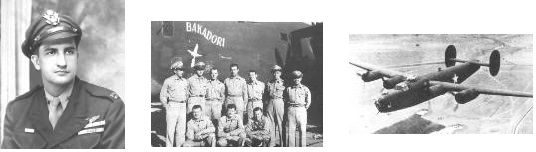
Ken Jewell, as a Captain, and with his Bakadori crew on their Cumberland stop. On the right is a B-24 on a mission over Germany.
During the war the citizens of the Cumberland area had little direct contact with fighting machines and their military personnel. The appearance of the large bomber generated much excitement creating a large crowd of people to witness the aircraft landing. The landing was successfully completed using a portion of the dirt overrun of runway 24 and the ‘Bakadori’ was parked and secured by the crew. After conferring with Virgil Parker, local aircraft mechanic and a former WW I pilot and Army officer, regarding the status of the number two engine it was time for Flight Officer Kenneth Jewell as the aircraft commander to report by telephone to his commanding officer in Missouri. Upon making contact the first question his commander posed to Jewell was, “Where is your hometown?” Jewell’s commander had obviously had other pilots land at their home town on previous occasions. When Kenny stated that his home was located in Pennsylvania and that the B-24 had come down in West Virginia, the reply was accepted. Luckily for Kenny his commander did not recognize the geography of the region, and that the Lake Gordon area of Pennsylvania was only a few miles from Wiley Ford, WV. When the commanding officer seemed a bit doubtful of Kenny’s further explanation of engine trouble, Kenny handed the telephone to his friend Virgil Parker who, with his WW I Army Air Service experience, understood such situations. Virgil convinced the commanding officer that number two engine did have a problem and that Parker was qualified to make the necessary repair. Parker further explained that it probably would take until the next day for the maintenance repair and the B-24 should be ready for departure in the morning.
Having made the impromptu stop on their way to war, the ‘Bakadori’ crew immediately became darlings of the local people who welcomed the airmen with open arms. Local prominent business man W. Donald Smith led a group that supplied the crew with free hotel rooms, free use of taxicabs, a supply of meat sandwiches (meat was rationed at that time along with gasoline), and two cases of whiskey. Eligible men were not in abundance at the time and local females were eager to befriend the handsome crew members. Several stops were made at local night clubs in downtown Cumberland. The next morning one crew member, having traveled by train to visit his family, did not return to Cumberland in time to board ‘Bakadori’. Jewell recognized that he could not delay departure any longer. Fortunately the missing crewman was able to catch up with the ‘Bakadori’ at their stop in Maine and resume his crew duties.
Little time was lost upon their arrival at Shipdham, England, with assignment to the 66th Bomb Squadron, 44th Heavy Bombardment Group, 8th Air Force. The crew was promptly participating in bombing missions over Germany. In a letter written to his parents on October 12, 1943, Jewell related that during their first mission when they returned to home base the ‘Bakadori’ was “all shot to hell”. Their new replacement Liberator was named ‘Banshee’, after an Irish Ghost. Later replacement aircraft were named ‘Banshee II’, then ‘Banshee III’, and then ‘Banshee IV’. Kenny recalled that due to enemy action he and his crew returned to home base only four times with all four engines functioning and that they had gone through five different B-24’s while participating in the European bombing missions.
Having successfully completed 28 missions, Lieutenant Jewell was now designated a squadron commander, and his crew were considered seasoned veterans. Jewell was given the honor and responsibility of leading the second section of a large formation of heavy bombers on a March 9, 1944 mission. The target was an aircraft factory at Brandenberg, located twenty miles west of Berlin. With the high casualty rate within the bomber crews of the 8th Air Force during this intense air war with the German Air Force, Jewell was assigned a single-engine fighter pilot as his co-pilot. Their assigned B-24 on this mission was named ‘E-Z Duzit’ and Kenny believed that this was to be a relatively easy formation flight. They would be the lead section airplane in the large formation of bombers, and the newly assigned co-pilot could get experience handling the four-engine Liberator on the way to the target. Heavy and accurate flak was encountered when over the target area. For greater accuracy during the bomb run, the aircraft was effectively turned over to the bombardier whose Norden bomb sight was connected to the automatic pilot. Just after releasing their bombs the ‘E-Z Duzit’ was hit by four bursts of flak. The nose wheel and front oxygen system were destroyed, the radio was rendered inoperative, and the number three engine and right side of the plane were heavily damaged. With the number three propeller feathered and the engine shut down the hydraulic pump was inoperative and no hydraulic functions were possible.
The following is how the October 1991 issue of Air Force Magazine described the plight of ‘E-Z Duzit’s’ crew:
These were losses a B-24 could survive and still make it back to base under the hands of an able, skilled, and experienced aircraft commander – but the stricken bomber no longer had an able commander. A shell fragment had nearly severed Lieutenant Jewell’s left leg leaving the flight deck, in Jewell’s words, ‘a gory mess’. No one had a knife to remove the remains of his leg. Lifting the wounded pilot from his seat, they tended to his injury as best they could, stopping the gush of blood. The B-24 was momentarily without a pilot at the controls. At the sight of the bloody flight deck, Jewell’s co-pilot had become sick and vomited into his oxygen mask, choked, and passed out. The crew revived him and the shaky young lieutenant managed to keep the plane under control. Suffering excruciating pain and the trauma of losing a limb, Lieutenant Jewell remained conscious throughout his ordeal. It was his responsibility to get his crew to their base at Shipdham. The likelihood of a safe landing would be greatly diminished if he were to lose consciousness, for his co-pilot had never landed a B-24 by himself – much less a damaged B-24. Luckily no German fighters attacked so the bomber could be flown to England on automatic pilot but would have to be landed manually, which Jewell could not do with one leg. He had members of the crew put him back in the left seat. As they turned on final approach, it was up to the inexperienced co-pilot, who to rely on instructions from Jewell and what had limited physical assistance the wounded aircraft commander could provide. Without hydraulic pressure, the B-24 had no brakes. Lieutenant Jewell directed the crew to attach parachutes to the waist gun mounts and when the plane touched down, to deploy them to slow the landing roll. At about seventy miles an hour the nose dropped, since they could not deploy the nose wheel, and the bomber skidded to a safe stop.
Heroism has been defined as the will to endure. For his extraordinary heroism, 1st Lieutenant Kenneth Jewell was awarded the Distinguished Service Cross and in June, 1945 ranked seventeenth in the Army Air Forces for the number of awards he had received. Included among Jewell’s awards was the Air Medal with three oak leaf clusters, the Distinguished Flying Cross, the Purple Heart, and the Silver Star. He received the first of two presidential unit citations for participating in the first raid on the Ploesti oil fields. During medical treatment at Walter Reed Hospital in Washington, DC, Captain Jewell was visited by General Henry H. ‘Hap’ Arnold, Commanding General of the US Army Air Forces in WW II, and Kenny persuaded the General to allow him to return to flying status. Kenny Jewell thus became one of the first Army Air Corps pilots to fly with an artificial leg. On June 11, 1945 at Drew Field, Tampa, Florida, Captain Jewell took to the air once again. Along with two other pilot amputees, he served as an instructor and test pilot.
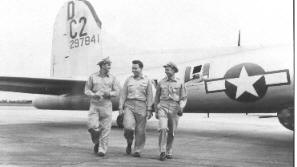
Pictured are three US Army Air Forces amputees, all serving as instructor pilots training other aircrews in the B-17 bombers, following their war time service. Ken Jewell is on the left.
After the end of WW II and Jewell’s separation from the Air Forces, Kenny was employed for a period as corporate pilot with Graham Aviation, the fixed base operator at the Cumberland Airport during 1946-47.
(The above information regarding Kenneth Jewell was obtained from the Air Force Magazine, the Cumberland Times-News, The Shopper’s Guide of the Bedford County Press, and from several personal interviews.)
* * * * *
 Wings Over Cumberland