Roger Thiel of Washington, DC, a Civil Air Patrol historian reported in the July,1992 issue of Vintage Airplane on activity of the CAP in the following article:
As early as 1939 forward thinking individuals such as New Jersey State Aviation Director, Gil Robb Wilson, and others had sensed that a plan should be prepared by which civilian airplanes and pilots might relieve the regular military of patrolling the extensive coast line of the US, in the event of war. As the storm clouds of war darkened, they pressed the case which resulted in the formation of the Civil Air Patrol on December 1, 1941 preceding the Japanese bombing of Pearl Harbor by six days. The US Navy’s priority was the Pacific which left the Atlantic Ocean severely under guarded. The Nazi Germany submarine fleet roamed the Atlantic Ocean at will sinking 12 ships in January, 1942 escalating to 52 ships in May, all of which sinkings were fairly close to shore. The CAP moved quickly to organize a patrolling force in early 1942 flying Fairchild 24s, Stinson Voyagers, cabin Wacos, Stinson Reliants, Ryan SCW s and others. Later, bombs or depth charges were added. By late summer 21 bases were formed from Maine south around Florida and the Gulf to Brownsville, Texas. Receiving but a small stipend, most CAP pilots paid for their own gasoline and maintenance. The CAP was credited with two submarine sinkings (probably more than two but witnesses were required ), dropped 82 bombs, reported 173 sightings, 91 vessels in distress, 17 floating mines, 363 survivors reported, 129 air crew rescued, and suffered 26 fatalities mostly due to engine failure at sea. In 1948, Air Medals were presented to coastal patrol pilots who logged 300 hours of active duty.
George Ruhl, a Cumberland professional photographer, served with the CAP Coastal Patrol, operating from Base No.1 at Bader Field, Atlantic City, NJ. During those operations Ruhl received a citation and the Air Medal from the US Government for his service in the CAP Coastal Patrol.
Enthusiastic patriotism was an all encompassing feeling for citizens of Cumberland and the US in early 1942, because of the gravity of the world situation. Most of Europe, Africa and South East Asia were occupied by the Axis Forces of Germany, Italy, and Japan. The Axis Forces were claiming victories on all fronts and most every family had a husband, son, or father in the Armed Services. Doing every thing possible to win this conflict and preserve our freedom against the tyranny of those forces’ wanting to control our destiny and way of life was the desire of all. Such statements may sound a bit unusual or even off beat and may cause a raised eyebrow today but, such fears and feelings were real and genuine in 1942 and were evident throughout during WW II.
All but two of the 38 members of the Cumberland Squadron of the CAP were in their CAP uniforms for a group picture taken in front of a hangar on the east side of the south runway at Mexico Farms Airport in May, 1942. Following the picture a mass formation of 15 airplanes circled over Cumberland and the beginnings of the construction of the newly planned Cumberland Airport near Wiley Ford, West Virginia.
The local CAP unit served as a means for the pilots remaining at home to fly their aircraft and perform useful duty during WW II. Gasoline ration stamps were available for fuel purchase for training missions throughout the Civil Air Patrol organizations. In 1943 the Cumberland Squadron 331 was Headquarters for the Hagerstown, Frederick, and Taneytown Flights. Officers at the time were; Arthur Lyem – Commander, L.G. Trimmier – Executive Officer, T. E. Carlson – Adjutant, G. W. Brenaman – Training and Operations Officer, V. A. Parker- Engineering Officer, and John D. Liebau – Intelligence and Public Relations. Flight officers were Joseph Bedinger, Commander of HQ Flight, G. B. Miltenberger – Flight A, and Wade L. Berg – Flight B. In 1942, the author with the rank of Sergeant was a student pilot-observer in the CAP. As is the case in today’s Civil Air Patrol, the functions entailed emergency services, education, and cadet training.
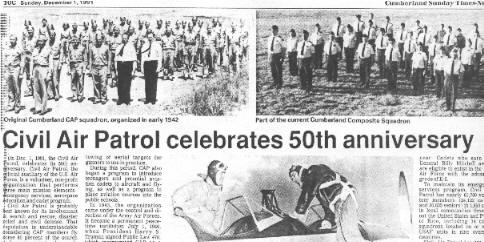
This Cumberland Times-News article highlights the local Civil Air Patrol Squadron in 1942. On the bottom, George Ruhl is preparing for an east coast patrol training flight.
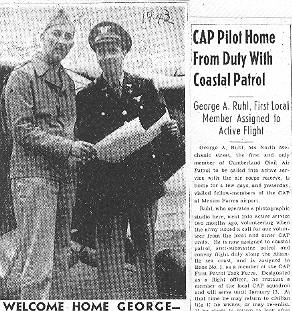
This Cumberland Times-News article shows Captain Lyem welcoming home Flight Officer George Ruhl.
On May 5, 1942 the local CAP unit was able to perform its first emergency service following the crash of an Aeronca Chief airplane. Frank Becker, age 42, owner and president of radio station WTBO, riding as a passenger, and pilot and local truck driver William Ellis Swartzwelder, age 36, met tragic deaths when the Aeronca Chief nose dived and crashed while attempting to climb the east side of Nichols Mountain at low altitude near Moore’s Hollow Road. The local CAP Squadron 331 provided a valuable public service of accurate aviation information to the local newspaper as to the probable cause of the crash. This is a valuable service that should be provided to the media in order to prevent inaccurate speculation, and is applicable to aircraft accidents at any time.
After removal of the bodies the crashed plane was left intact for inspection by Inspector Willis D. Renz and two other inspectors of the Civil Aeronautics Administration. Richard Post, Lawrence Wagner, and Bob Poling, CAP observers spent an all night vigil guarding the wreckage. All three of these CAP observers subsequently entered the Armed Services shortly thereafter and became Army Air Force pilots. Both Becker and Swartzwelder were members of the CAP, which offered an aerial salute to the deceased flyers in the form of a five aircraft fly over in a V formation, as the funeral procession was enroute to Grace Methodist Church.
After WW II the Mexico Farms CAP unit was disbanded and was dormant for many years. About 1970 a unit was activated as Civil Air Patrol Composite Squadron 18065 based at the Greater Cumberland Regional Airport. A teenage Dale Nicholson took an active part in the formation and early training of cadet members. This organization has continued its volunteer efforts of providing service to the Air Force and to the tri-state area. Interested youngsters may join as a cadet up to age eighteen with senior members providing guidance and leadership with their various aerospace education programs. The local squadron has been of great value by their involvement in numerous activities at the Greater Cumberland Regional Airport.
* * * * *
 Wings Over Cumberland