Cumberland Airways and the city of Cumberland could no longer agree on a contract in 1948. A contract for the fixed base operation of the airport was eventually awarded to the Mountain Air Service. This air service organization was composed of pre-war Mexico Farms pilots, Sanford Jenkins, Jack Delagrange, and Fred Jenkins. With the GI Bill no longer supporting flight training activity at the airport, flight activity slowed considerably. In June, 1948, the Exchange Club, Junior Chamber of Commerce, and Mountain Air Service jointly sponsored an air show attended by an estimated 10,000 patrons. This air show was unique in that it had mostly local pilots as performers. Harold Armstrong, who was just recovering from recent surgery, flew a German Messerschmidt ME-108 in tight formation with a pre-war English Miles Sparrowhawk flown by his brother, Jim. Both Harold and Jim were veteran pilots who had served during WW II. The Messerschmidt and the Sparrowhawk were based at Baker Air Park, Burlington, WV, and the Armstrong brothers made a low close formation pass prior to landing in front of the crowd at Cumberland.

The German Messerschmidt ME 108 on the left, and the English Miles Sparrowhawk, photographed at Baker’s Airpark in Burlington, WV.
The Messerschmidt ME-108 was a smaller offspring of the famous ME-109 German fighter and was used as a courier and all purpose aircraft. Some how Leo ‘Pat’ Patterson had it shipped to Burlington, WV, shortly after WW II. It had many interesting features but it had a complicated and faulty fuel system which was cause for Harold Armstrong to make a forced landing on one occasion. It fell out of favor at the Baker Air Park and was later acquired by a German diplomat who planned to have transported it back to Germany. That did not materialize and two Pennsylvania residents acquired the ship and made some changes. In 1993 the unique aircraft was obtained by Lufthansa Airlines, returned to Germany, and completely re-manufactured in their maintenance facility at Frankfurt. The ME-108 was given a German identification and placed on display in its home country.
The pre-war English Miles Sparrowhawk was a beautiful little white low wing double open cockpit sport airplane owned by Carl Conrad. The craft was constructed of wood and powered by an inverted four cylinder in line Gipsy Major engine, giving the cowling and fuselage a sleek look. In former Republic P-47 Thunderbolt pilot Jim Armstrong’s hands, it was a capable aerobatic performer, displayed during the main exhibition flight of the day.
Veteran Mexico Farms pilot Bernie Miltenberger displayed his usual excellent and crowd pleasing ‘Flying Farmer’ comedy act. Richard Hockman performed a thrilling high altitude delayed parachute jump. As reported in the Cumberland Times-News the Maryland National Guard and their Republic P-47 Thunderbolt Fighters presented a spectacle when they flew in tight formation after taking off at split second intervals. Their final feat was a mock strafing raid in front of the crowd, a fitting climax to their performance.
Local and visiting pilots participated in balloon bursting and flour bombing contests. However, a mishap occurred when one of the participants in the flour bombing flew too low and struck Harold Bloom, one of the volunteer workers, on the head with the wing tip of an Aeronca Champion. Although Bloom’s injuries were not serious he did require medical attention.
Also scheduled as part of the day’s activity was a handicap closed course air race for production airplanes. Entered in the race were; Kenneth Hager – Taylorcraft, Bill Cramer – Aeronca, Charles Park – Ercoupe, Tom Shannon – Aeronca Champion, Bernie Miltenberger – Cessna 120 (owned by Lewis Ort), Harold Clayton – Taylorcraft, Fred Jenkins – Piper Super Cruiser, Harold Dodd – Cessna 140A, W. L. Kline – 50 hp J-3 Cub, Earl Wilson – Aeronca Chief, Sanford Jenkins – Cub, Ewald Reuhl – Ercoupe, and Berkey Smith – Taylorcraft. The first leg of three laps was a continuous climb to the first turn point at Dan’s Rock atop Dan’s Mountain, then to Fort Ashby, and then returning to overfly the wind tee at the Cumberland Airport. As in last year’s race the starts were staggered according to a top speed performance handicap system determined by Derr Golladay. The 50 hp Piper Cub, flown by W. L. Kline, was the slowest and therefore started first, then at a predetermined interval each launched in turn. The first prize winner received a trophy and a $200 US Savings Bond.
Sitting on the hillside behind the airport terminal building, the paying crowd was positioned to have an excellent vantage spot to observe much of the course and the racing aircraft during the first two laps. Derr Golladay’s handicapping system worked almost perfectly to produce a thrilling finish. Heading towards the home airport from Fort Ashby at the end of the last lap, several airplanes could be seen gaining on the leading 50 hp Cub of W. L. Kline. The Cessna 140A flown by Harold Dodd managed to pass Kline while over Mexico Farms Airport and passed overhead to win at the last moment. Berkey Smith, who finished third in a Taylorcraft, had some measure of revenge for Harold Dodd, and his Clary Club sponsor, as Smith had beaten him in the previous year’s cross country race at Mexico Farms while flying an Ercoupe. Dodd, a severe arthritic, had flown a Taylorcraft in that race. Phillip Miltenberger said that his father, Bernie, won a pair of shoes, donated by W. Donald Smith, owner of Smith Shoe Stores, for placing well in the race while flying Lewis Ort’s Cessna 120.
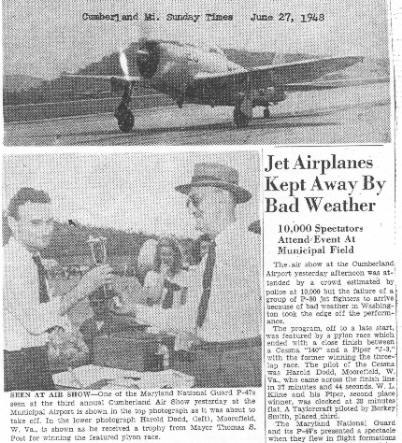
This Cumberland Times-News article highlighted the 1948 Air Show. Seen is Mayor Thomas Post presenting to Harold Dodd the winning trophy for the pylon race.

These are the top three participants in the race. On the left is W.L. Kline – second place, Berkey Smith in the center – third place, and on the right, Harold Dodd – the overall winner.
It should be noted that the airshows, held in 1946, 1947 and 1948, were huge events that indicated the tremendous interest in aviation following the post war period. Although the talent provided by the visiting performers was recognized as outstanding displays of arimanship, the local pilots proved a worthy match and a great deal of pride and credit needs to be directed to these local aviators for their aeronautical talent.
* * * * *
 Wings Over Cumberland