The arrival of William C. ‘Bill’ Holbrook as chief pilot of the Kelly-Springfield Flight Operations was fortunate for the Cumberland area. Holbrook became known as ‘Mr. Aviation’ in the 1950’s, 60’s, and 70’s at the Cumberland Municipal Airport much as Ronald B. ‘Torque’ Landis had been in the 1920’s, 30’s and 40’s at Mexico Farms Airport. Growing up in Akron, Ohio, where his dad worked for the Goodyear Tire Company, Bill was privileged to watch the giant dirigible airships (zeppelins) being built for the U.S. Navy. He was fascinated by these giants of the sky, as he was by the International Balloon Races his dad took him to see. The family also attended the Cleveland Air Races; a huge annual event of the 1930’s which was held over the Labor Day week-end. After graduating from high school Holbrook was employed by Goodyear as a draftsman before entering the U.S. Army Air Force.
Bill learned to fly in the Army Air Force Aviation Cadet Program beginning with the open cockpit Boeing PT-17 Cadet during primary training, the Vultee Valiant BT-13 in basic, and the Cessna Bobcat AT-17 in twin engine advanced. He graduated in Flying Class 43-H at Marfa, Texas. While flying the Cessna Bobcat he had the first of his four career engine failures, landing successfully with the power of the remaining engine. His initial assignment following cadet training was to the Naval Air Station, Pensacola, Florida for training in the Consolidated PBY Catalina OA-10 flying boat under a special project. At the time of its first flight in 1934 the PBY was the largest flying boat assigned to the Navy. It had two Pratt and Whitney 1830 hp engines, five machine guns, a crew of nine or ten men, a gross weight of 35,420 pounds, with a listed but doubtful top speed of 179 mph. In 1939 a retractable landing gear was added by the Consolidated Aircraft Company making it an amphibious airplane. After learning to fly the Catalina flying boat Holbrook received his Gold Navy Wings on January 11, 1944. However, due to inter-service rivalry, by the Navy towards the Army Air Force, it was required to gain a direct order from Washington to get a Marine Colonel to present the Army Air Force Flying Officers with the Gold Wings worn by Navy pilots. It was a unique distinction, for Holbrook and others of his class, in being permitted to wear both the silver wings of the Air Force and the gold wings of the Navy on their Army Air Force uniforms.
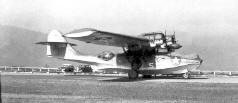
A photo of the Consolidated PBY similar to that flown extensively by Bill Holbrook.
Holbrook was one of the original pilots of the Second Emergency Rescue Squadron formed at Gulfport Army Air Base in Mississippi as the Army Air Force was forming its own air sea rescue units for duty in the Pacific Theater of War. He and his crew ferried an assigned Catalina to Hamilton Field, California. After six weeks work to modify the aircraft they proceeded to Hawaii, Canton Island, Tarawa, Guadalcanal, and finally Townsville, Australia where the ship was painted a dull blue. From there they proceeded to the Island of Biak off the northeast coast of New Guinea, which became their combat base. Here activity became intense as they participated in search missions lasting twelve to eighteen hours as they performed their duty assignment of rescuing downed Air Force fighter and bomber crews. The PBY 5A’s rugged dependability saved lives time after time where open sea landings were hazardous due to the swells of the ocean. Even a normal landing seemed like a crash with much sea water flowing over the hull and flight deck. The hulls sustained damage in open sea rescue, popping rivets, often bending stringers, or buckling the heavy bottom skins, once even opening a basket ball size hole in the hull and twisting the large tail on the fuselage of the Catalina. Fortunately a crew member alerted Bill to abandon the landing and continue on with a full power climb out and a subsequent landing at back at their base. Holbrook’s squadron lost all of the original planes during their first year, four on the ground during air raids and the others during sea water operations while rescuing over seven hundred men.
First Lieutenant Bill Holbrook was discharged from the Air Force in November 1945. His combat flying experiences earned him the Air Medal and seven oak leaf clusters. Bill was then hired by the Goodyear Tire and Rubber Company as a co-pilot in their flight department. In 1951 he came to Cumberland.
Holbrook is a dynamic person with a congenial and persuasive personality who accomplished much for the Kelly-Springfield Flight Department and the Cumberland aviation community. He constantly worked diligently and with rare vision to improve the airport and its instrument landing capabilities. Bill was one of those rare corporate pilots who flew professionally during the week and when off duty on week-ends came to the airport to fly small private planes or sailplanes. Holbrook rebuilt several aircraft and gliders and built his own sailplane, a Schreder HP-14. He was generous with his time and was known to use his own aircraft to teach many to fly. Bill was a gifted instructor and was especially helpful to young teenagers. For many years the Kelly Hangar was the hang out for local pilots. Bill Holbrook was and is a truly professional pilot, one who is worthy of emulation.
Dr. Edward F. ‘Ed’ Byars, of the West Virginia University faculty, was a member of the Cumberland Soaring Group who based his sailplane at Cumberland. He and Bill Holbrook became close friends and realized the need for the dissemination of formal soaring information. They jointly formed ‘Soaring Symposia’, an organization dedicated to the furtherance of knowledge and the art of soaring. They presented their first symposium in February, 1969. Fortunately, Gene Moore, a local soaring pilot, had become nationally known for his pioneering work in the development of soaring instruments, principally a sensitive rate of climb variometer. Gene Moore’s presentations at the symposia were well received by soaring pilots. Ed Byars held discussions on aircraft structures and performance, while Bill Holbrook gave presentations on soaring techniques. The Symposia were held annually for several years. Their recorded proceedings were published and prized by soaring pilots. The Soaring Symposia eventually became the basis for the Soaring Society of America’s present mid-winter annual meetings. Soaring Symposia also conducted a tour to the soaring sites and sailplane factories in Germany, Austria, and Switzerland. Bill and Ed also wrote a best selling soaring pilot’s text book, Soaring Cross Country.

Ed Byars on the left and Bill Holbrook. On the right is Gene Moore.
On May 5, 1973, Bill Holbrook set a world soaring record ‘out and return’ flight of 783 miles (1,260 kilometers) on the Knobley Mountain range, just west of the Cumberland Airport, and on adjoining mountains stretching from Lock Haven, PA to Hansonville, VA. The Hansonville point was just ten miles from the Tennessee line. This was a dangerous flight in that Bill had to fly his Libelle sailplane at the red line speed of 120 mph through severe turbulence 50 to 200 feet above the mountain ridges while navigating where the ridge lift existed. The gusts stressed the Libelle close to its design limits and Bill knew that he could be on the ground in a matter of a less than a minute if he did not remain in the updraft portion of the wind over the ridge. It was necessary to maintain a rapid pace near the red line speed in order to complete the required task during daylight hours. Surface winds blew so hard on that day from the northwest at the Cumberland Municipal Airport that members of the Cumberland Soaring Group had to nail the Quonset Hangar doors shut to keep them secure. Holbrook was only the tenth person in the world to fly a sailplane over 1,000 kilometers. It was an outstanding achievement.
Bill participated in two coast to coast Smirnoff Soaring Derby contests. The contest consisted of a daily assigned cross country soaring route of several hundred miles, beginning in California and after several soaring days ending at Dulles Airport, Washington, DC. Many of the flights were in poor flying conditions, the opposite of Holbrook’s world record flight. Several of the flights were over stark and lonely areas with smooth glides of twenty to thirty miles across forbidding desert canyons and wilderness areas. Here an off-field landing and a retrieve by his auto-trailer crew would have been a lesson in survival.
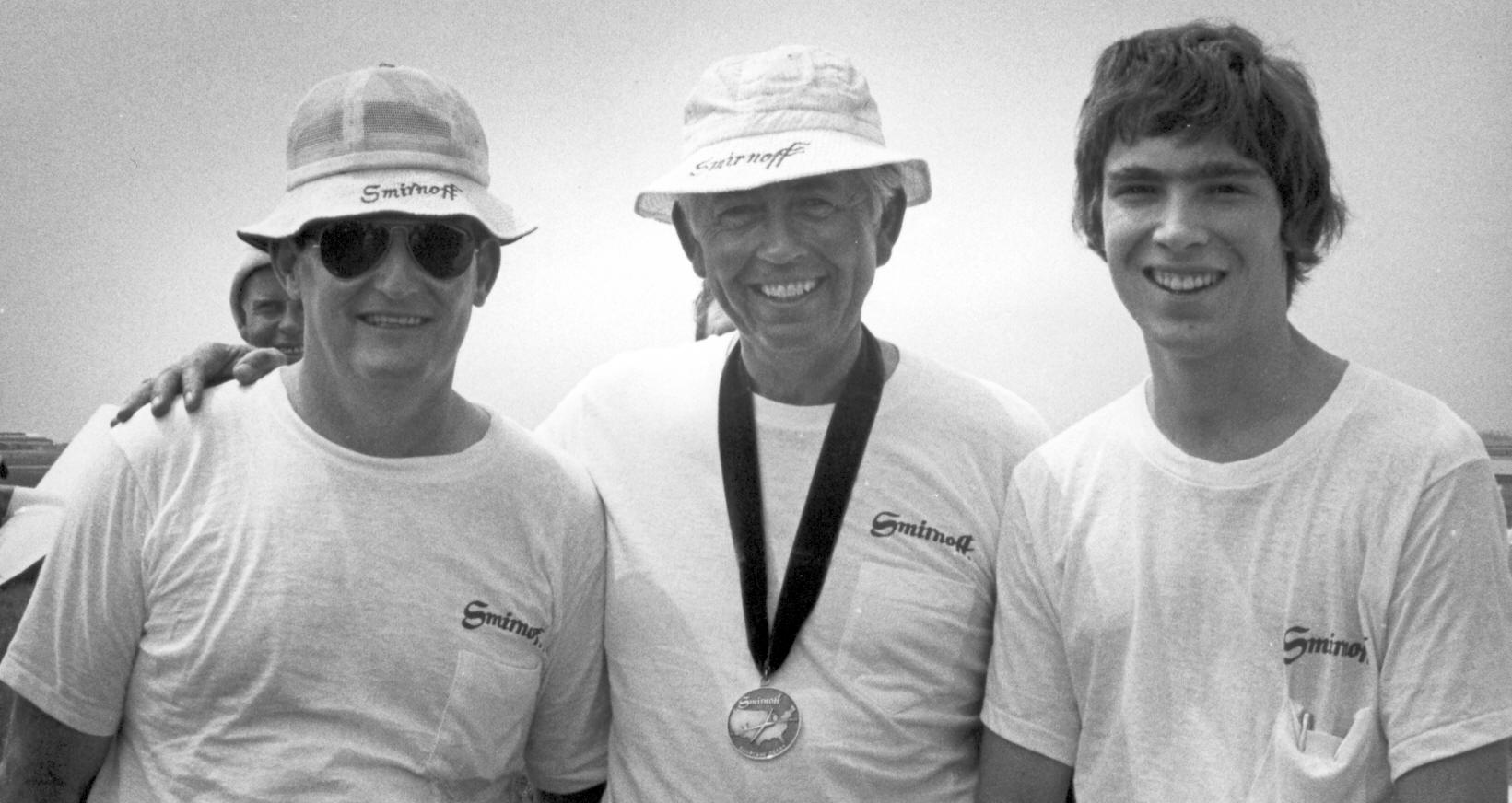
From left to right: Stan Leasure, Bill Holbrook proudly wearing his Smirnoff Derby medal, and David Poling. Stan and David have been long standing members and tow pilots for the CSG.
Bill won the first event in 1974, competing against national and world caliber soaring pilots while flying his Kelly-Springfield sponsored Libelle sailplane, the ‘Spirit of Cumberland’. The Cumberland Dapper Dan Club honored him with its top award for this achievement which was highly commendable and reflected favorably on and gave noteworthy attention to the city of Cumberland. The following year Holbrook placed high in the derby while flying a lower performing Schweizer factory sponsored 1-35 sailplane.
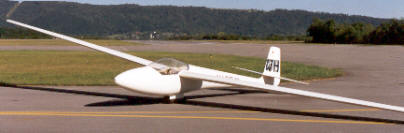
Bill Holbrook’s Libelle sailplane on the taxiway at Cumberland.
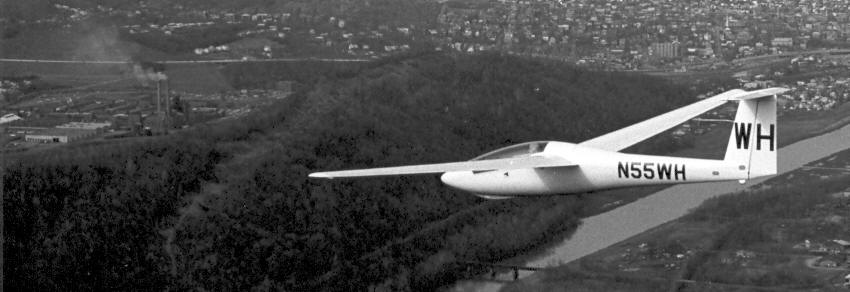
Bill Holbrook, in his Schweizer 1-35 glider, as he flew over south Cumberland towards the Kelly Springfield plant on the left.
In the early periods of the K-S operations, occasionally the Lockheed Lodestar would be out of commission but transportation requirements would still be needed. George Newman served as President of the firm during that time and did not hesitate to have Bill Holbrook use his own Piper Super Cub as a means of returning him to Cumberland from National Airport in Washington. Holbrook was well known to the air traffic controllers who accommodated him even though hindered by the Cub’s crude communication radio. It was an unusual but pleasant sight to observe a smiling Mr. Newman climb out of Bill Holbrook’s Piper Cub dressed in an expensive three piece suit, white shirt and tie, and with black and white shoes. Newman was enthralled with small aircraft flying and greatly enjoyed glider flights with Holbrook in the Cumberland Soaring Group’s aircraft. With this cordial relationship, Kelly Springfield, under President Newman’s guidance, provided appropriate trophies for the Mid-Atlantic Soaring Meets hosted by the local Soaring Group.
Bill Holbrook is now living in Tucson, Arizona and makes occasional visits back to Cumberland. He retains his live long keen interest in aviation.
* * * * *
 Wings Over Cumberland