Location of Races: Cumberland Municipal Airport, Wiley Ford, West Virginia.
Description: The track was 1.6 miles long, had 7 curved courses edged with 40 tons of hay, 75 water filled drums and approximately 7,000 feet of fence, which all served as protective barriers between the spectator area and the track.
Sponsorship: For nineteen consecutive years, the Cumberland Sports Car Races were staged by the Cumberland Lions Club for the benefit of the Cumberland Lions Foundation. The events were sanctioned by the Sports Car Club of America in conjunction with the Steel City Region/Sports Car Club of America of Pittsburgh, PA.
The Sports Car Club of America emblem as it appears on the wall of the Cohongaronta Gallery in the airport terminal.
Proceeds Distribution from this Charitable Event by the Cumberland Lions Club:
ø Children’s Sight Conservation – Provided free eye examinations and eye glasses for the underprivileged and needy children of Allegany County.
ø Lions Manor Nursing Home – Major contributor to the funding required for building of the Lions Manor Nursing Home on Haystack Mountain.
ø Wilmer Eye Clinic / Johns Hopkins, Baltimore – The Lions Club was the largest contributor to this clinic.
ø Salvation Army, Boy Scouts of America, and YMCA – Major funding support for these community organizations.
Sports Car Races were first held at the Cumberland Municipal Airport in 1953 after many months of meetings and planning by the Cumberland Lions Club and the Pittsburgh Steel Cities Region – Sports Car Club of America. Original founders and organizers consisted of Dr. Benedict Skitarelic, Edgar Vandegrift, William Carscaden, and Dr. M. R. J. Wyllie of Pittsburgh SCCA. The initial 1953 event started as Steel Cities/Pittsburgh Regional Races with 80 entries and a rather sparse group of spectators. The following year, 1954, saw the entry list grow to 122 cars and an estimated crowd of 12,000.
Based on the previous two years of success, the 1955 Cumberland races were upgraded to a full-fledged National event, meaning that only race drivers with a nationally sanctioned competition license could participate in the main car classes. With a total of 1,100 nationally licensed drivers in the country, 284 cars (approximately one-fourth), entered the 1955 Cumberland event. It represented the largest car race conducted in the US and included many prominent racing figures such as the Briggs Cunningham team of Maseratti race cars. Also, the American manufactured Corvette was making its presence known.
The 1956 National entry list soared to 350 and included West Coast race drivers John Edgar and the famed Jack McAfee driving a Ferrari. Walt Hansgen, a newcomer from New Jersey, who was soon to blossom into an international race driver, won the main event at an average speed of 68 MPH in his home-made ‘Hansgen Special.’ Famed band leaders Paul Whiteman and Skitch Henderson, along with television personalities Steve Allen and Dave Garroway, participated in the 1956 event.
The 1957 race entries included the famous Carroll Shelby who won the main event in a Maseratti. It was also a successful venture by General Motors with their efforts to develop the Corvette into a world class race car. Dr. Dick Thompson led the first of three top finishing Corvettes in the large cube Production car class. Briggs Cunningham was again represented with a race team consisting of a car of his own design, a Cunningham C61R, and D Jaguars driven by Walt Hansgen and John Fitch.
A crowd estimated at 45,000 plus set a new spectator record in 1958. Entries were again highlighted by the Briggs Cunningham race team of Lister Jaguars and D Jaguars with Walt Hansgen the winner in a Lister Jaguar. Participants included Roger Penske in a Corvette and Denise McCluggage whose Porsche won the Ladies Race.
Entrants for the 1959 and 1960 races continued to be dominated by the prominent race teams of Briggs Cunningham’s Lister Jaguars (driven by B. Cunningham, W. Hansgen and E. Crawford), Roger Penske in Porsche 550RS, and Bruce Jennings in production Porsches.
Entries in 1961 saw Roger Penske in the new ‘Birdcage’ Maseratti set a new record but he encountered mechanical problems allowing Bob Holbert to win in a Porsche RS61. Group 44 and driver/team manager, Bob Tulius, made their first appearance. Don Yenko of Corvette fame won the big bore Production Race and Donna Mae Mims won the Ladies Race, also in a Corvette.
Roger Penske entered the 1962 races already leading the country in National points with two wins. Driving the Telar Special, powered by 2.5 liter English Climax engine, Penske set a new lap record of one minute, fourteen seconds. Hap Sharp of Midland, Texas, in a Cooper Climax finished second.
In a new race car, Zerex Special (Ferrari-based), Roger Penske returned in 1963 to win the Vandegrift Cup in record time and best lap of 1:12. The Production car class was dominated by the new Ford Cobra, with the winning car being driven by Bob Johnson of Ohio. Dominance by the Ford Cobras, with an increase in engine displacement, continued in 1964 with race drivers Bob Johnson and Hal Keck winning handily over the Corvette teams.
The introduction of the newly developed GT Mustang happened in 1965. This high performance ‘muscle car’ driven by Bob Johnson won the Production car event over the Corvettes.
In 1966, Bob Bucher of New York won the feature race in a newly developed Lola, setting a new lap record of 1:11.8. Featured in the Production car class was the new big bore 427 Cobra driven to victory by Ed Lowther setting a new lap record of 1:13 for Production cars. The Walt Hansgen Memorial Trophy was established at this event in memory of Walt Hansgen, a five-time winner and popular driver at Cumberland, who was killed at Le Mans, France earlier in 1966.
Hal Keck, in a 427 Cobra, won the 1967 Hansgen Memorial race with George Alderman winning the feature Vandegrift Race in a Chevy powered McClaren. Bruce Jennings continued his dominance in the Porsche Class. The Sedan Production car class created much interest with the introduction of the new Z28 Camaro contingent led by the notorious and popular Chevrolet driver, Don Yenko. Don lost the lead to John Moore who won over the Mustangs in another Camaro.
A turbine powered race car made the big news in the 1968 Cumberland Races driven by Ray Heppenstall. The Howmet TX Turbo car displayed a handling advantage with its 4-wheel-drive configuration, but the acceleration and torque of Bob Nagel’s McKee Ford 427 beat the turbine car to the finish line. In the process, Nagel set a new lap record of 1:07.6. The Hansgen Memorial Production car class was again won by Hal Keck in a 427 Cobra.
Bob Nagel’s winning streak in the McKee Ford continued in 1969 by winning the Vandegrift Trophy at a new record average speed of 85.5 MPH. A sensational new lap record of 1:04.2 was established in the process. Nagel’s dominance continued in 1970 until being passed on the very last lap by Jerry Crawford, the eventual winner in a McClaren.
On May 17, 1971, as the curtain fell on Cumberland Sports Car Racing, over 200 drivers entered and Oscar Kovaleski won the featured Vandegrift Memorial before an estimated crowd of 17,000. His ex-Trans AM car, powered by a 427 Chevy engine, came within 0.4 of a second of setting a new lap record. The Scranton, PA defending national champion of the highly modified Class A Sports Cars drove his Auto World McLaren to an easy victory.
With the completion of the 1971 race program, the Cumberland Sports Car Races were to be no more. For a nineteen year period, at the Cumberland Municipal Airport, racing was King. The race events helped to bridge the gap between the end of racing on military and civilian airports and the opening of the modern private racing complexes tailored to the dual needs of the spectator and the various racing divisions. It spelled the end of an era where the Cumberland Lions, in conjunction with the Steel Cities Region of the Sports Car Club of America, joined forces to enjoy a weekend of racing, while successfully raising money for the Lions distribution and support for the various charitable community funds and organizations. The whine of big revving race cars, the squealing of tires, the din of applauding fans – all will be forever silenced.
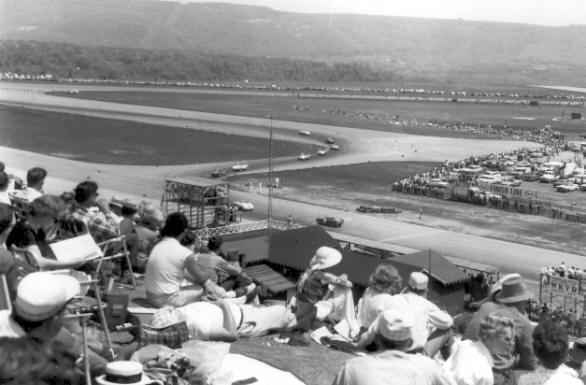
A view of the auto racing at the Cumberland Airport in the 1950’s which depicts the large crowds on the bank line as well as on the far side of the race track.

The racing crowd that lined the bank on the west side of the airfield.
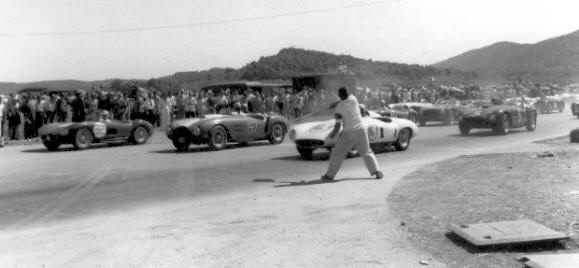
The flagging off of a race, with the starting point abeam the first administration building.
* * * * *
 Wings Over Cumberland