One of the most important events in the history of the Cumberland Airport occurred in the summer of 1951 when The Kelly-Springfield Tire Company established a flight department. Kelly-Springfield’s headquarters saw the need to fulfill their corporate requirements for their officials and salesmen. The Kelly-Springfield Tire Company had become a subsidiary of the Goodyear Tire and Rubber Company of Akron, Ohio. In 1936 President Edmund S. Burke sold the Kelly-Springfield Tire Company to the Goodyear Tire & Rubber Company. Strangely this transaction occurred late one night in a taxi cab in Baltimore. P. E. H. Leroy, the Chief Financial Officer of Goodyear, dug down into the recesses of his billfold to produce a folded one hundred dollar bill (a great amount of money in 1936) and gave it to Burke to seal the purchase of Kelly-Springfield by the larger Goodyear organization.
Frequent trips to Akron were necessary by Kelly officials and using rail transportation was too time consuming as well as tiring. As the Kelly operations grew and broadened its horizons it became evident that the company could benefit greatly from having their own aircraft for corporate travel. With the tire production plant located in Cumberland and the corporate headquarters in Akron, Ohio the establishment of a supporting flight operation was a natural progression of the expanding company. It remained as the most important local airport resident until termination in July of 2000.
Bill Holbrook, a Goodyear Flight Department pilot since 1945, was transferred to Cumberland in July 1951. His assignment was to establish the flight operations using the oldest aircraft in the Goodyear fleet, a five passenger, twin-engine model D-18 Beechcraft. Walter Burd was hired as a combination co-pilot and mechanic. Betty Mullenax (Williams) said she and her husband, Warren, were surprised one morning as a Twin Beech landed and taxied to the airport terminal. The pilot deplaned, and extended his hand and said, “Hi, I am Bill Holbrook, pilot for the new Kelly-Springfield Flight Operations here at your airport.” That same afternoon Kelly President Edmund S. Burke was flown to Philadelphia, PA and returned in the evening. No hangar existed at the Cumberland Airport and the Beechcraft was tied down in the open area. Fuel was obtained from the fuel farm next to the original terminal building. Shortly, a concrete block hangar was built to house the Beechcraft but blew down the following February, with fortunately but little damage to the aircraft.

On the left is Bill Holbrook and Walt Burd with the Twin Beech shortly after arrival at Cumberland and, on the right, a view of the Lockheed Lodestar.
On November 24, 1952 Kelly-Springfield traded the Beech for the fastest transport of WW II, a refurbished former Army Air Corps C-60 Lockheed Lodestar. This Lodestar had seen service as a patrol aircraft in WW II in the South Pacific. New Zealand National Airways operated this same aircraft after the war as a nine passenger airliner. Lodestars were popular executive aircraft and this one was converted to corporate service by Ohio Aviation, Vandalia, Ohio before being acquired by Kelly. This Lodestar was a model 18 with two Wright 1820 nine cylinder 1200 hp engines. With its corporate luxury seating arrangement of nine passengers, two pilots and fuel, the craft gross weight was 17,000 pounds and it had a cruise speed of 190 mph. It was a state of the art corporate aircraft in the 1950’s and 1960’s.
The aircraft was identified as N55KS, the Lodestar license number reflecting Kelly-Springfield and as such was one of the first airplanes in the nation to have a registration number (or aircraft tail number) relating to its ownership. The use of the call sign necessitated an air traffic radio voice phonetic pronunciation of ‘55 King Sugar’ (the letter N, designating United States registered aircraft is normally not used), to identify the Lodestar. This phonetic name became well known over the air traffic control aviation radio air waves. Randy Hostetler, a Kelly pilot, said that the Federal Aviation Administration later changed the phonetic alphabet to Kilo for K and Sierra for S. However, all the Kelly pilots continued to identify the aircraft as 55 King Sugar, and were often corrected to Kilo Sierra. Once when on a long flight from Texas to Cumberland, Hostetler identified the Kelly Lodestar as ‘55 King Sugar’ and was corrected by the controller. Hostetler immediately announced, “This is Lodestar 55 Kilo Sierra, or 55 King Sugar, or 55 Kemo Sauve, take your pick!” Hostetler said that in an unusual act of levity by the air traffic controllers, for the rest of the long flight the Kelly Lodestar was referred to as ‘55 Kemo Sauve’. The N55KS license number was retained for use on aircraft later acquired and when the Flight Operations acquired a second airplane it was licensed as N44KS. Bill Holbrook said it gave the crew a good feeling when the air traffic control said, “Is that you King Sugar?” The rapport established was much like a warm handshake.
Earl Wilson, Sr. was hired as chief mechanic and Randy Hostetler was moved to a joint role as mechanic/co-pilot with the departure of Walter Burd. At the time no published instrument flight approach procedure existed for Cumberland for use in bad weather as there were no existing radio fixes or aids to assist in making low visibility recoveries. Bill Holbrook overcame this obstacle by developing his own by using the commercial radio station, WTBO, as a radio fix for bad weather orientation to Cumberland. In the middle 1950’s WTBO abandoned their transmission tower in Cumberland’s Constitution Park. Holbrook convinced the Mayor and City Council, as the then owners of the airport and the park, to assume control over this tower and to install a non-directional beacon that acted as a radio homer. By using an automatic direction finder mounted in their aircraft, pilots now had a positive fixed location when landing at the Cumberland Airport in inclement weather.
The first ADF instrument procedure designed by Holbrook using only WTBO had, of necessity, an altitude descent limit well above the surrounding Irons and Knobley Mountain tops. Bill insisted on having the Kelly aircraft installed with two ADF radios which then could home in on both WTBO and WDYK, two closely aligned stations. With the two homing needles aligned on the two different stations a more positive indication of position was now possible. This unique ‘home made’ instrument procedure designed by Holbrook allowed for a lower altitude for the approach and was a much safer method of accomplishing landings during bad weather. At the time the ADF homing beacons were the only method available and the ADF needle was prone to fluctuate wildly in severe weather. Holbrook continued to work to improve the instrument landing facilities at the Cumberland Airport.
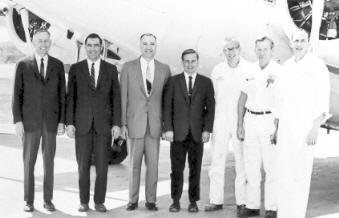
Pictured are left to right: Bill Holbrook, Tom Geary, Randy Hostetler, Jim Abe, Gerry Shaffer, Earl Wilson, Sr., and John Crump standing in front of a Lodestar.
The 14 seat Lodestar was ‘The Kelly Plane’ that flew K-S executives all around the United States until 1965 when a second airplane was acquired to help offset the increased demands. There was the need to travel to the new Kelly plants located in Fayetteville, NC, Tyler, TX and Freeport, IL. The second airplane was an Aero Commander 520, which was leased until 1967, when it was replaced by a second Lodestar designated as N44KS. In late 1970, the beloved Lodestars, which had served the company so well for almost 20 years, were retired and Kelly entered the jet age. A new ‘55 King Sugar’, a Learjet 24, became the pride of the fleet, and was joined by a Beechcraft King Air 200 prop-jet aircraft, identified as ‘44 King Sugar’, used for regularly scheduled shuttle flights to Pittsburgh, Baltimore and Akron and many other destinations.

The Lear 24 with Bill Holbrook, Jim Abe, and Earl Wilson, Sr.

The Mitsubishi MU-2.
Along the way the small early Learjet was replaced by two Japanese Mitsubishi MU-2 turbo-prop planes that were frankly ugly, difficult to maintain, and possessed less than desirable performance. It was replaced by a larger capacity Sabreliner, then a Learjet 55, then a Lear 60, all with the designation ‘55 King Sugar’. A larger and much more efficient Saab 340 prop-jet aircraft replaced the Beechcraft King Air, as ‘44 King Sugar’. The Learjet and the Saab aircraft were state of the art and represented the top of the line of corporate aircraft.
Learjets, especially the 60 model, were high performance corporate aircraft with performance that boggled the minds of local airport buffs. Captain Larry Albin related an occasion when the Lear was light with fuel and no passengers on board he made a departure from runway 23. After clearing the departure end of the runway he began a 180 degree turn, which took slightly more than one minute after which the Lear was at an altitude of 10,000 feet. Captain Earl Wilson stated the model 60 Lear would climb so rapidly that often times air traffic control would have a difficult time keeping track of the aircraft and that he has observed a rate of climb of over 14,000 feet per minute. Captain Tim Long said that the Learjet 60 could fly higher than most commercial aircraft. Air traffic control once cleared his flight direct from San Francisco, CA to the Grantsville Omni station, the last fix prior to landing at Cumberland. This flight clearance was happily given by air traffic control when Tim had filed for an altitude of 40,000 feet for the more than 2,000 nautical mile journey.

The Lear 60 in front of the K-S Flight Operations building.

The SAAB Fairchild 340 awaiting a passenger load.
Significantly, only two chief pilots have guided the Kelly-Springfield Flight Operations. When he retired in 1981 Bill Holbrook had accumulated 24,300 hours flying time, of which 4,500 was in gliders, a sport in which he excelled. Captain David Bingham then took over as manager of the flight department. Kelly Flight Operations exuded quality in their operations and instilled lasting confidence to their passengers. The Kelly aircraft transported numerous non-company passengers as acts of kindness or on mercy missions, including many dignitaries on important missions. After over 49 years of activity by the Kelly-Springfield Flight Operations no passenger or pilot was ever injured. This is extraordinary considering the conditions of the 1950’s and 1960’s when the Flight Operations utilized only primitive type equipment.
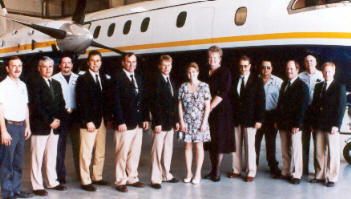
Shown are K-S Flight Operations personnel in front of the SAAB 340. From left to right: Joe Denne, Earl Wilson, Jr., Paul Weinfurtner, Larry Albin, Len Williams, Dave Bingham, Kim Whetzel, Wilma McInturff, Tim Long, Lind Moore, Dan Hastings, John Crump, and Mark Wolfe.
By their very presence at the Cumberland Municipal Airport, the Kelly Flight Operations prodded the Mayor and City Council of Cumberland into maintaining the airport. Without their use of the airfield and their impact with the City of Cumberland, the local airport might well have slowly deteriorated and not have become the modern airport it has become.
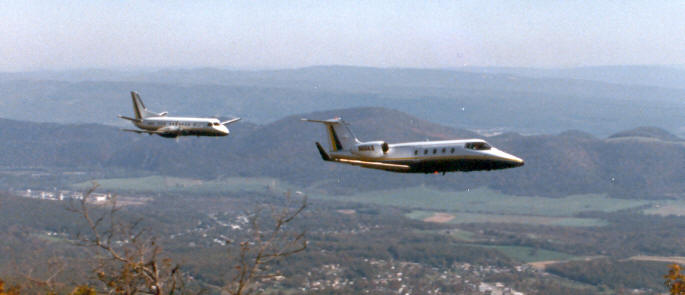
Kelly Springfield’s Flight Operations KS44 (SAAB 340), and KS55 (Lear Jet 60) photographed passing over Dan’s Rock at the top of Dan’s Mountain. Photograph by Jack Thrasher.
* * * * *
 Wings Over Cumberland