In 1950 a contract with the city of Cumberland granted Warren Mullenax the right to act as the fixed base operator at the Cumberland Municipal Airport. Operating as the Queen City Air Service, Mullenax served the airport as manager, with his wife Betty serving as office manager. This aviation service organization continued until 1960. The Cumberland Pilots Association and Queen City Air Service jointly sponsored two air shows during this time. These air shows were staged by America’s recognized number one aviation events announcer, Bill Sweet. Featured were a Navy Jet Flight Exhibition, parachute jumps, Woody Edmonson in a Clip Wing Monocoupe, Beverly ‘Bevo’ Howard flying his Bucker Jungmeister, George Young in a Pitts Special, and Melvin Robinson flying his Midget Racer. Through the urging of Leroy Winterstine, a Ridgeley, WV, resident, the West Virginia Air Guard attended with fifteen North American P-51 Mustang fighters, one of which was flown by Winterstine as a member of the guard unit.
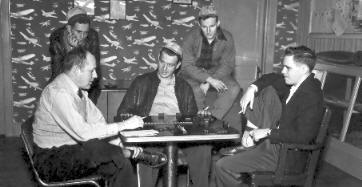
A group discussing an air field problem. Pictured in front, left to right are: Paul May – Ticket agent for All American Airways, Warren Mullenax – Airport Manager, and Dr. Bill Williams. In the back are: Ed Koch and Stanley Leasure.
Two members of the Mid-Atlantic Soaring Association Aero Club towed a WW II US Navy surplus Pratt-Reed training glider from Winchester, VA to Cumberland. The glider released from the tow plane over the airport and then circled for several minutes before landing on runway 24 in front of the air show crowd. The Pratt-Reed was the first glider to appear at Cumberland since the Primary Glider owned by Delagrange, Williams, and Duvall was flown at Mexico Farms Airport in 1934. When preparing to depart, the large Pratt-Reed glider was positioned on runway 24 in front of the terminal building but headed west towards Wiley Ford. The 165 hp Warner powered Meyers OTW open cockpit bi-plane used for glider aero tow was stationed in front of the glider, with a 200 foot tow rope connecting the two aircraft. When a bystander mentioned to the glider pilot that not much runway length was available for take off from that position, the remark was brushed off, and the duo started their take off roll. The two aircraft managed to become barely airborne and staggered at minimum air speed beyond the end of the runway. Barely maintaining a climbing attitude both aircraft managed to narrowly avoid the rooftops of the houses in the town of Wiley Ford. A few moments later they were successful in establishing a very gentle left turn but still struggling mightily to gain altitude while flying towards the lower terrain of the Mexico Farms area. After a few stressful minutes they safely over flew the lower ground and were able to establish a normal climb and proceeded to their home base at Winchester.

This photo, taken in 1995, is of a Pratt-Reed glider similar to that described above.
Warren Mullenax bought and sold many airplanes during his ten years as airport manager, several of which were most interesting. Among these were a WW II surplus Vultee Valiant BT-13 basic trainer powered by a 450 hp Pratt and Whitney engine, a Canadian Fleet primary trainer, various Stearman PT-17 Cadets and Fairchild PT-19 Cornell primary trainers, several pre-war Waco’s, a 1930s vintage Monocoupe 110 Special, a Great Lakes Trainer, a Cessna Bobcat AT-17 twin engine trainer, and many others. Perhaps the most intriguing airplane was a 1929-30’s vintage model Waco Taperwing. The Taperwing was a popular aerobatic airplane of its day and was owned previously by airline pilot Rod Jocelyn in the 1950’s. Flying the Waco, Jocelyn had won the National Aerobatic Championship and performed a popular act on the air show circuit with the crowd pleasing Taperwing and its roaring Wright engine and whining constant speed propeller. Captain Rod Jocelyn’s airline employer felt that poor public relations resulted from the image of Rod’s activities as a dare devil aerobatic pilot and air show performer. Because of this edict Rod’s air show act ceased and the Waco was in storage for several years.
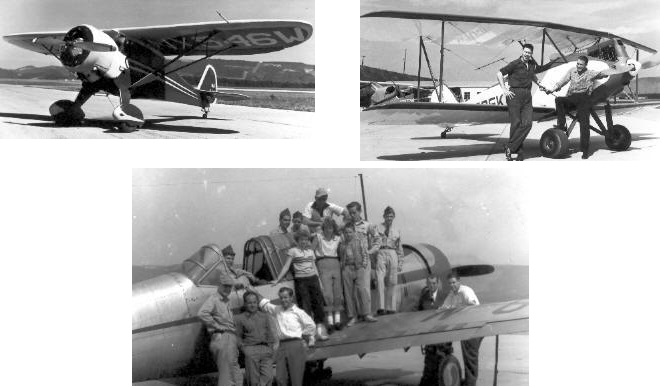
On the top left is the Monocoupe 110 Special, and on the right the Great Lakes Trainer with Warren Mullenax standing by the prop. Below is the BT-13 Vultee Valiant with Mullenax standing at the top, surrounded by a group of CAP Cadets. Standing on the pavement are: Randy Hosteller, Walt Burd, first and second from the left and on the far right, Jim Rutledge.
Mullenax had learned of the inactivity of this famous aircraft and contacted Jocelyn, convincing him to sell it. On the purchase date Warren and friend Ed Koch traveled to New Jersey and after much maintenance preparation readied the aircraft for flight. Jocelyn took the Waco up for one last aerobatic flight and then turned the aircraft over to Koch, who was given the duty of flying the craft to Cumberland. Apparently Warren and Ed were unable to drain the gasoline tanks completely free of water and as a result Ed had an engine stoppage which resulted in a successful forced landing. After correcting the problem Koch pressed on and arrived at the Cumberland Airport late in the afternoon. After refueling Mullenax flew the Taperwing and was very pleased and vocal in his praise and good fortune in obtaining such a fine and famous airplane. About this moment good friend Bill O’Neill arrived and was admiring the plane when Warren asked Bill if he would like to take the Taperwing around the field. O’Neill quickly accepted, fastened his seat belts in the open cockpit, started the Wright Whirlwind engine, and quickly taxied out and successfully took off in the dwindling light of day.
During this era the grass areas parallel to the paved runways were often used during strong cross winds and during student training for take-offs and landings. A grass surface makes for easier landings and causes less tire wear than hard surfaced runways. Bill O’Neill knew the Taperwing had been landed in the large grass area on the north side of runway 24 and since most old time airplanes ground looped easily he decided on that area for landing. Unfortunately, the airport maintenance employee had just recently dumped a truck load of dirt in the middle of this grassy section. Not knowing this fact and in the lowering light of dusk Bill did not observe the protruding dirt and struck it on his landing, flipping the famous Waco over on its back. The aircraft did not catch fire and O’Neill was unhurt. The Taperwing was dismantled and every one was distraught to the point that Mullenax and O’Neill let the wrecked aircraft be acquired by Bob Lyjak, a professor at the University of Michigan.

Top left is the Waco Taperwing after arriving at Cumberland, and on the right after the crash. On the bottom is the Waco after it was sold, and while performing by Bob Lyjak at an air show.
Lyjak restored the noteworthy Waco Taperwing to its former majestic state, painting it a flamboyant red and white design with a Polish emblem on the top wing and vertical fin. Bob Lyjak was extremely proud of his Polish heritage and was a friend of Richard ‘Dick’ Roberts, his mechanic on the Taperwing. Roberts was a pilot and for a period served as a mechanic at the Cumberland Airport and also was a part owner of Nicholson Air Services at the local airport. After the rebuilding of the Waco, Lyjak performed his aerobatic show for several years at the Experimental Aircraft Association Convention Fly-In at Oshkosh, Wisconsin. At the beginning of his performance Lyjak would perform a unique and daring triple snap roll almost immediately after take off in the Waco Taperwing.
Warren Mullenax’s wife, Betty, related that an Air Force F-86 Sabre jet fighter gave them a thrill one afternoon. She assumed the jet pilot was performing a low level a buzz-job on runway 6. But in reality the Sabre jet had experienced a flame out and the pilot was forced to make an engine out emergency landing in the F-86. The Air Force pilot made a great dead stick landing at his unplanned stop and was able stop at the end of runway 6 without damage except for blowing two tires.
On another occasion the Mullenax’s became aware of a strange incident. A local pilot was hand propping a Fairchild PT-23, without benefit of chocks in front of the wheels or having another safety pilot in the cockpit. The throttle was advanced further than he thought (or was prudent) and when the engine started with a roar the pilot was able to jump clear of the prop. The PT-23 proceeded to fly off with no one abroad. Fortunately, the unoccupied aircraft did not fly far and crashed into the trees bordering the airport.
* * * * *
 Wings Over Cumberland