August ‘Gus’ Graf was a test pilot, pioneer parachutist, and one of the original mail aviators. He later became the executive pilot for the West Virginia Pulp and Paper Company, a position he held for more than 20 years prior to his retirement in 1968. In 1918 Gus built his own airplane but it would not fly very far. However, that experience created an insatiable hunger in the young man for flying. In addition to his flying activities Gus took to riding in hot air balloons, going up several thousand feet and then cutting him loose and floating to earth in a homemade parachute. He then graduated to stunt flying and parachuting exhibitions. At a 1925 Air Meet near Bristol, Connecticut Gus made one of the first recorded free fall parachute jumps from 2,200 feet and delayed chute opening until at a very low altitude.
Graf knew and associated with the flying greats of his day. Bert Acosta, famed pilot who won the 1921 Pulitzer Race and who flew the Atlantic with Commander Richard E. Byrd, was his pal and flying instructor. Igor Sikorsky, Orville Wright and Anthony Fokker – all outstanding aeronautical designers and inventors offered advice and encouragement to the daring young eagle. When the first all metal low winged plane was developed, which was the forerunner of our modern aircraft, Gus was called upon to make the initial test flight. When the newly established Pan American Airlines looked to the Caribbean as a prospective route, Gus and a few others island hopped to lead the way. Before and during WW II Graf trained military flying instructors so that they could pass their skills to fighter pilot trainees. He also test flew most of the training craft used during that period – over 1,300 separate flights over a three year period.
Following WW II Gus accepted the position of executive pilot for Westvaco. Graf was well known by numerous Luke Mill associates and also in local aviation circles. He made frequent stops at the Cumberland Airport while flying Westvaco’s corporate aircraft, a Grumman G-44 ‘Widgeon’. This aircraft was a twin-engine amphibian flying boat which was a most unusual type for use in corporate aviation. It is believed that this Widgeon was used in WW II. It was originally powered with two six cylinder 200 hp Ranger engines with fixed pitch wooden propellers. More powerful Lycoming engines of 295 hp with full feathering metal propellers gave the flying boat much improved performance, especially during single-engine operations. The Widgeon was a six-place aircraft painted black and yellow reflecting the colors of the parent Westvaco Corporation.
David E. Long, a pilot and a Luke Mill engineer, related that at the time of Westvaco’s Stoney River Dam, located on the Allegheny Front Mountain Range, Gus Graf would use the flying boat to transport executives there, alighting on the water of the dam. Long related that the Stoney River Dam caretaker, Fred Becker, lived on the site. The highlight of the inspection trip for the executives was to partake of a noon meal scrumptiously prepared by Fred Becker’s mother. The Widgeon was used on trips to Canada using one of the numerous lakes in that region. Dave Long remembers Graf as an excellent pilot and on one occasion with only Dave along as a passenger was pleased to have Graf let him pilot the aircraft from Baltimore to Cumberland. Long also was privileged to observe water take-off and landings in the Widgeon.
Gus Graf was highly respected by the Westvaco Corporation and by members of the founding Luke family, some of whom he taught to fly. At his retirement, as a reward for the many years of dedicated service and for the excellent manner he cared for the flying machine, the Westvaco Corporation presented the Widgeon to Graf to become his personal aircraft.
(The above information was taken in part from the News Letter, West Virginia Pulp and Paper Fine Papers Division, Luke, Maryland, March 1968).

This is the cover sheet from the newsletter depicting Gus Graff on his retirement from Westvaco.
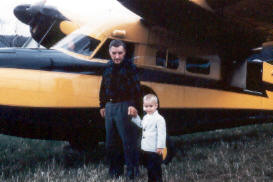
Pictured is a 1959 photo is Graff with Tim Long at age four in front of the Grumman Widgeon.
* * * * *
 Wings Over Cumberland