Soaring is a unique form of sport flying using an aircraft without any power plant for forward thrust. Some later soaring or gliding aircraft are equipped with a small engine that is retractable after the craft gains sufficient altitude to participate in pure soaring activity. However, almost all gliders or soaring craft rely on a tow aircraft to gain a desirable altitude prior to release from the tow. The sailplane, with no power of its own, must produce lift simply by forward movement. By searching, finding, and flying in rising air currents that ascend faster than the sailplane is descending, a sailplane pilot may be able to gain altitude and stay airborne to extended periods of time. In the right conditions a pilot may stay in the rising air currents and gain thousands of feet. Often times such actions requires strict mental concentration and correct piloting technique in order to achieve altitude gain.
The Knobley Mountain Range, located just three miles west of the Cumberland Airport, is an excellent source of ridge or mountain lift. With the prevailing western winds blowing against the mountain side, air currents rise up over that area producing rising air. By flying along the upwind side and parallel to the ridge line soaring pilots can take advantage of the vertical wind component to gain altitude and, if desired, can cover extensive distances without losing altitude. Bill Holbrook’s world record setting soaring flight used this ridge lift from the Knobley Mountain Range for part of his flight.
Thermals are rising columns of air in which a sailplane may climb if the pilot can remain in the thermal column or rising lift by constant circling the aircraft. Thermal lift is the most prevalent type of rising air used by sailplanes.
Gren Siebels’ book “Pilots Choice” describes another form of rising air called wave lift or mountain lee waves. These are like the stationary ripples we see downstream from a large rock in a fast moving brook. The up and down displacement of the flowing water appear stationary, while the water itself flows right through the standing waves. There can be several diminishing cycles of up and down before the ripples finally disappear. Under favorable conditions, the air being more compressible than water – when flowing over a mountain – behaves in the same manner downwind of the mountain, only more so than the water action.
Mountain or lee waves are common in the Cumberland area and are often distinguished by lens shaped or lenticular clouds that form at the top of the wave. They often occur in their strongest form when winds aloft are high and surface winds are from the northwest. The aero-towing of sailplanes in the Cumberland wave, especially when the wind is strong out of the northwest, can be an exciting experience for both the tow pilot and the sailplane pilot. It is often necessary to penetrate the ‘rotor’ which is an area of violent swirling air that can be extremely turbulent. The rotor is usually located downwind on the east or lee side of Knobley Mountain and must be contended with in order to climb over the mountain and enter the smooth ‘glassy’ realm of the wave by the towed sailplane. Flights into the Cumberland wave have resulted in pilots attaining altitude in the range of 20,000 feet. Altitude this high is not now permitted due to the limitations of air traffic control at the higher altitude.
Bill Holbrook and Bob Poling in earlier days had heard other pilots, such as Joe Brown, talk of ridge soaring in small aircraft with the throttle at idle soaring from Keyser to the Cumberland Airport following the Knobley Ridge line. After confirming this soaring flight possibility in Holbrook’s Piper J-3 Cub, the pair decided to attend the Schweizer Soaring School at Elmira, NY in 1958. Under the tutelage of young Brad Strauss and the famous glider instructor Bernie Carris, Holbrook and Poling returned to Cumberland with the attainment of their Commercial Glider Pilot Ratings. In the autumn of 1958 the eager pair acquired a two place war surplus XTG-4A Laister-Kauffman training glider. The aircraft, tail number N2040, had been used to train glider pilots during WW II. They did not realize that this particular sailplane was the prototype XTG-4A, and was a descendant of the famous pre-war ‘Yankee Doodle’ glider built and flown in 1937-38 at Lawrence Institute of Technology at Highland Park, Michigan by Jack Laister and a team of students. A previous owner had modified the L-K into a flattop with a bubble canopy by removing all structure on the fuselage down to the longerons and constructing a new fuselage top with a nose of fiber glass. In this configuration during the post-war era the flat top L-K was a fair performing sailplane.
After a winter of tender loving care the L-K was launched in 1959 by auto towing with Bob Poling’s station wagon automobile. This was accomplished by speeding down the 5,800 foot runway 6-24 at the Cumberland Municipal Airport. The transmission of Poling’s automobile protested and the launches were less than successful to tow the L-K high enough to obtain lift for a soaring flight. The duo then decided to try an aero tow using Bill Holbrook’s 65 hp Piper J-3 Cub. To their surprise the Cub was able to successfully tow the L-K to two thousand feet and at last high enough to enable soaring in their beloved aircraft. Holbrook and Poling were able to successfully fly several altitude and distant flights in the L-K using the Cub as a tow plane.

The modified Laister-Kauffman glider on the runway at Cumberland.

Kneeling in front of the L-K is Jim Abe. The others from left to right are: Jack Wagner, Franklin ‘Bud’ Young, Randy Hostetler, Bob Poling, Bill Holbrook, Dick Aldstat, Earl Wilson, Sr., and Dick Roberts.
On a couple of occasions the Cub was used with two pilots abroad, proving that even with that additional weight in the J-3 successful tow launches could be made. This was considered an amazing accomplishment with the Piper aircraft powered only by a 65 hp engine.
In 1960 Bill Holbrook purchased a Piper Super Cub which made glider aero towing much safer and more versatile.
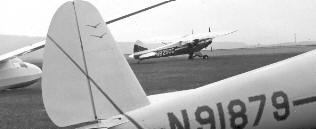
The Super Cub in the background with two gliders in the foreground.
Now Poling and Holbrook really experienced the soaring fever. They introduced several other local pilots to the fascination of motorless flight with the L-K, one of which was Dick Aldstat. Dick had flown North American F-86 Sabre Jet fighters in the Korean War. Jack Wagner and Franklin ‘Bud’ Young subsequently gathered ten pilots together who were willing to contribute $200 each toward the purchase of a used two place Schweizer 2-22 training glider for $2,000. Included in this group were Wagner, Young, Holbrook, Poling, Aldstadt, George Nash, Ralph Frantz, Dr. Royce Hodges and W. Donald Smith. The eager gliding pilots designated themselves the ‘Algonquin Soarers’.

In the back seat is George Newman, President of the K-S Co. with Bill Holbrook in the Schweizer 2-22.
Soaring flight in the Cumberland area was at a primitive stage in the early 1960’s, but the potential for good soaring conditions attracted enthusiasts from Pittsburgh and the Washington area. The glider group grew by luring soaring pilots seeking a remote area to practice their craft. The club grew to nearly forty members, with a few having their own gliding aircraft. In 1965 the official name of the club was changed to ‘The Cumberland Soaring Group’. The club had become very active with frequent week-end meets and cross country soaring contests. Many national and world champion glider pilots traveled to Cumberland to enjoy the excellent soaring conditions. The Knobley ridge west of the airport was utilized by sailplanes pilots to set countless local, state, national, and world records. Today the Cumberland Soaring Group, Inc. is continuing its rich heritage as caretaker of one of the premier soaring sites in the country. Its membership has grown to include 55 families, and it operate five sailplanes as well the serving tow aircraft, which is kept busy launching flight after flight. The CSG has managed to keep the cost of soaring to a low level. Nearly any weekend a flurry of activity can be observed around the glider hangar. A large Quonset building, located on the southwest corner of the Cumberland Airport, serves as the club’s hangar and point of operation. The club welcomes visitors at any time and orientation flights may be arranged.

This photo was taken in front of the CSG Quonset in the early 1960’s. From the left are: Gene Moore, George Nash, Jack McGonigle, Bill Holbrook, and Bob Poling.
The facilities at the Cumberland Airport are excellent as a home base for soaring activities. The Quonset hangar with electric bi-fold doors on each end became available to the club during an interim period when the airport base operator changed. The large hangar, which can house a multitude of gliders, has remained leased to the Cumberland Soaring Group for a period of 40 years. The hangar is located close to the launching area and little effort is required to push a glider to the end of runway 11. A large paved area adjacent to the secondary runway 11 is available for parking of waiting sailplanes. This convenient situation is not found at other soaring sites. The launching runway is sufficiently long for glider launches regardless of wind conditions. Fortunately the departure end of runway 11 is some 150 higher than the adjacent farm fields and the nearby Mexico Farms Airfield which affords emergency landing sites.
The Knobley Mountain ridge, just to the west of the airport, is an excellent source of ridge lift and is located away from the normal traffic flow which minimizes aerial traffic conflicts. The use of runway 11-29 has been used by the soaring pilots and this use does not impact on the powered aircraft use of the main runway 5-23. The landings of the sailplanes are on runway 29 and pilots plan their approach so that they can roll back to their launching area and quickly are in position to be launched on succeeding flights.

A group of gliders lined up for launch by the Super Cub down runway 06 at Cumberland.
The grass areas, the taxiways, and the runways are maintained by airport personnel and are in excellent condition. With the large hangar facility, the convenient location and the friendly atmosphere, pilots at the local airport enjoy the best soaring site in the eastern United States.
One of the great soaring thrills is a cross-country flight using one location of rising air and climbing, then speeding on to find another area of rising air to replace any lost altitude and repeating this procedure for long distances. A sailplane can thus travel hundreds of miles. Cross-country soaring is exhilarating and extremely satisfying since the successful flight distance is due to the pilot’s resourcefulness in locating and using the rising air while traveling and keeping the motorless aircraft aloft. Sailplane pilots become very cognizant of weather changes and particularly those affecting lifting air currents. They must stay alert to the type of terrain over which they may fly in case the flight has to be terminated prior to reaching an airport. An off airport landing is occasionally necessary and usually occurs in a farmer’s field. Modern high performance sailplanes, with their forty to one glide ratios are safer since greater areas can be covered in search of lift and in reaching suitable terrain for safe landings. If a sailplane is 6,000 feet high it can travel more than 40 miles in a no wind condition.
Knowing when the mountain wave is present at Cumberland is difficult and usually required an exploratory flight to determine its presence. An enterprising local inventor and soaring pilot, A. Gene Moore, developed a device called a wave machine. A continuous running recorder of the wave machine gave Gene information as to what conditions were necessary and when they existed. Gene found that early mornings were a favorable time and also a period when lower surface winds were acceptable for the launching of sailplanes.
Week-ends became a favorite period for sailplane pilots who had heard of Moore’s wave machine. Often the tow plane, with a sail plane behind, took off while still in the early morning hours, sometimes while still in darkness. There were times in the early morning when six to eight sailplanes would be at perhaps 10,000 feet, and their forward movement would be practically equal to the speed of the wind of the wave in the opposite direction. With their low ground speed the sailplanes appeared as if they were standing still parked on a westerly heading. This was a beautiful sight as the rising sun appeared behind the aircraft, a scene that will remain within a pilot’s recollection of the beauty of flight. Marvin Holland, chief instructor of the CSG, recalled that in the 1990’s, he and a student pilot flew the medium performance Blanik sailplane to 17,000 feet. Holland also made two trips to Petersburg, WV and on one flight staying between 11,000 and 12,500 feet of altitude.
In the 1960’s it was permissible to engage in sailplane flight in instrument flight conditions (controlling the aircraft solely by reference to in-cockpit instrumentation) while flying in areas other than on designated air traffic controlled airways. When circling a sailplane in a thermal and climbing to an altitude where the rising column of air is cooled to condense the moisture, a cloud usually is formed. Normally the sailplane pilot abandons the climb at the bottom of the cloud and moves on, not wanting to enter the cloud. However, entering the cloud is attractive to the pilot because the rate of the rising column of air inside the cloud greatly increases. But he must be capable of flying his craft solely by reference to the cockpit instruments, or trouble could quickly develop. A gyroscopic instrument, known as a turn and bank, can be used as the minimum instrumentation in the sailplane without reference to a natural horizon. The turn and bank gyroscopic instrument gives the pilot an indication of the aircraft’s rate of turn. The pilot can therefore maintain a controllable degree of bank in the circling turns required to remain in the rising column of air while inside the cloud.
The turn and bank gyroscopic instrument can be powered by a venturi mechanism mounted on the external portion of the fuselage or it can be powered by flashlight batteries. The air speed indicator is used to maintain pitch control of the aircraft as the pilot attempts to maintain a constant air speed reading while in the turbulence of the thermal. This type of instrument flying is known as the ‘needle, ball, and air speed’ method and was the first primitive type of instrument flying devised for blind flying of aircraft in the 1920’s. Using this primitive instrument flying technique while thermal circling is extremely difficult as the pilot maintains control of the aircraft inside the cloud, with the turbulence caused by the vertical air currents. The developing cumulus cloud may mature into a thunderstorm and may be unnoticed by the pilot if not diligently monitoring the situation. When reaching the freezing altitude level the pitot tube can often freeze over blocking ram air to the air speed indicator rendering that instrument useless for pitch control. Aircraft control can be lost for other reasons such as poor pilot technique. Fortunately, before reaching excessive air speed, the aircraft can be brought back to level flight upon departing the cloud. One can only imagine the exciting experiences of local soaring pilots in their innocent soaring exploration of this attractive and potentially dangerous source of rising air in the cloud formations. Soaring pilots have often related wild tales of such experiences. Experienced instrument pilots such as Bill Holbrook and Ed Byars and others were able to tame the turbulent clouds and experienced phenomenal altitude gains.

The L-K glider turning base to final for RW 29 at Cumberland. Irons Mountain is in the background.
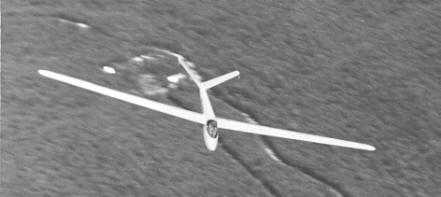
A soaring pilot in a Standard Austria enjoying the scenery.
* * * * *
 Wings Over Cumberland