The avocation of rebuilding, restoring, and preserving aircraft built in bygones times has become quite popular and has spawned several organizations with the primary interest of preserving aviation history. But who are these individuals who painstakingly undertake these projects, spending an inordinate amount of time in reconstructing an air machine that literally arose from a junk pile, and making that airframe once again airworthy?
The attributes of these individuals compile into a long list, but it can be said that they are certainly a breed apart. A mechanical and inquisitive mind, dedication to the task, the commitment of an unknown amount of time, perseverance in searching through flea markets and junk yards, the tools and work space to accomplish what seems a never ending project, and a family with a compassionate understanding of the task undertaken – these are the idiosyncrasies associated with these aviation aficionados. And, oh yes, the capability and willingness to spend money for rare items that seem impossible to attain, or the peculiar re-manufacture of a long missing part, is also essential. Harold Armstrong is one such individual.
The flying career of Harold Armstrong began in the summer of 1940 with the purchase of a 1929 OX-5 powered Swallow TP. This old open cockpit bi-plane had ended up on its back in a plowed field when a water line broke causing the engine to overheat and lose power. The aircraft was disassembled and brought to Harold’s home near Rawlings, Maryland and the damage was repaired, occupying most of his spare time. Expert guidance and assistance was provided by John Nash, an experienced aircraft mechanic and pilot. By early August the task was completed and the Swallow was again airworthy. Harold then enlisted the services of Herb Wentz, a colorful character, who provided some brief flight instruction. After a dozen brief flights totaling three hours and fifty minutes of dual instruction, Harold made his first solo flight in the antiquated aircraft on October 22, 1940.

A photo of the Swallow TP taken in 1940.
The Swallow was kept in a neighbor’s field adjacent to the Armstrong family farm, and tied down securely along the bank of the Potomac River. During the next two months Harold flew the old bi-plane thirty hours on short local flights and on several occasions crossed over the Knobley Mountain range to the east, landing at the Mexico Farms airfield. As the weather got much colder with the onset of winter, the open cockpit flying could be unbearable, but the youthful Harold was immersed in the joy of flight too much to terminate his activities. It became necessary to drain the cooling system to prevent freezing. Harold would haul five gallons of hot water to the field, fill the radiator, and hope the OX-5 engine could be started before the water cooled. With a successful engine start, Harold would crawl in the cockpit, fly a short twenty minute flight, land and tie down the aircraft, drain the radiator, and then go home to warm up and thaw his cold body.
This pleasurable activity came to an abrupt end on December 23. Harold was at work at the local Celanese plant, working the second 3 to 11 pm shift. That afternoon a friend of Harold’s was flying the Swallow, accompanied by Glenn Armstrong, a younger brother. While attempting a landing on his father’s farm Harold’s friend came in short and touched down in a plowed field. This ill advised landing resulted in the collapse of the landing gear and caused extensive damage to the fuselage, engine mount, lower wings, and breaking the propeller. The next day Harold once again disassembled the aircraft, hauled it to his home, and began another rebuilding process.
During the following eight months most of Harold’s spare time was spent on restoring the Swallow to flying condition. It was necessary to completely strip the fuselage so the damaged structure could be replaced or repaired. Some replacement parts were located and others fabricated with the expert assistance of John Nash. The OX-5 engine was removed, overhauled, and replacement propeller was located. Eventually all the damage was repaired and covered with new fabric and several layers of dope applied. The final colors were Stearman Vermillion on the wings and Consolidated Blue on the fuselage. On September 2, 1941, following final assembly a successful flight was accomplished by Harold. Much to his satisfaction, no adjustments were necessary. While the repair work was in progress Harold had managed to make a few flights in other aircraft, including a similar Waco 10 bi-plane. But he was elated to again be flying his own aircraft.
In October 1941, as the world was about to embark in that largest of all wars, World War II, Harold entered the United States Army Air Corps. That was the beginning a military flying career that would last 32 years. The progression included aircraft mechanical school, Aviation Cadet flight training, instructor duty in a variety of aircraft, and flying large bomber and transport aircraft at locations throughout the globe. Following his retirement from the Air Force in 1973, Harold continued flying as a part time corporate pilot while offering flight instruction to numerous fledging aviators, and performing seasonal jobs, including low level forest surveys.
In the early 1950’s a movement began with the objective of preserving and restoring vintage aircraft and the Antique Airplane Association was formed in Ottumwa, Iowa, with Robert L. Taylor as president and founder. Harold became a charter member of this organization. Having, regretfully, sold his Swallow several years earlier, he began searching for a Travel Air 2000 to restore. He never located that Travel Air, but instead found a restorable 1927 Waco 10 in Pennsylvania, which was purchased and placed in storage. Except for the engine, no work was begun until after his Air Force retirement.
Restoration of the old Waco began in the fall of 1974 and continued on a part-time basis for seven years. Harold was ably assisted in this work by his son, Bob. The ‘Ten’ was produced in large numbers by the Advance Aircraft Company of Troy, Ohio. A large three passenger open cockpit bi-plane, it is powered by a Curtiss OX-5 engine, a water cooled V-8 type which develops 90 horsepower that turns the eight and one-half foot long propeller, or air screw, at a relatively slow 1400 revolutions per minute. This engine was developed during World War I and was used to power training aircraft such as the Curtiss JN-4 ‘Jenny’. Nearly 13,000 of these engines were produced by various manufacturers, but the majority of them were never used by the military and became surplus when the war ended. The OX-5 became available at a fraction of the cost of new engines such as the Wright J-4, and with the low cost many were used by aircraft builders during the 1920’s and 1930’s.
The Waco 10’s engine was overhauled, and then its fuselage was stripped to the bare framework, cleaned, repaired where necessary, primed and painted. All new wood formers and fairing strips were fabricated, as well as floorboards and the instrument panel. The wings required much rib repair and other re-work, but eventually all of the details were completed. The aircraft was then covered with ‘Grade A’ cotton, doped, and painted silver with a red fuselage and black trim. On April 26, 1981, the Waco 10 with registration number NC3960 was flown for the first time in forty years. During the next three months Harold and Bob flew the aircraft to Burlington, NC, and five other regional ‘Fly-In’ events, gathering one or more awards at each location.

The Waco 10 airborne southeast of Cumberland.
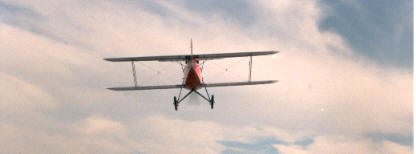
The Waco 10 from an in-trail position.
The world’s largest Fly-In/Convention/Air Show is hosted annually by the Experimental Aircraft Association at Oshkosh, Wisconsin. As a life member of the EAA, Harold was determined to fly the Waco to Oshkosh. Fittingly, he was accompanied by his son, Bob, and Paul Shank, both of whom he had taught to fly. With Bob in the front cockpit and Paul flying escort in his Bellanca Citabria, they departed in July, 1981. The first stop after crossing the Alleghenies was Mount Pleasant, Pennsylvania. The next refueling stop was at Marion, Ohio, after a three hour flight. Two hours later the two aircraft reached North Manchester, Indiana, where low ceilings and poor visibility were encountered. They pushed on for another forty minutes and spent the night at Plymouth, Indiana. The use of a corporate hangar during the night for the Waco was greatly appreciated and the crew was fortunate in having a Holiday Inn within walking distance.
After a weather delay the following morning, a short flight was accomplished to Valparaiso, Indiana, where the local EAA chapter graciously supplied refreshments. The next leg necessitated skirting the western suburbs of Chicago. This leg to Burlington, Wisconsin was cause for concern, since there were great lengths where no safe landing sites were available in case the 63 year old engine got tired and quit. With the weather delay, it became impossible to arrive at Oshkosh within the time ‘window’ specified for aircraft arriving with no communications radio. The daily air show at Oshkosh had begun and no arrivals were permitted. A phone call to Oshkosh tower was made by Harold resulting in approval to allow the no-radio Waco to accompany the Citabria as a flight of two, with Paul in the lead to communicate with the tower, and with a specific arrival time of 1900 hours. As the flight of two approached Wittman Field at Oshkosh, the sky darkened and rain began. In spite of the conditions the ancient Waco was directed to a smooth touchdown with the runway lights on. Numerous flag wavers, similar to traffic handlers aboard an aircraft carrier, directed the bi-plane to the antique parking area. Paul Shank in the Citabria, having accomplished his duty, was shunted off to the north parking area for modern aircraft.
The Waco 10 was parked in a prestigious spot in the Antique/Classic area near the Red Barn which serves as a focal point for the ancient aircraft of the EAA. As the engine was shut down, the two Armstrongs gave a huge sigh of relief and were greeted by the numerous spectators with a loud cheer. Mission accomplished – the aged Waco had come to the ‘Mecca’ of aviation!
Harold’s ground crew, consisting of his nephew Clem Armstrong, along with Keith Sines and Fred Wieneke, had arrived earlier and had set up a camper trailer, towed from Maryland, in the area nearby. The now relaxed air and ground crew thoroughly enjoyed the evening dinner and a good night’s rest. The following days were spent touring the flight line and exhibit areas, viewing the vast numbers of aircraft which included antique, classic, warbirds, and ultra-light craft over the expansive display area. They also browsed the ‘Fly Market’ that offers unique and rare items not found elsewhere. But a great deal of time was directed to answering queries about the aged 1927 Waco, beautiful and pristine, sitting among the other highly visible and intriguing aircraft.
Each day prior to the three hour air show special events were scheduled, one of which was the ‘Parade of Flight’, a fly-by of show aircraft led by the oldest of the old, a Curtiss Pusher. The 1927 Waco 10, with Bob Armstrong at the controls, was flown in this gathering, placed number four behind a replica of Charles Lindbergh’s ‘Spirit of St. Louis’. Bob was also later able to take each member of Harold’s supporting ground crew for a short flight around the crowded airfield, a gracious gesture as a reward for their support.
The culminating event of the week long Oshkosh Air Show was the Awards Presentation in the Theater in the Woods, near the antique aircraft parking area. Following the dissemination of numerous other awards presented, Harold and Bob were elated to hear the Master of Ceremonies state, “the Lindy award for Reserve Grand Champion Antique goes to NC3960, 1927 Waco 10!” The beautiful and eminent trophy is referred to as the Lindy Award, as it is topped by a bronze statue of Colonel Charles A. Lindbergh. The Waco 10 was also awarded a charming plaque naming it the Best Antique by the Schellville Antique Escadrille, an EAA Chapter in Schellville, California.
With the annual Antique Airplane Association Fly-In scheduled just two weeks later, the decision was made to fly the Waco from Oshkosh direct to Blakesburg, Iowa, for that event. During a refueling stop at Platteville, Wisconsin, the OX-5 had a balky spell and refused to start. The Waco had been shut down in the wrong place for fueling and had to be taxied across the field. The OX-5 engine, always more difficult to start when hot, finally came to life and the mission progressed. Arriving in mid-afternoon at Blakesburg, the Waco 10 was turned over to AAA President Bob Taylor for temporary custody and then placed in one of the hangars. The rest of the day was spent in browsing through the Air Power Museum and other facilities. The ground crew, with camper in tow, arrived and all had a quiet and restful night. The following morning Bob joined the ground crew for the return to Maryland via automobile, while Paul Shank and Harold returned in the Citabria. Departing Blakesburg, the Citabria caught up with the ground caravan headed eastbound down the highway. Harold and Paul dove down for a low swooping 130 mph overhead pass, as a saluting gesture, and returned to home base six and one-half hours later, well in advance of the ground crew.
Two weeks later Harold and Bob returned to Blakesburg for the Antique Aircraft Association Fly-In, flying in a more modern Cessna 172. The AAA gathering was underway and the Waco had been moved to the flight line and parked with the other vintage airplanes. The following day Harold was approached by Stephanie Maze of the National Geographical Society, with the desire to photograph a formation of the old restored aircraft. She specifically wanted the Waco 10 to lead the formation. Getting a group of pilots with varying degrees of proficiency together in formation for the first time is a daunting challenge, especially since none of the aircraft were the same. A group of six aircraft was briefed, assembled and became airborne. With turbulent air, maintaining a steady position was impossible, but multiple passes were flown. A “V” formation was flown, followed by an echelon, with Stephanie taking pictures from a Stearman, flown by Tom Melham. One photograph was subsequently published in a special National Geographic book entitled ‘Preserving America’s Past’. An impressive echelon formation color photograph appears on page 150. The formation was led by Harold Armstrong in the Waco 10 with the following in order; a 1928 Kreider-Reisner KR-31, a 1930 Brewster Fleet, a 1929 Parks P-1, a 1931 Brunner-Winkle Bird, and a 1930 Butler Blackhawk. Rarely, if ever, in the annals of aviation, has such a diversified group of airplanes been flown in formation and then historically photographed.
After four days at Blakesburg the awards were announced. The Waco was selected as the ‘Best Oldest Waco’, ‘Oldest Antique’, and ‘Best OX-5 Powered Aircraft’. After reaping these awards it was now time for the beautiful Waco 10 bi-plane, piloted by father and son, to be returned to its home base. The first stop was at Sheldon, Illinois, at an airstrip called ‘Zoomer’. The field, owned by a Mr. Zumwalt, was placed amongst a field of very tall corn. Zumwalt owned a rare Funk Model B aircraft and had participated in the air show at Blakesburg. Following a brief visit a three hour flight ensued with a refueling stop at Urbana, Ohio.
An early start was begun the next morning but extremely poor visibility conditions were encountered. Although the sun was barely visible overhead, the haze was so bad that it was difficult to keep oriented, as it was nearly impossible to observe the horizon. The conditions did gradually improve and the old Waco proceeded onward. The final refueling stop planned was at Barnesville, Ohio. As the departure was about to begin, the airport manager asked for a delay so that the local newspaper reporter could conduct an interview in regard to this rare bird. Later, the Armstrongs were mailed a copy of the Barnesville Enterprise, with the unusual Waco 10 stop as the lead story.
The final leg of the long journey saw the Waco cross over the Alleghenies, and finally descend into the Potomac River valley and land at the home base of Miller Field, just south of Keyser, West Virginia. The Waco and the OX-5 engine had traveled 1,777 statute miles and had been airborne for 25.6 hours. The average speed was a less than spectacular 70 miles per hour with the old Curtiss engine burning an average of 6.8 gallons per hour. The ancient OX-5 engine performed flawlessly – well, almost! While passing over Kokomo, Indiana, the OX-5 belched a big burp, then smoothed out and ran normally all the way home. It was as if the aircraft was saying, “Boy, that felt good, now I believe I can go all the way!” Or perhaps the ancient OX-5 engine was asking, “Are you awake back there?” in an effort to shake up the air crew.
Harold Armstrong, with assistance from his son, Bob, followed the restoration of the Waco 10 with three other aged aircraft. A 1946 Aeronca 7AC ‘Champion’ was completely restored over a two year period and changed from a drab green paint scheme into a glorious yellow and orange, looking better than factory new. This aircraft has set the standard for numerous other ‘Champ’ restorers, with the colorful paint scheme reproduced countless times. Following that project, a 1927 Pitcairn PA-4 ‘Fleetwing 11’, acquired years earlier, was completed over a seven year period. The pristine yellow and black open cockpit bi-plane has been the highlight of numerous air shows. The Pitcairn, like the Waco 10, is powered by the ancient OX-5 engine. This Pitcairn has ties to local Cumberland, Maryland, history and was once owned and flown by the renowned barnstormer pilot, Ronald ‘Torque’ Landis, during the 1930’s. The PA-4 ‘Fleetwing’, like the Waco 10, had a long six decade period in a dormant, junk heap state before once again becoming a flying machine, or in another term, arising from the ashes. More recently the Armstrongs restored a 1946 Schweizer I-19, a glider craft, as they progressed in the soaring realm. All four of these prized and admirable aircraft have been Grand Champion winners at the huge Oshkosh Air Show.
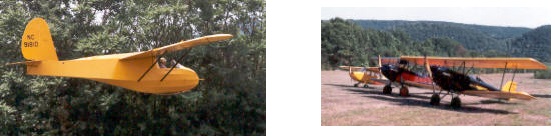
The Schweizer I-19, and the Aeronca 7AC Champion, Waco 10, and Pitcairn PA-4.

Airborne photos of the Pitcairn PA-4 and the Waco 10.
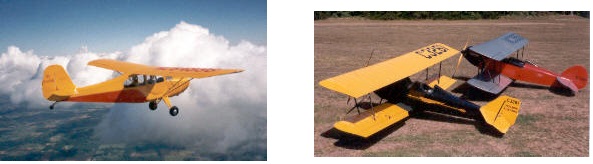
The Aeronca Champion airborne and a roof top photo of the Pitcairn and Waco.
It is completely understandable and proper that, with this backdrop, Harold Armstrong has been inducted into both the Experimental Aircraft Association’s Hall of Fame at Oshkosh, Wisconsin and also in the OX-5 Aviation Pioneer’s Hall of Fame at Midland, Texas. He has thus joined other selectees and well identified aeronautical personalities in these two prestigious honors.
The four aircraft, all maintained in airworthy condition by Harold and Bob, are now located at the Armstrongs’ private airfield, and named High Rock Airfield for the adjacent landmark that sharply rises 1000 feet above the grass runway. The airfield is located in Western Maryland south of Keyser, WV, along the Potomac River, with approaches for the 020 / 200 degree runway that traverse over West Virginia real estate. The picturesque grass airfield, clearly appropriate for the home of this fleet of aircraft, is just a mile from the Armstrongs’ home. It was in that house where the bulk of the restoration of these aircraft was accomplished in their well equipped basement and garage. A large 1920’s style wooden hangar was constructed at High Rock Airfield and houses this precious collection. The well designed structure is adorned and embellished with numerous artifacts of the early days of aviation.

This 1999 photo on the left depicts High Rock Airfield, the home of the Armstrong fleet of aircraft, as it lies along US Route 220 and the Potomac River. Note the ‘High Rock’ in the lower left corner. On the right is shown the hangar surrounded by numerous visiting aircraft.
Proof of the honor that has been bestowed on the Armstrongs for their superior and acknowledged workmanship on these four vintage aircraft is the fact that the fleet has here to date collected 56 total awards. The old and beautiful Waco 10 leads with 27 awards, and sits proudly among the fleet at High Rock Airfield, content that it is surrounded by good and proper company.
* * * * *
 Wings Over Cumberland