A unique friendship developed at the Cumberland Airport in the 1970’s between two individuals who shared a common interest, flying gliders over the Knobley Mountains. They participated in soaring through the skies seeking the best thermals or air currents to sustain flight. This was sport flying that both greatly enjoyed. These two, diverse in background, participants on different sides of World War II, one as a fighting airman, the other as a scientist and intellectual, could be called an odd couple. They would better be described as exceptional individuals whose common interest in soaring and the exhilaration of flight bound them together in their later years.
The tale of the two – Jack Wagner and Wernher von Braun – is one that could take reams of paper to properly put in words. Here, then, is a brief recap of their coming together as members of the local Cumberland Soaring Group in the 1970’s.
As a member of the Army Air Forces in Germany in 1943, Jack Wagner was a highly decorated B-17 ‘Flying Fortress’ aircrew member who served as a waist gunner and flight engineer. Participating in twenty five dangerous bombing missions over Germany, Jack and his crew went through nine B-17’s in 1943 due to various and extensive combat damage. All of these aircraft were given the name ‘Wabbit Twacks’, a name not uncommon in the nose art identification of the time. Jack’s crew in these unescorted missions received credit for twenty-one Nazi aircraft destroyed, with Wagner personally downing three German fighters on one mission. On that day their aircraft had lost one engine and was returning to England alone when a group of twenty-five FW-190 enemy fighters attacked what they thought would be a sitting duck. The end result of that low level skirmish over the English Channel was the confirmed downing of seven German fighters, with four other probable kills. The ‘Wabbit Twacks’ miraculously returned from that mission with 500 bullet and anti-aircraft holes as a result of the encounter. Wagner sustained wounds in the eye and foot and even used his large 13-AAA boot to plug a hole and assist in keeping the rudder in place until the Fortress got back to England.
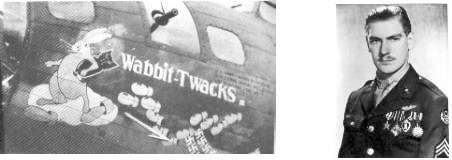
This is the nose art on Wagner’s B-17 ‘Wabbit-Twacks’. The swastikas indicate the number of kills, and the bombs the number of missions flown by his crew. On the right is Jack Wagner in uniform.
Jack would later serve as a gunnery instructor and, then, as an acknowledged hero, became a spokesman for the war effort in bond drive raising endeavors. In the 1970’s Jack was living in Wiley Ford, WV and was the chief instructor for the Cumberland Soaring Group. It was here that he developed a friendship with a gentleman from Germany.
In Germany in the 1930’s a common avocation of the younger set was learning the art of flying gliders as the age of aviation came in full swing. One of these youths was Wernher von Braun. As the outbreak of war in Europe became overpowering with the German blitzkrieg resulting in the greatest war in human history, von Braun was intimately involved with the war machine serving the Nazi cause. As a scientist and engineer he was instrumental in the development of rockets resulting in great strides in this heretofore unknown field. The feared V-2 rocket that harassed London and other Allied cities was the outcome of von Braun and other German scientific minds. As World War II was ending von Braun and over 150 of his associates elected to surrender to the American Army, bringing with them all of their recorded research and some hidden V-2 rockets. This group, with Dr. Wernher von Braun as their leader, became the architects in the development of the post war United States space program. Wernher completed his conversion to the democratic freedom of the west by becoming a US citizen in 1955. After serving with the National Aeronautics and Space Administration (NASA) until 1972 Dr. von Braun retired from NASA and became a corporate vice president with Fairchild Industries. By then he was a renowned figure and welcomed the opportunity to join the local Cumberland Soaring Group in regaining the sport of soaring while enjoying the anonymity far removed from the spotlight.
At Cumberland Dr. von Braun and Jack Wagner become close friends and Wernher was a frequent house guest of Jack’s at his Wiley Ford residence. Von Braun frequently flew Wagner’s Libelle sailplane in high altitude mountain wave flights. Eventually, under Jack Wagner’s instruction von Braun obtained his qualification flights and was awarded the coveted Silver C Badge from the Federation Aeronautique Internationale, issued by the Soaring Society of America. It was also here at Cumberland that Wagner taught Iris, von Braun’s daughter to fly gliders. The memory of Iris’ solo flight and the friendly, profound association of the unique couple of Jack Wagner and Dr. Wernher von Braun continue. Iris von Braun’s cut off shirt tail, obtained after her first glider solo flight in that continuing aviation ritual, still hangs on the wall of the Cumberland Soaring Group’s club room.
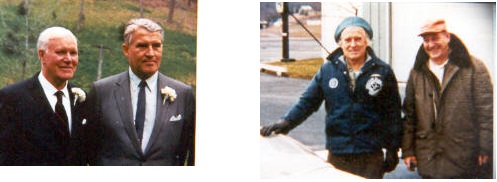
On the left is US Congressman Harley Staggers of Mineral County, WV with Dr. Wernher Von Braun during an official visit at Keyser. On the right is Von Braun with Jack Wagner during their friendly soaring days at Cumberland.
* * * * *
 Wings Over Cumberland