In the late 1980’s there appeared at the Greater Cumberland Regional Airport a flying machine that dangled a contraption observed by many but whose purpose not all would recognize. Ag-Rotors, a firm operating out of Gettysburg, PA, has a division that travels the country with this unique apparatus and serves the needs of power companies by keeping high electrical transmission lines free from growth. As is the case in many parts of the country, the numerous high tension lines in our area have continuous growth that infringe on the right of way. This unique service continues to operate to the current time.
A description of this contraption is in order. A relatively small helicopter, piloted by a sole individual, has attached to its underside a long boom with a gasoline powered motor hung about forty feet below. Further down this long flexible boom are a series of fifteen 18 inch diameter high speed circular saws which receive their cutting power from the suspended motor. When the helicopter is at rest on the ground the purpose of this contraption looks weird and mind boggling. But once airborne it is even stranger to observe. The helicopter lifts off ever so slowly and allows the dangling contrivance, which is about sixty feet in total length, to hang straight down from the now flying machine. The pilot then proceeds to his assigned area to perform his mission. Once over a power line he maneuvers (extremely slowly) to parallel the high tension wires and the overhead suspension cables. It is then that he fires up the suspended motor with controls from the cockpit and begins the turning of the circular saws. At that time the intrepid pilot slowly moves along the outer edges of the cleared area and allows the rapidly spinning saws to cut tree limbs and branches growing towards the power lines. If this procedure were to be accomplished over level terrain it would certainly be a demanding task. However, in our area the power transmission lines run generally east and west, placing them perpendicular to the rapidly rising and falling terrain, and so making the task that much more difficult and hazardous.
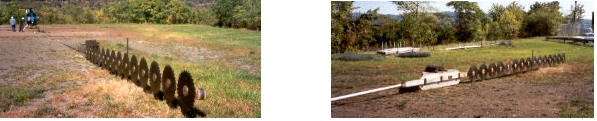
Two views of the power line saw laying on the ground prior to flight.
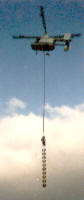
Note the long boom from the helicopter and the motor at the end of the circular saws. The flying power saw rig airborne and inbound for work.
After working a section of the power line, frequent return trips are necessary to refuel the helicopter and the suspended powering motor. A ground crew assists in the servicing of the equipment to assure it remains in good working order. As the return to base is accomplished, the pilot gingerly arrives over the landing site, and then ever so gently lowers the helicopter towards the ground as the contraption is guided to a level horizontal position on the surface. Only after the total boom is aligned on the ground does the pilot then touch down with the helicopter.
This function is periodically performed during the growing season and, as new growth occurs, it is repeated on an annual basis. Obviously the power companies have determined that this is a cost effective method of keeping the transmission lines free from the falling trees and large branches that would cause a breakdown of service to their customers. Otherwise, the power companies would have to employ a large number of personnel in accomplishing the clearing service from ground level. This is not even considering the fact that there are miles and miles of power lines that could not be easily accessed by surface vehicles.
When one considers the type of work performed, the location in proximity to the high tension lines, the terrain over which he accomplishes this task, the fact that he performs this service as a sole pilot, and the large area covered, it becomes evident that this is one helicopter pilot who unquestionably earns his pay.
* * * * *
 Wings Over Cumberland