In 1969, Dr. R. A. Cowley, who theorized the ‘Golden Hour’ – that critical time frame for trauma patients – was passionately seeking ways to rapidly transport seriously injured personnel from accident scenes to high level, progressive medical facilities. At the same time the Maryland State Police was seeking funds for expansion of its capabilities. As luck would have it, the National Transportation Highway Safety Administration concurrently was devising guidelines to provide grant funding for the express purpose of combating highway fatality rates through the establishment of MEDEVAC helicopter units. This idea was based on the proven success of the military in the Korean and Vietnam Wars.
By 1970 these entities came together and the Maryland State Police began flying trauma victims to the University of Maryland Hospital Center. Rapid transportation was now available and simultaneously Dr. Cowley’s theory could be proven. Eventually a master plan for the states’ emergency medical services system was devised. The plan called for additional aircraft and a total of seven sections statewide to operate 24 hours a day in the hopes of providing better service. On July 1, 1982, the Cumberland Section opened its doors, under the supervision of Sgt. Carl Marshall. It was identified as ‘Trooper Five’ with its base of operations on the Cumberland Municipal Airport in Wiley Ford, WV. The office was a 10′ x 26′ trailer and was initially manned by four personnel. Hours of operation were flexible based on the availability of crews. The helicopter, a Bell Jet Ranger, was temporarily housed in a hangar provided courtesy of Lewis Ort, of Ort’s, Inc. Later Allegany County and Cumberland City joined forces to provide a new hangar which would house both the helicopter and crews. The building was completed in 1983. In August 1983, a third crew was added to the section, allowing for increased hours of operation and, for the first time, offered a fixed schedule of availability, from 8 am to midnight.
The Cumberland Section serves the largely rural, mountainous area of Western Maryland. Besides serving Allegany, Garrett, and Washington Counties, Trooper Five also responds to nearby Pennsylvania and West Virginia, offering critical medical care, law enforcement, and search and rescue resources upon request. Funding for this service and response is provided by the taxpayers of Maryland, and is done so at no charge. The usually quiet, rural community served by Trooper Five yields fewer calls than its sister sections operating in the metropolitan areas; however, the missions flown are often dramatic and highly visible to the area’s citizens.
It is the unique terrain of Western Maryland with its rising mountains, sheer cliffs, and raging rivers that inspired Sgt. Marshall to devise a rescue system which could be adapted for helicopter use. The initial system consisted of a 100 foot climbing rope and horseshoe collar. Over the years the system has been upgraded and continually put to the test. As use of this system has grown so too has a colorful history of aerial rescues at the Cumberland Section. Rescues from flooding along Wills Creek, Town Creek, the North and South Branch of the Potomac, and the Shenandoah Rivers have been notable examples. Not limited to water rescues, the helicopter has hoisted people from the cliffs of Knobley Mountain and the remote areas of Dolly Sods and Blackwater Falls. In 1985 and 1996 the Governor’s Citation, and the EMS Star of Life Award, respectively, were presented to Cumberland crew members for outstanding performance in aerial rescues during widespread regional flooding.
Over the years the Cumberland Section has experienced progressive changes in equipment and training. In 1988 the Maryland State Aviation Division began acquisition of new aircraft, with area residents seeing the arrival of the Aerospatiale Dauphin helicopter the following December. Along with the new aircraft came a new two-story hangar facility, upgraded training for pilots and flight paramedics, the addition of a fifth crew and expanded hours of operation to two 10 hour shifts per day. The period between 3 am and 7 am is covered by nearby Frederick’s 24 hour section.
The two-engine Dauphin, costing six and one-half million dollars, is a sophisticated, state of the art machine which has proven to be an invaluable tool for medical, law enforcement, and search and rescue operations in this remote region of the state. Capable of flying faster, farther, and safer, specialty referral centers have become more accessible.
o The first instrument flight conditions mission was initiated when the Speaker of the Maryland House of Delegates, Casper Taylor, suffered a heart attack and was transferred from Cumberland’s Memorial Hospital to the University of Maryland Medical Trauma Center.
o Equipped with a 30 million candle power search light, F.L.I.R. (forward looking infra-red camera), and rescue hoist, the new aircraft offers a distinct advantage in search and rescue and law enforcement missions. It has proven essential where ground searches are typically difficult to perform in this rugged mountain terrain.
o The search for a two year old boy, by Trooper Five, ended successfully after the toddler wandered into the woods from the family’s vacation home in Green Spring, WV.
o Trooper Five conducted a night search for a lost hunter in the Green Ridge area of Allegany County. Frantic and tired, he was able to attract the crew’s attention with his flashlight.
In 1995-96 the Aviation Division further upgraded its aerial rescue system. This modified basket design further enhanced rescue capabilities by allowing the victim to be placed in either a seated or supine position. The basket seemed to be designed with Western Maryland in mind.
o Confluence, PA. The hoist system was used to rescue the pilot and passengers of a downed helicopter after it crashed into the Youghiogheny River.
o Zihlman, MD. A motorcyclist was hoisted to safety after driving over a 50 foot cliff and sustaining serious injuries.
o Dolly Sods, WV. Trooper Five responded for the victim of a logging accident. Seriously injured and inaccessible to ground vehicles, a clearing was made allowing for deployment of the rescue basket and removal of the victim.
o Blackwater Falls, WV. A hiker fell 40 feet into a ravine and became stranded on a ledge. The victim was hoisted by Trooper Five to a waiting ambulance at the top of the gorge.
The multiple mission capability of the Maryland State Police Aviation Division makes the helicopter a formidable asset for the challenging task of saving and protecting lives in Western Maryland. The mission of Trooper Five well serves the special character of this tri-state area, where all communities are bound together by personal and financial ties.
(This history compilation of the local MEDEVAC unit was primarily through inputs by Christine Mazaika in December 1997).
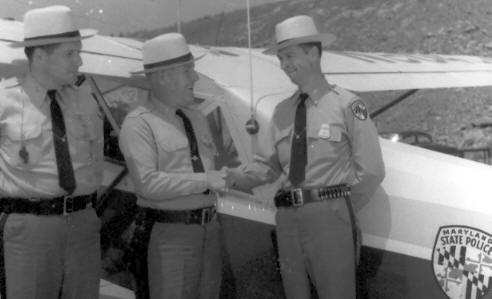
An early Maryland State Police surveillance aircraft in the 1960’s.

The Bell Jet Ranger helicopter used from 1982 until 1988.
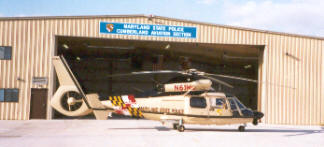
The French built Aerospatiale Dauphin helicopter in front of the MEDIVAC hangar at Cumberland.
* * * * *
 Wings Over Cumberland