The following narrative was written in August 1992 while the author was serving as Airport Manager at the Greater Cumberland Regional Airport. He was among eight most fortunate individuals that had the golden opportunity to participate in the flight of two World War II bombers, meticulously restored by the Collings Foundation, as they flew from Cumberland to Frederick, MD. The two vintage aircraft, a B-17G – Flying Fortress #231909 – and a B-24J – Liberator #224J – were being transported between display locations where large numbers of visitors viewed the bombers up close and personal. The B-17G was the mode of transportation but the author would have been equally exuberant to have been aboard the B-24J. The following is his description of that experience:
Three are turning and churning while one waits to come to life. The sweating air crew members in the sweltering cockpit of B-17 Flying Fortress 909 are satisfied, by glancing at the nervous needles within the maze of engine instruments that the two starboard and the near port engines are running OK. Now it is time to get the fourth to join its siblings.
I watch aircraft commander Jon Rising and his co-pilot, working in unison with hands and elbows intertwined, repeat the starting sequence for the final engine. Switches and levers are operated methodically as the pilot glances left for results. The old three-bladed prop slowly rotates, hesitates, coughs, and stops.
The idle engine is nearest to the crowd standing behind the fence and atop the west side hill at the Cumberland Regional Airport. A huge group has gathered for a last view of the famous B-17, and its unique partner, the B-24 ‘All American’, after a popular three day visit. Faces in the crowd display deep emotions, reflecting the historical significance of the beautifully restored World War II bombers. Many have just experienced the rare opportunity of climbing inside the aircraft and seeing up close the spartan interior, with its 50 caliber machine guns, 250 pound bombs over an open bay, navigational equipment, and historic Norden bomb sight. These aircraft were made for war and now, fifty years later, they look ready for a combat ready crew to take them on any assigned mission.
Although I am standing behind the co-pilot, I cannot hear the communication between the two crew members. I gather, however, that they are ready to try that last engine start again. The old prop had stopped as if to tweak the crowd’s curiosity. After patiently waiting through the long pre-flight in the hazy, humid August day, they must be wondering. Will the half century old 1200 HP Wright engine be able to perform its job again? Or is there a problem within its big nine cylinders, some gremlin among all the wiring and plumbing and oil streaked mechanisms? The air crew knows better. They not only fly this machine, they keep her in the first class working order that befits a relic of the past with so much history to tell and so many airfields to visit.
This time the prop turns oh so slowly, picks up speed, tantalizingly slows down, then gains speed once again as its cylinders begin their full operation. A cough and a huge ball of blue-black smoke engulf the cowling, but quickly is blown away. Finally stabilized RPM occurs, and the fourth engine has joined the other three in harmony of sound and sight.

Engine start up at Cumberland
I am happy, I am grateful, I am fortunate to be among the group on board this B-17 as it begins its departure from the Cumberland Airport. We are bound for Frederick, Maryland, for another grand stop so that others may stand in awe and view with wonder.
The air crew runs some more checks to their satisfaction, the pilot in jest calls for air conditioning on, a function not available on this old war bird, as we all sweat profusely but unknowingly. A radio call is made, and ‘Fortress 909’ begins to leave its resting place of the last three days. The B-24 trails in tandem as if obeying its leader in their most recent joint mission. Both of these aerial war horses care not if this be war or peace. Mission accomplishment – to fly and fight and don’t you forget it! – That is their creed. Just put a worthy air crew within and let’s get on with the mission.
Taxi out, wave to the crowd, acknowledge the emotional faces, slowly move to the north end, make engine run up, the pilots are satisfied and confident, twenty-four propellers blades and seventy-two cylinders within the two large bombers are in harmony, move into position, call informing all lucky enough to be monitoring the airport radio that a Fortress and a Liberator are departing Runway 23. It is a sight for many to remember and talk of for many a day.
Pilot and co-pilot in practiced harmony push levers slowly forward to full four engine power, the noise level increases, the power thrust is felt, rudder force for centerline directional control, airspeed increases, two thirds of the 5050 foot runway is now behind us, the pilot pulls gently rearward on the large control wheel, with 1000 feet remaining the lumbering giant is now airborne and is no longer lumbering but a wondrous flying machine ready to do what some great and good people from a far off time designed her to do.
The landing gear is retracted, airspeed increases rapidly, but do we climb? No, Jon Rising has leveled off close to the now fast moving earth below, our track is out Route 28 from Wiley Ford heading southwest, a left turn is made around a hilly protrusion, the B-24 can now be seen in trail and coming abeam in formation, our now agile machine is turned tightly back to the airfield. At low level we head down towards the eastern part of the airfield, a tight right turn is made to parallel the main runway and a wing rock is made as we turn north in front of the crowd. Many are now surging forward to the runway to get a closer view of these flying machines from the past. For a brief moment I have a guilty feeling that I, as airport manager, should be there on the ground aiding in crowd control, preventing those enthusiastic people from getting dangerously close to the active runway. I observe the green airport pickup truck with flashing beacon patrolling the crowd, preventing an incursion on the runway. The guilty feeling passes as I know one of my employees is accepting the proper responsibility.
Passing the north end of the field, a hard left turn is begun and the ground track is over South Cumberland. Then the B-17 with B-24 in trail rapidly proceeds again down Route 28 over Wiley Ford, passing near the high towered airport rotating beacon. Another hard turn is made by Jon as we circle around the Kelly-Springfield Flight Operations building, then another pass over the main runway, another wing rock and a final good-bye as we head east and all of this at low altitude. I am impressed. Having spent over two decades as an Air Force pilot, with extensive experience flying high performance jet fighters, I do have a basis for comparison.
A thought passes – you dummy, your camera, you forgot about using your camera, you failed to get some shots of the crowd as the big bombers put on their departure display. The thought process sometimes goes askew when you are having fun.
And so onward to Frederick through the August haze, low altitude all the way, about one thousand feet above the ground and in a bomber designed for high altitude work well above 20,000 feet. A somewhat direct line to Martinsburg, over Sleepy Creek, no one there to view these two glorious machines, except maybe a camper or two who probably shout, “My gosh, what was that!” A low pass is made over the Martinsburg Airport after receipt of permission from the control tower. Yes, there are Air National Guard C-130’s on the ramp – a more modern four-engine Air Force work horse – if they had a mind what would they think of the sight above?
The fortunate transients aboard are free to roam from station to station, from the flight deck to the nose bubble which houses the bombardier’s platform and the Norden bombsight. I can move forward and view through the cross hairs in the small window of the sighting mechanism and see the terrain passing under at three miles per minute. I can picture a bombing run under way, waiting for that railroad marshaling yard or that strategic bridge to appear so that the iron bombs can be released at the appropriate second. As one takes in the panoramic view from this protruding nose, it becomes evident that on this day our worst enemy is the bugs that smash against the Plexiglas, hindering forward visibility already hampered by the dense haze.
From the nose compartment I crawl rearward under the flight deck back to the mid-section, where an open door on the top of the fuselage allows me stand erect with my head in the air stream. I see the Liberator in tight echelon formation on the port side. A tool box is used to stand on to gain elevation as I rest the camera to record some of these moments. The 180 mph passing wind is not too excessive or bothersome except to make it difficult to hold the camera steady. The view of the large protruding rudder and saddleback of the fuselage is strange but compelling, as the B-24 on the wing plays games and makes a cross over.
The catwalk runs through the center fuselage, allowing passage from station to station, to the side gun position, to the belly hung ball turret, to the tail gunners cocoon with guns pointed to the most vulnerable six o’clock position. There are guns all around, hence the appropriate name ‘Flying Fortress’. Caution is necessary to avoid the rough metal protrusions everywhere. The catwalk and all movement areas were certainly not designed for oversized humans. In my movements around the bowels of this flying machine, I glance at my left leg and notice a slight bleeding cut on my shin bone above the ankle. I wipe it dry, think of it no more and continue to enjoy the trip.
Verbal communication among the happy passengers is possible, but only by taking directly into your neighbor’s ear. But under these conditions, with the constant hum of the four old reliable Wright engines, and being airborne in this flying museum, inner thoughts are more appropriate. One need not talk to see the pleasure on the faces of the fortunate few aboard this grand old lady. I muse about the dedication of the millions that participated in the ‘Big War’, the one that brought the people of this great country in better harmony and unity of purpose than certainly at any time since. I also dwell on the loss of life, the wounded, the separations, the turmoil experienced by the generation of Americans aged seventy and beyond, and how their efforts enabled guys like me to undertake a military career and participate in a minute way in the winning of the Cold War.
As we pass Martinsburg and go eastward toward Frederick, suburban America lies below. One hopes that all people below, aged seventy and higher, who may have assisted in the design, building, maintenance, or flying of these war machines may be outdoors and glance skyward, recognize the sound of these reliable engines, or see the silhouette of the Fortress and Liberator pass overhead and say, “Can it be? Is it possible? Do I see what I think I see?” Long forgotten memories can then come to mind for this older generation.
One also should recognize that these flying war relics should be viewed as but one symbol of our victory in World War II. That symbol or likeness could be a tank, a jeep, a ship, a howitzer, or any other tool of that war, because it was not only airmen, but huge numbers of Americans that served our country’s call, that displayed valor and dedication to the worthy cause. The airplane is simply a symbol that can be restored through the concerted efforts of a band of people with sweat, money, and time to make this museum available for historical viewing by millions.
Are the viewers on the earth’s surface moved by what passes overhead? I certainly hope so. The Collings Foundation crew members, who fly these machines from destination to destination and display their versatility of purpose by accomplishing all the mechanical necessities of keeping them flying, deserve all the plaudits thrown their way. This is history personified.
One has to feel honored, fortunate, and, yes, humbled to be on board this living piece of history. It is not enough simply to be overcome with joy by the experience. If it does not go deeper than that, then one should not be so lucky as to join in the sojourn.
The town of Frederick is in view as our journey continues, the airfield is in sight, a radio clearance call is made, and a low pass down the runway is followed by a chandelle to the downwind for landing. Nothing fancy here, for fear of some Federal Aviation Administration (FAA) non-elected bureaucrat attempting to enforce not a law, but some obscure regulation. As Jon Rising stated when I approached him at Cumberland to come and join in on an open phone line with a local radio station advertising the vintage bombers display, “Sure, just as long as it is not WFAA!” All passengers are requested to lay low, strap in, and not have any smiling faces protruding from any open windows for fear of presenting the wrong scene to that unseen bureaucrat. We comply, for we are honored and thankful guests within this museum, and humbleness is in order.
The wheels are lowered, landing clearance received, and a smooth touchdown by the B-17, with the B-24 in trail, is followed by a taxi to the ramp, and eight engines are silenced. The flight was too short, about an hour from engine start to engine shutdown, less than forty minutes of flight, but a more fulfilling time will be long in coming.
Exiting of the aircraft follows with some photos of happy faces at plane side, then heartfelt thanks to all crew members. The arrival gathering at Frederick appears to be small, thirty-five to forty folks, and just another day at the office. They should have seen the crowd and enthusiasm at Cumberland for comparison.
It was a pleasure and an honor to be part of the Collings Foundation visit. Reports indicate over 2,000 people at the Cumberland Airport made a donation for the tour of the aircraft. Fourteen individuals made a donation of $300 each that enabled them to experience a local thirty minute ‘dawn patrol’ flight in the bombers. The Tri-State support was terrific, with an unknown total of visitors coming to the airfield, resulting in overflowing parking facilities. Gratis lodging and transportation was generously donated for the air crews. The Collings Foundation was extremely pleased and promised to return. The monetary amount to renovate, maintain, and fly these machines is huge – without that support the wartime relics could not continue to fly.
There may have been some isolated complaints about the noise level from the low altitude passes by the two relic bombers over our area. For those individuals, I say, “Do not fret, that was the sound of freedom, a symbol of dedication by our ancestors that we all may better enjoy life as we know it in the United States of America”.
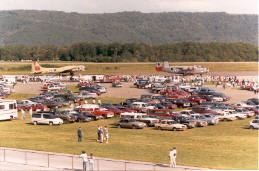
Two bombers taxiing out from Cumberland.

B-24 and B-17 making a low pass on departure
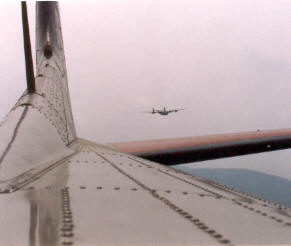
B-24 joining up with the B-17.
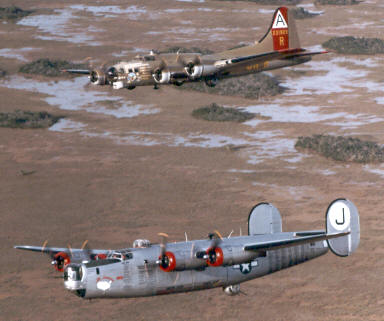
A Collings Foundation photo of both bombers.
* * * * *
 Wings Over Cumberland