With the dedication in 1999 of a new, modern terminal building at the Greater Cumberland Regional Airport, it was determined that a Visitors Gallery on the second level would be a desirable place to display some of the history of the region. The Chairman of the Potomac Highlands Airport Authority, James Stahl, requested and directed a planning committee to undertake this project. Co-chaired by Dr. Bob Poling, a PHAA member, and a former airport manager, Bill Armstrong, this committee planned, over a two year period, the contents of this visitor’s site. The gallery has proved to be a popular attraction for visitors and local residents as well.
The COHONGARONTA GALLERY is open to the public during all terminal business hours. The gallery contains an array of displays showcasing the history of the Greater Cumberland area. The centerpiece of the gallery is a 40% scaled replica of the Wright Brothers 1903 first powered flight aircraft that set the stage for aerial transportation and revolutionized our traveling capabilities. A descriptive plaque for the 1903 Wright Flyer, constructed and donated by the local EAA Chapter 426, is posted near the replica. A seventy foot long time line, sequenced over a profile of the Knobley Mountain range that lies just to the west of the airfield, highlights dates and historical events pertaining to the Potomac Highlands region. Other aeronautical history pertaining to the Cumberland area is placed throughout the Cohongaronta Gallery, with some of that history further detailed in chapters of this manuscript.
For further information regarding tours and special arrangements for the Greater Cumberland Regional Airport and the Cohongaronta Gallery, contact the following address: Greater Cumberland Regional Airport, Rt 1, Box 99, Wiley Ford, WV 26767 – Phone 304-738-0002, Fax 304-738-0032. The Airport and Gallery’s web site is: http://www.cbeairport.allconet.org/.
As a conclusion to a tour of the Cohongaronta Gallery, in a seating area overlooking the main runway is a large mural reproduction of the original photograph of the historical Wright Brothers 1903 first powered flight at Kill Devil Hills in North Carolina. The mural is circled by a vapor trail leading from a profile of a modern Lear Jet aircraft, depicting the old contrasted with the new. This space can be a place of meditation, where one can dwell on the tremendous progression and advancement of aviation over the last century.
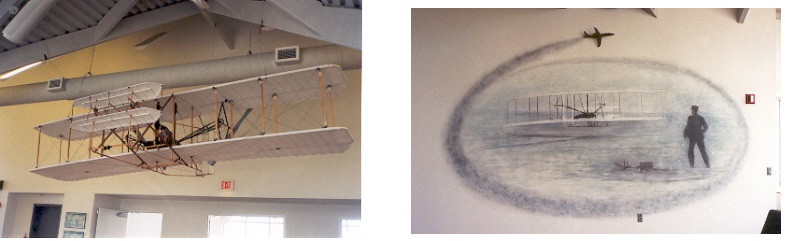
View of 1903 Wright Flyer in Gallery. Mural of Wright Brother’s first flight.
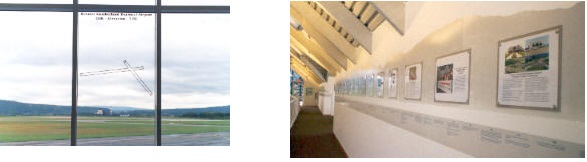
View from Gallery looking southeast over tarmac and runway. A portion of the Gallery and time line.

A view looking NW towards Cumberland. A close up view of Orville Wright.
The following wording from a plaque located at the beginning of the Gallery serves as an introduction for visitors upon their arrival in the upper level of the new terminal building:
Welcome to the Greater Cumberland Regional Airport and to the Potomac Highlands Cohongaronta Gallery. ‘Cohongaronta’ is the name given to what is now the North Branch of the Potomac River by the Shawnee tribe of the Algonquin Nation, and is translated to mean ‘Wild Goose Stream.’ The artifacts and artwork displayed herein were extracted from many sources, too numerous for credit, and are designed to emphasize transportation and its impact upon our region. View the items at your leisure.
To your right, on the northwest wall, is a time line listing highlights appropriate to the evolution of the local area. Although certainly not designed to be all inclusive, it is hoped that this time line captures the historical flavor of past events and will in many instances bring back memories in the minds of viewers.
While the city of Cumberland has been the center of commerce for the tri-state region over the years, until the 1940’s it had no airport of its own. Prior to that time, Mexico Farms Airfield, a grass strip just south of the city, was the only local airport in existence. Construction of the existing airport began in 1941, under the Works Progress Administration (WPA), but was not completed until after the end of World War II. The project entailed extensive earth moving, topping off the hills and filling in the valleys, to allow for a flat environment conducive to an airfield. Although physically located adjacent to Wiley Ford, West Virginia, the real estate and airfield were owned and operated by the city of Cumberland under the name of the Cumberland Municipal Airport. This remained the case from the airport’s opening in 1945 until 1987, when Cumberland agreed to transfer the control and operation of the airport to Allegany County, Maryland. In 1990, Governor William Donald Schaefer of Maryland and Governor Gaston Caperton of West Virginia signed a Bi-State Agreement authorizing the Potomac Highlands Airport Authority to become the controlling agency for the now Greater Cumberland Regional Airport. The Airport Authority is comprised of nine members, five from Maryland and four from West Virginia, who voluntarily offer control and oversight to the airport’s operations.
The Greater Cumberland Regional Airport is unique in many ways. Physically located in the adjacent state from its namesake, it is one of only a few in the United States with a bi-state flavor and control. Maryland and West Virginia jointly contribute financially to its operations. Although located only one air mile from the center of the city of Cumberland, its unusual plateau siting does not present any great problem of urban growth or noise control. It is anticipated that this airport will continue to be a focal point of commerce and to serve the aerial transportation needs of our community well into the future.
The Potomac Highlands Airport Authority extends a grateful welcome to our area and hope, whether your stay is brief or extensive, that your visit to the Greater Cumberland Regional Airport is most pleasant and that you will soon return.
Funding for this Gallery was made possible in part by a grant from the Appalachian Regional Commission as administered by the Maryland Office of Planning.
On behalf of the Potomac Highlands Airport Authority, a volunteer Themes Committee directed their efforts towards the aesthetic appeal and contents of the ‘Cohongaronta’ Gallery. This committee consisted of: Co-Chairmen Bill Armstrong and Dr. Bob Poling, Andre De Palatis – Spectrum Design Services (technical guidance and layout), Al Feldstein – Maryland Office of Planning (major inputs on historical research), Jack Sanders (West Virginia historical research), Joe Ott, Jr., Shirley Giarrita, Beverly Walker, Deborah Miller, Shirley Wisenburg, Sharon Nealis, John Jennings, and Mary Fanelli. Additional assistance provide by Gerry Long and Colleen Burke.
* * * * *
 Wings Over Cumberland