During the history of the Cumberland Airport three different terminals buildings have served as the base of operations. The original terminal building was constructed in 1945 at the time of the opening of the Cumberland Municipal Airport. The design included an office facility for the fixed based operator and the airport manager. A part of the structure included an apartment for the airport manager and his wife. A small area was devoted to a pilot’s lounge and a snack bar. Located close to the west side hill where it now remains, the building is currently occupied by the Civil Air Patrol Composite Squadron. This facility was witness to many interesting activities at the local airport until its function ceased as a focal point of operations in the late 1970’s.

A 1945 photo of the initial administration and terminal building. Note the six large T-hangars to the northeast. This photo depicts the airfield shortly after much ground removal and fill in over the Western Maryland Railroad track that ran through a valley at the center point of the airfield.
The second terminal building is located on the crest of the hill as one drives onto airport property. It was occupied, in the late 1990’s, by Cumberland Air, a flying school and aerial charter service. The lower level previously housed the Cumberland Cafe which served fine food in a friendly atmosphere until its recent closure. Built by the City of Cumberland in the late 1970’s, the structure is of a split level design and was designed to serve Nicholson Air Service, which began operations at that time. With airline service established by the Nicholson firm, a concrete block addition was added to the southwest side of the building to accommodate passenger service. Two lower level rooms were used for administrative purposes and an airline counter and reception area. Coin operated snack machines and rest rooms completed the lower level. On the upper level were the airport manager’s office (Dale Nicholson at the time), a pilot’s flight planning room, and a conference room. A lounge area on the top floor afforded visitors with a splendid view of most of the airfield. A corner of the lower level served as an office for refueling personnel, with radios for ground to air communication. Two altimeters for field pressure setting and an anemometer indicator for wind direction and velocity allowed the airport personnel at the control point to relay information to arriving and departing pilots.
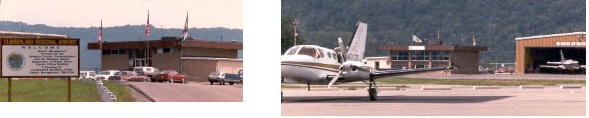
On the left is a view of the terminal entry, and on the right the second terminal from the air field side.
The second terminal building was modified several times. Following the departure of the Nicholson Air Service firm a change was made with the upper level lounge being dedicated to airport management and administration and the lower level was used for airline service. An automated weather observing system (AWOS) was installed that provided 24 hour conditions to pilots and anyone desiring a current airport weather report through a local phone call (304-738-0451). The radio frequency for this service is 128.625.
After a lengthy planning stage the third terminal building was constructed in 1997-8 and dedicated in 2000 with Maryland Governor Parris Glendening and West Virginia Governor Cecil Underwood in attendance. This more modern and larger structure is designed to accommodate two commuter airline operations, a rental car agency, a control center for communications and fueling operations, and larger administrative offices.
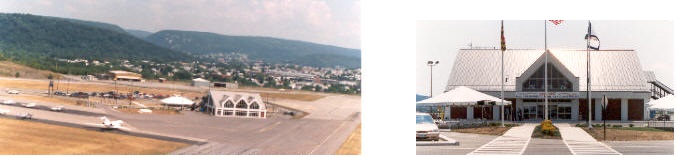
The new terminal, photographed in 2000 during its dedication, now serving Cumberland.
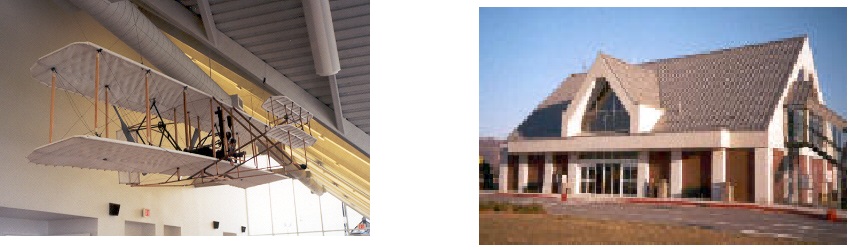
On the left is the 1903 Wright Flyer, and on the right an eastern looking view of the new terminal.

This photo depicts the dedication of the new terminal building in 2000. From left to right are: Bob Schadler, Dave Fertig, Dick Schwab, WV Governor Cecil Underwood, Walter Bosley, MD Governor Parris Glendening, Jim Stahl (hidden), Cas Taylor, Lynn Nelson and Lee Fiedler.
With the changes that have occurred over the years it is noteworthy that all three terminal buildings on the airport continue to serve a useful purpose. Their construction ranged from 1945 to 1976 to 1998.
* * * * *
 Wings Over Cumberland