In 1922 the Cumberland Chamber of Commerce received a letter, dated May 11, from the Headquarters of the US Army Aviation Service, Bolling Field, Anacostia, District of Columbia, informing them that in a few days a government airplane will visit Cumberland to investigate the possibilities of a landing field. It was requested that any services that could be provided to the pilot and his mechanic would be greatly appreciated. Signing the correspondence was M. F. Scanlon, Major, US Army Air Service.
Shortly thereafter a May 17, 1922 Cumberland Daily News article stated the following:
Lieutenant Paul Wilkins and his mechanic, George Baker, landed at Cumberland flying a DeHavilland DH-4 Army Airplane arriving from Anacostia, MD. The area where the craft landed was at Cumberland Heights and Oldtown Road (that is believed to be behind the present St. Mary’s Catholic Church on Prince George Street). Joined by A. Hammond Amick, Jr., a former Lieutenant in the Aviation Section of the US Army, they flew over sites at the Lamp farm (now known as the Swan Pond area east of the Cumberland Regional Airport). The party also flew over Mexico Farms, Mapleside (southeast Cumberland), Potomac Park, the Amcelle area, the Vale farm southwest of Frostburg, Vale Summit, and the Welton Farm a short distance from Cumberland. The purpose was to familiarize the aviators with the area and to determine the best location for a planned airfield. Lieutenant Wilkins was to file an official report upon his return to Bolling Field and a selection of a landing site will follow. Former aviators of this area, it was reported, have planned extensive activities for the proposed air field here. It is likely that one or two planes will be purchased by local aviators and housed at the landing field. Also planned is the erection of a light tower on one of the mountain tops near the city for the purpose of guiding night flyers.

DeHavilland DH-4 arriving at Cumberland Heights and Oldtown Road in May 1922
On the right is Captain Amick (WW II photo courtesy of the Amick family).
The interest of the US Army Air Service, commanded by Major General Mason Patrick, in having a Cumberland area air field was affirmed by correspondence between General Patrick and Captain Amick. A noteworthy telegram shown below confirms that interest.
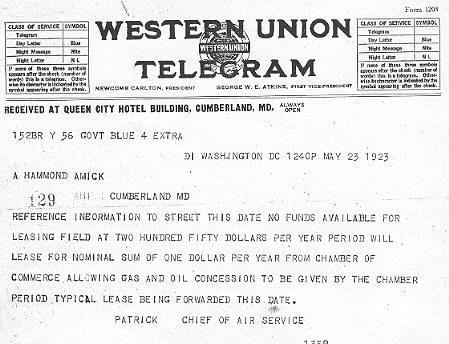
A copy of a 1923 telegram sent by General Mason Patrick to Cap Amick.
The Cumberland Daily News reported on July 2, 1923 the following:
The Cumberland Chamber of Commerce has received a letter from Captain L. L. Snow, US Army Air Service, Washington, DC, congratulating that body on its initiative in securing a site for an airplane landing field at Mexico Farms, located six miles south of the city, near North Branch. The Government Landing Field would be along a proposed model airway from Bolling Field, Washington, DC proceeding to Wright Field, Dayton, Ohio. The Cumberland Chamber of Commerce, through A. Hammond Amick, Jr., chairman of the aviation committee, is succeeding in securing local interest in the flying field. It is proposed to fully equip the landing field with hangars, a filling station and observation towers, and obtain a regular force of aviation and airplane experts on site for the accommodation of Government and private flyers.
The earliest proof of the existence of the Mexico Farms Landing Field is contained in an Aeronautical Bulletin announced by Airways Section, Office of the Chief of Air Service, Washington, DC. This document, dated September 15, 1923, listed the Mexico Farms Government Field, on the Long Farm, as a landing site.

Due to the scarcity of funds for Army Service projects, land owners were given only nominal fees in exchange for the sale of fuel to civilian pilots. The city of Cumberland donated services in the preparation of the field, and in November 1923, published that the field was available for visiting aircraft. Unlike the airplanes of today, in the 1920’s and 1930’s, aircraft had little cross-wind capability and therefore needed to land directly into the wind. This dictated an airfield, not with designated runways, but a simple square or rectangular area that allowed for takeoffs and landings to be made into the wind in any given direction. An adjoining field to the east of the Long farm, owned by Jerome Johnson, would later be used for the same purpose. During 1924, two 80 foot metal radio transmission towers and a gravity-fed refueling station were built. Also constructed was a combination barracks and operations building by the Army Quartermaster Corps. A five man crew was stationed on the site. This crew consisted of a sergeant who was a special engine and rigger person, with the other members being radio and meteorological personnel. Meteorological reports were broadcast twice daily, using electric power generated from a motorized generator, through Morse code to other airfields and passing aircraft. The Army Air Service conducted experiments in ground-to-air communications also, and in 1927 marked wooden panels were displayed in such a manner as to show weather conditions ahead. It was at that time that command of the air field transferred from the commanding officer of Bolling Field, Washington, DC, to the commanding officer at Burgess Field, Uniontown, Pennsylvania.

This is a copy of the letter replying to Cap Amick’s request for the World Flyers to circle Cumberland.
A young journalist by the name of Lowell Thomas authored a book titled The First World Flight. In the aircrew’s own words the book chronicles the six months of flying around the world in three Army Air Service aircraft. The 1924 recording tells of the experiences encountered in this historical undertaking which was a enormous flight for that time. The Douglas World Cruisers were large single engine open cockpit bi-planes which were variously fitted with wheels for landing at fields of opportunity or pontoons for water operations. These around-the-world flights attracted world wide attention. Beginning at Seattle, Washington, the three craft proceeded west and after finally returning to the United States on the east coast they had only to fly across their home country to complete their long journey and circumnavigation of the globe.
On September 13, 1924 they departed Washington, DC, flying along the model airway with a destination of Dayton, Ohio. The following is quoted from Lowell Thomas’ book:
West of Harpers Ferry, WV we rammed out noses into the fog. Crossing the Alleghanies in the best of weather has its risks. But Captain Lowell Smith led us through or we should have had to turn back, as did the escort planes. Just after leaving Cumberland the weather was so thick you could have cut it with a knife. We tried to climb over the fog, but it reached beyond our ceiling. Then we tried hugging the tree tops. When it proved impossible for us to proceed straight ahead without running considerable risk of hitting a mountain, the five escort planes left us, but Smith, with the aid of his map and the uncanny faculty he has for finding his way in any weather, turned right until we picked up a canyon, and flying just high enough off a railroad to avoid trains and telegraph poles, he managed to lead us through the pass, single file, to Uniontown, Pennsylvania. The five escort planes, unable to find a way through, returned to Washington and followed us the next day.
Whether the World Cruisers or their escort planes used the Mexico Farms Government Field is not known, but it is quite certain that they did use the station’s weather reporting facilities.
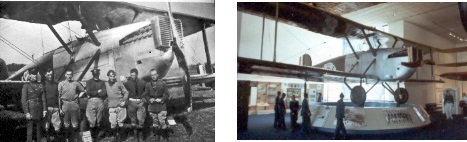
A group photo of the Around the World Flyers, and the original Douglas World Cruiser ‘Chicago’ on display at the Aerospace Museum in Washington, DC.
* * * * *
 Wings Over Cumberland