By Bill Armstrong
The following was delivered by the author in July 2023, at a gathering of friends and family, honoring Bob Armstrong upon his retirement as a professional pilot.
Among the multitude of assignments where my brother Harold was stationed during his long active Air Force career was Brookley AFB, in Mobile, Alabama. Harold’s wife, Martha, on 13 July 1953 gave birth to a son, named Robert Keith Armstrong. “Bob” was therefore deemed an Air Force brat, or the fraternity of those family dependents who followed their parents to military bases far and wide. Lt. Col. Harold Armstrong, after more than three decades of service, retired from active duty in 1973.
It is fitting that Bob Armstrong grew up around military bases with large inventories of Air Force aircraft. That cemented the stage for his never ending interest in aviation, the same dedication instilled in his father and best friend. Later stationed at McGuire AFB in New Jersey, Harold’s duties included flying great distances in large aircraft with four engines hung on the wing. But he also, while off duty, was active in a flying club that maintained a fleet of low and slow flight machines.
It was here that Bob earned his first buck, actually $5, for cleaning one of the club’s aircraft. The natural outcome of this exposure was that Harold, a civilian FAA flight instructor, first began to offer flight instruction to his son in 1969. After having 16.7 hours of instruction, Harold said “so long” to Bob and said “give me three satisfactory landings”. That mission was accomplished and Bob became an FAA authorized private pilot. The horizon became wide open for Bob.
Romney Flying Service was a firm that had connections with the West Virginia Department of Agriculture. West Virginia was at the time exporting lumber overseas and did not wish to send any diseased trees to another country. This birthed the Oak Wilt operation, where aircraft were flown low and slow over the state’s wooded areas. The pilots and a back seat observer were searching for wilted orange colored leaves that denoted the Oak Wilt disease. Bob, along with his father, his uncle Bill, and Jim Abe flew four aircraft in pursuit of this mission, operating out of the Mexico Farms airport. The program was begun earlier but during the years 1975-1988 the aforementioned pilots completed this mission, covering almost all of West Virginia during the summer months.
In 1978 Bob was employed by the Nicholson Air Service operation out of the Cumberland Airport. As an airline pilot and First Officer he flew Beechcraft 99 and Piper PA-31 aircraft. During the 1980’s his father operated Armstrong Flight Service and performed local corporate requirements using a Navion Rangemaster, Cessna 421, Cessna 310Q, Beechcraft-58P and Piper PA-601P aircraft. Harold and Bob flew corporate owners in the Cumberland area on these varied missions.
Bob was then hired as a survey pilot for Earth Data Aviation from 1999-2001. He operated out of Hagerstown flying a Piper PS-31 and Helio H395 as he covered large areas in various locations throughout the US as the onboard cameras recorded the data. During this time he became the Chief Pilot for Lou Ort in his Fibred Group LLC operations, flying Lou and others on company business to many locations. This was accomplished in a Piper PA-60 (Aerostar) and a Machen 700 aircraft. Bob spent 14 years supporting Lou Ort and his operation. After Ort downsized and sold the aircraft, Bob sought a new position.
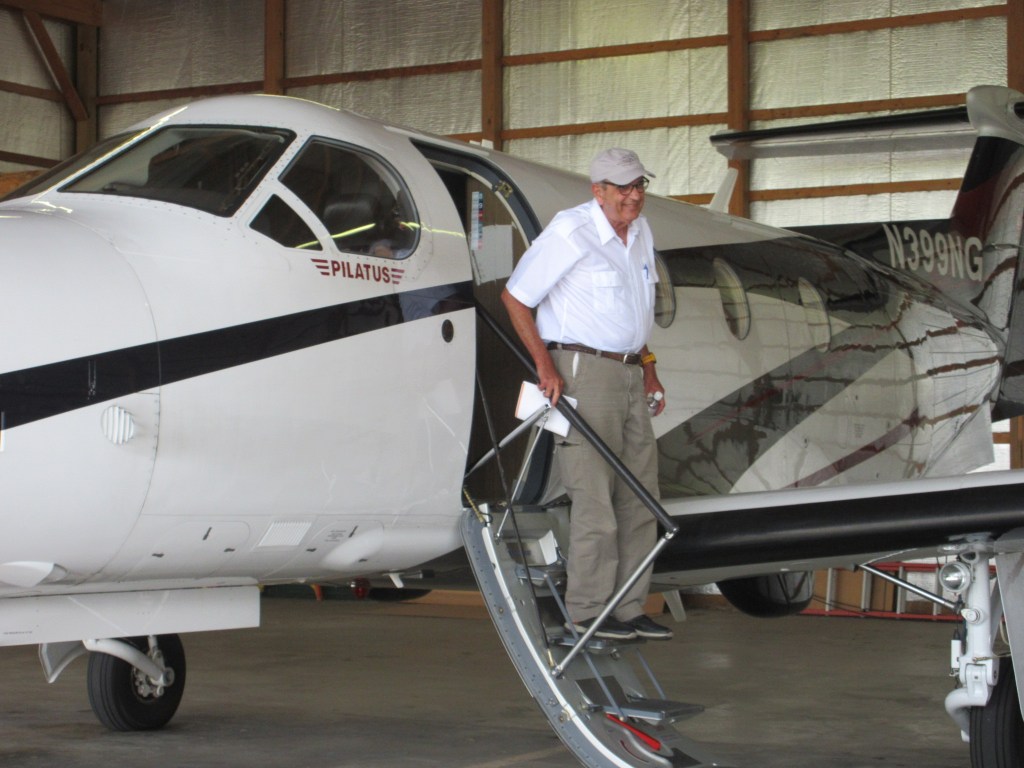
Good fortune followed as Bob was hired as Chief Pilot for Allegheny Wood Products. Later he became Chief Pilot for the Summit Bank of Moorefield, flying the modern Pilatus PC-12NG, based at Petersburg Airport in West Virginia. From 2019 until the present time he has flown all over the country in support of both of these operations. It hardly needs to be stated that Bob has enjoyed every minute while performing these flight operations. Bob Armstrong has a proven record of reliability and dedication as a professional pilot over these many years. As he retires from corporate flying responsibilities, Bob will remain an active pilot as he flies his own aircraft from his own airfield at McCoole, Maryland. He welcomes one and all to visit him as he maintains his private airfield and the Armstrong Aircraft Museum, a worthy stop for anyone with aviation interests.
Addendum
Before the above speech was delivered, family and friends of Bob gathered at the Petersburg Airport, to greet him upon landing. This was arranged without Bob’s knowledge. While most of the group waited outside, Bob’s Uncle Bill remained in the terminal. When Bob called in for clearance to land, instead of the Airport Manager, it was Bill Armstrong who acknowledged the request and gave the clearance. Bill did not identify himself, but only said what the manager would have said, to any other pilot on any other day.
One wonders what went through Bob’s mind when he heard a voice that was familiar but out of place. A moment of confusion would be natural. Should he risk embarrassment if he misidentified the voice? Should he ask the voice to repeat the message? Or should he carry on and pretend he hadn’t noticed?
Maybe those questions flashed through Bob’s mind. Or maybe he followed Air Force Colonel John Boyd’s OODA loop – Observe, Orient, Decide, Act. If so, he knew this decision-making process is not actually a simple loop, but a complex non-linear cross-referencing model with information feeding back as well as forth.
What actually happened was that Bob instantly replied, “Hello, Uncle Bill.” Then he proceeded to execute a perfect landing.
Back in the terminal, Bill Armstrong looked at the airport manager, smiled, and shook his head. So much for surprising Bob. Throughout his flying career, Bob certainly faced more important and genuinely hazardous decisions. But this one small one, made as he was about to land after the last leg of his last professional flight, shows what a true flyer Bob was. There is something beyond knowing the science of aviation, transcending the technical details, that makes a pilot more than a pilot, into a natural and instinctive flyer. Bob’s Uncle Bill had that quality, Bob’s father Harold had it, and Bob had it too.
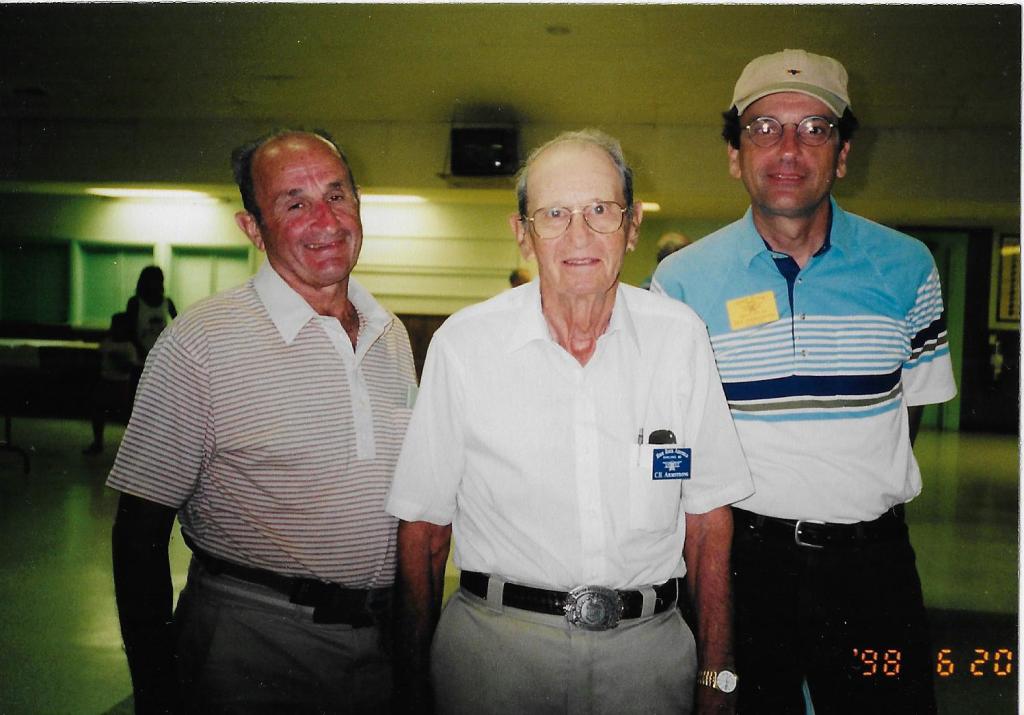
(Left to Right – Bill, Harold, and Bob Armstrong)
 Wings Over Cumberland