The following was written by Dave Long, and delivered at Harold Armstrong’s memorial service on 28 December 2004.
I am honored to have a part in this celebration of Harold Armstrong’s life. I first met Harold in the mid-nineteen fifties while he was on leave from the Air Force, but I really did not get to know him until after his retirement from military service in 1973.
I found Harold to be a man of many talents: pilot, mechanic extraordinaire, flight instructor, project manager, and restorer of vintage airplanes. Whatever he chose to do, and that could be almost anything, it was done to perfection, and that is the way he lived his life.
Harold grew up on a large dairy farm in Rawlings, MD and began his flying career there in 1940. He purchased a damaged biplane and promptly repaired and learned to fly it. He soon entered the US Army Air Corp where he served through WW II instructing in trainers and bombers and the cold war flying many different planes, ending with the Lockheed C-141 Starlifter, a big long range beauty powered by four jet engines. While serving in Vietnam, he was credited with more than 1100 combat support missions, and this when he was approaching 50 years of age.
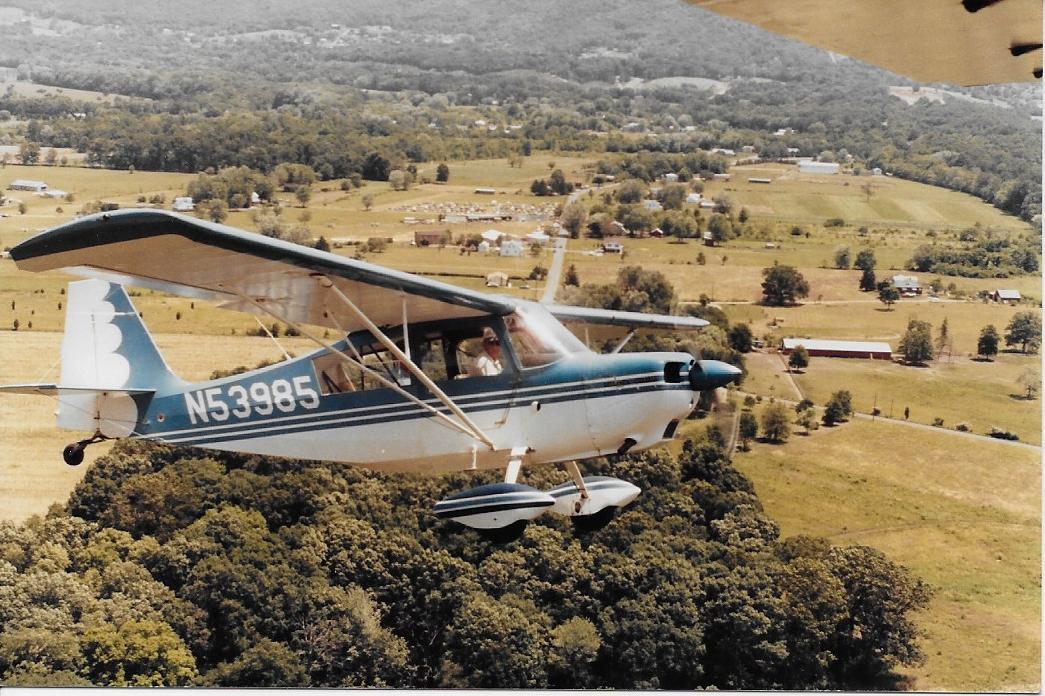
Following military service he returned to instruction, corporate flying, forest patrol, gliding and soaring, and lastly, flying his own four airplanes. I saw Harold fly on the Centennial of Flight, December 17, 2003, and he has been airborne several times since. In all he has logged nearly 29,000 hours of flight time.
Within the flying fraternity there are many pilots. A very few are so naturally talented and have become such artists of the profession that they are referred to by their brothers as AVIATORS. Harold would be at the head of this class.
I guess it was because of his many years in the military, but Harold’s verbal communications were always short and to the point, at times even terse. “Attaboys” were in very short supply. There was, however, one major exception – his tribute to Martha during their 50th Wedding Anniversary Celebration. He displayed such love, appreciation and praise for Martha that it left you firmly convinced that his life could not have been so successful were it not for her loving support.
Harold once paid me a compliment, at least I took it that way. It was early in my acquaintance with him. I had recently been checked out in a biplane. It was bigger than any plane that I had flown up to that time and I thought the check out was too brief. Consequently, I was a little apprehensive when flying it. I encountered Harold one day on a flight into Baker’s Airpark in Burlington and asked him if he would ride through a few take-offs and landings with me. After the first landing, Harold got out, looked at me and said, “You’re OK”.
Incidentally, it is a little known fact – and probably important only to me – Harold and I had the same flight instructor, Herb Wentz!
The later generation of professional pilots around this area respectfully referred to Harold as “The Colonel”. It seems to me that the Colonel’s true passion was for the restoration of antique airplanes. During his retirement, he and Bob completely restored four aircraft, all receiving major national awards. One, his Pitcairn PA-4 Sportwing, is the only airplane ever to received 100 points (the maximum) at the Experimental Aircraft Association’s Fly-In at Oshkosh, Wisconsin.
That reminds me of a story – When Harold and Bob were planning to fly the Pitcairn to Oshkosh for its first showing, Bob Poling and I decided to follow them in the “chase plane”. Martha was to follow with the station wagon as the “ground crew”. At the first fuel stop, the planes had been on the ground only about 15 minutes when up drives Martha. As we all stood in amazement at her early arrival, Harold walks over to Martha and asks, “Where in the hell have you been?” That then became the greeting to Martha at every fuel stop.
The Pitcairn was awarded Grand Champion Antique, the most coveted prize at the world’s largest air show. As mentioned before, it received 100 points, meaning that the team of super-critical judges could not find one flaw in the restoration. This brought national recognition to Colonel Armstrong and he was subsequently inducted into the Experimental Aircraft Association’s Antique/Classic Hall of Fame and also the OX-5 Aviation Pioneers Hall of Fame, two very exclusive groups.
Perhaps somewhat less well known is Harold’s generosity with his talents and time when anyone needed help. However insignificant a question or small a task, Harold was always ready to lend a hand. I know personally of an occasion where he spent three weeks, full time, to repair a plane’s broken wing – the charge – ZERO! He just wanted that airplane back in the air.
As I mentioned in the beginning, Harold could be a project manager. After Bob had acquired the farm that would become High Rock Airfield and had, by slashing and seeding, made the air strip usable, the next logical step was to construct a hanger. Harold undertook this project with vigor. He conceived the design, drew the plans, hired a contractor, procured materials and managed construction. I think that anyone that has seen that hanger will agree that it is a fitting structure for Bob’s airport. With the airplanes and memorabilia so beautifully displayed, it is truly a museum. I value any opportunity to spend time at the High Rock Airfield. I have told Harold and Bob many times that I consider it a piece of Heaven on earth. I consider it a true blessing to have spent a portion of my journey through life in the company of Harold Armstrong and the Armstrong family.

 Wings Over Cumberland