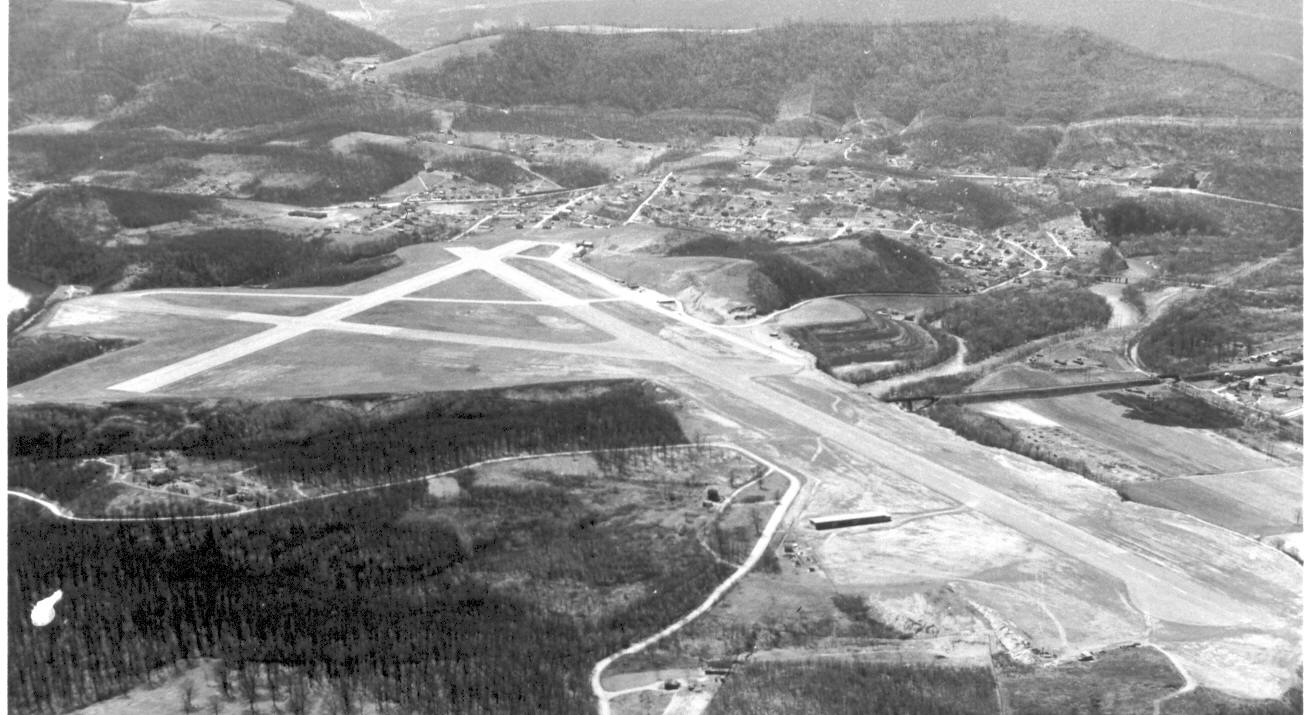
Dr. Robert K. Poling delivered the following presentation on the 1940-1950 history of the Cumberland Regional Airport to EAA Chapter 426 at their December 1996 Christmas party.
According to folklore a field at the present location of the Cumberland Regional Airport was used as a landing field for moonshine and bootlegger whiskey flights in times past. Nearby cities such as Elkins, Morgantown and Hagerstown had modern airports. Even though Cumberland was the second largest city in Maryland, Mexico Farms was its only airfield. Mexico Farms had short grass runways that were unusable in late winter and spring.
With the coming of Defense Preparedness in the late 1930’s a new airport for the Cumberland area was finally undertaken in 1941. The governor of Maryland attended the ground breaking and Ronald “Torque” Landis flying a Pitcairn Fleetwing bi-plane participated in the program. The Pitcairn is the same aircraft restored by Harold Armstrong and currently in flying condition in our local area.
Torque Landis was the most famous flying personality of the time, having taught many local pilots and having developed his own unique aerobatic routine. The irony of Torque’s participation at this event was that neither Torque nor the Pitcairn were properly licensed. Within a year runway 1-19 was partially finished and many pilots wanted to be among the first to land there including me. The first big airplane to land at the new Cumberland Municipal Airport was an Army Air Force B-25 to deliver Sgt Fred Hosey for a visit on October 24, 1942. Sgt Hosey was one of the first flying Sergeants in the AAF.
On September 8, 1943 Flight Officer Kenny Jewell and his crew landed a B-24 Liberator bomber at Cumberland while on their way to combat in the 8th Air Force in England. They landed on partially completed runway 24 using 3500 feet of macadam and 500 feet of dirt runway that had not yet been paved. The plane circled the city several times and a large crowd was on hand to see it land, including my father. He relayed all the details to me while I was on active duty in the AAF. Kenny Jewell had been a classmate of mine at Fort Hill which made the incident most interesting to me. Many citizens came to see the roped off and guarded B-24 (named Bakadori) that evening and the next morning. This event could be contrasted in excitement and interest to a B-52 landing at Cumberland during the Gulf War, on its way to Saudi Arabia.
Kenny Jewell and his crew conveniently developed engine trouble on their B-24 and had to make the landing at Cumberland. It just so happened this was Kenny’s hometown. Kenny later told me that when he telephoned his commander in Kansas to tell of the landing he stated it was at Wiley Ford, WV. His Commanding Officer immediately asked Jewell where his hometown was, and Kenny being from the Lake Koon area said Pennsylvania. Apparently the commanders knowledge of geography was not too good and he let it pass. The commander had other crews also land at their hometown for a last quick family visit while on their way to England and combat tours from which they might not return. With that in mind Kenny handed the phone to Virgil Parker, a local aircraft mechanic and former WWI pilot and Army officer, who understood such things, and verified that indeed the B-24 had engine trouble. Of course no one believed it, but if Virgil said so it was beyond dispute.
Jewell’s crew left the next morning minus one crew member who had taken the train to his hometown – he caught up to them shortly after in Maine. They arrived safely in England and began flying combat bombing missions. After their original B-24, Bakadori, was badly damaged they received another B-24, Banshee.
After many missions Kenny Jewell, as the bomber formation leader in a B-24 named “E Z DUZIT”, was severely injured losing his left leg due to an exploding anti-aircraft shell in the cockpit. Luckily the aircraft had just dropped its bomb load and was flying on automatic pilot. The co-pilot was a single engine fighter pilot and had no experience with large bombers. Since Jewell was the most experienced and proven combat pilot, and frequently was the lead aircraft, a less experienced pilot flew in his right seat. This new co-pilot became sick at the sight of Kenny’s wounded leg and seeing blood everywhere threw up in his oxygen mask. The rest of the crew not only had to give Kenny first aid, but had to render aid to the co-pilot lest he die from a lack of oxygen. They managed to keep flying toward England and home base and were able to determine that the flak explosion had damaged the nose wheel and with no hydraulic fluid would have no braking action. After descending to a lower altitude and upon approach to landing they lifted Kenny back into the pilots seat. Kenny then instructed the revived co-pilot how to land the airplane and to hold the nose up as long as possible after main gear touchdown. The crew tied parachutes to the waist machine guns and at touchdown deployed the chutes to act as air brakes. The nose dropped and slid a long way down the runway before coming to rest. Fortunately everyone had survived the mission. For this act of heroism Kenny Jewell received the Distinguished Service Cross. He also received the Silver Star, the Distinguished Flying Cross with 2 clusters, the Air Medal with 5 clusters, and the Purple Heart.
While recuperating in a state side hospital General Hap Arnold, Chief of the Army Air Forces during WW II, visited the hospital and promised Kenny he could fly again with an artificial left leg. Before the war ended Jewell was instructing in B-17’s. Following the war he became an instructor for Cumberland Airways at the local municipal airport.
In the late stages of World War II the airport was basically finished and many war birds landed at Cumberland. In early 1946 Cumberland Airways signed a contract to be the Fixed Base Operator of the local airport. Cumberland Airways was a division of Graham Aviation of Pittsburgh. John Chapman, who had run a civilian Army Primary Flying Schol for Graham Aviation during WW II, was placed in charge of the FBO.
In April of 1946 the city of Cumberland purchased a B-17 Flying Fortress from the US government for $350, the price including fuel for the trip from Walnut Ridge, Arkansas. The aircraft was parked in front of the old Administration Building (now occupied by the Civil Air Patrol Composite Squadron) as a memorial to the many men who fought in WW II. Harry Flook, a well known veteran of the 8th Air Force with combat experience in B-17’s, along with Virgil Parker and John Chapman flew the purchased aircraft on the non-stop flight from Arkansas to Cumberland. This B-17 was known to have been flown by Major General Nathan Twining, Commander of the 15th Air Force who later become the head of Air Force after it became a separate service in 1947. General Twining was also a member of the Joint Chiefs Of Staff.
Cumberland Airways was a busy organization following WW II and their operation trained numerous pilots who had their aviation training paid under the GI Bill of Rights through the Veterans Administration. The instructor pilot cadre included many experienced and competent pilots. So many people came to the airport that five junior hostesses were on hand every Sunday to sell flight tickets and help select which airplane a student pilot desired to fly. Cumberland Airways claimed they had the largest GI Flight Training Center in two states.
In August 1946 Cumberland Airways sponsored an Air Show at the Cumberland Municipal Airport. The following acts were on the program:
* A formation acrobatic routine by three Fairchild PT-19’s flown by Larry Wagner, Bill Duncan, and Harry Flook.
* A delayed parachute jump by 18 year old Dick Miller.
* Transfer from a speeding car on the runway to an overhead aircraft by Harry Flook.
* Cranking plane in mid-air after engine shutdown of a Piper Cub. John Chapman stood on landing gear and hand propped engine. (Prior to the hand propping Chapman would throw a dummy out of the aircraft which the unexpected crowd construed to be onboard the aircraft and they fully expected to witness a fatal accident as the body came earth bound).
* Comedy act by Charlie Bing.
* Helicopter demonstration by Army Air Force pilots – a first at Cumberland.
* Aerobatics by Woody Edmundson in his renowned clipped wing Monocoupe.
* Aerobatics by Bevo Howard in his clipped wing Cub. Howard was also a renowned acrobatic pilot who concluded his display with a dead stick landing rolling to a stop in front of the crowd on one wheel.
In 1947 another Air Show featured Charles Bing in an AT-6. Harry Flook flew a Piper Cub through a burning wooden wall. Bernie Miltenberger flew a comedy act in his Taylorcraft and Dick Miller performed a parachute jump. Bevo Howard again performed in his clipped wing Cub and also in a Bucher Jungmeister. This famous German pre WW II trainer was brought to the US in 1935 aboard the Hindenburg dirigible. The Jungmeister was probably the best aerobatic aircraft of its day and this type is still in acrobatic use. Bevo Howard was a real gentleman who mingled with the crowd and freely spent time with some local model airplane builders. Two P-80 Shooting Star jet fighters visited the air show and awed everyone with their speed and graceful aerobatics. The Air Show was favorably compared with the big shows of the time at Miami and at Cleveland.
In 1948 the Fixed Base Operation changed to the Mountain Air Service, managed by a combination of Fred Jenkins, Sanford Jenkins and Jack Delagrange. In June 1948 the Exchange Club, Junior Chamber of Commerce, and Mountain Air Service jointly sponsored an Air Show which featured an Air Race. An estimated 10,000 patrons were in attendance. Our own Bernie Miltenberger did his usual excellent comedy act and Richard Hockman performed a delayed parachute jump. Jim Armstrong, a former P-47 pilot performed a low altitude aerobatic routine in an English Miles Sparrowhawk. There was also a spot landing, balloon bursting, and bombing contest. Almost all performers were local pilots which made this air show the more interesting. As a finale the Maryland National Guard in P-47’s thrilled the crowd by formation flying and making simulated strafing runs over the hillside spectators. Harold Armstrong in a ME 108 and his brother Jim in the Miles Sparrowhawk flew in close formation from the Baker Air Park in Burlington, WV and made a fly by at Cumberland. These were both most interesting and historical aircraft.
The Messerschmidt 108 was a smaller offspring of the German ME 109. The ME 108 was used as a courier and all purpose plane by the Germans during WW II. Somehow or other Leo “Pat” Patterson had taken possession of this aircraft in Africa and had it shipped to the US shortly after WW II. It had many interesting features, however, a faulty fuel system caused serveral forced landings for Harold and the airplane fell out of favor at its base in Burlington. It is believed to be still in existence in Germany and is reported to be coming to the 1997 Oshkosh Air Show. The Miles Sparrowhawk was a pre-WW II sport airplane constructed of wood and built in England. It was a beautiful aircraft with great flying qualities. It was powered by a Gypsy Major engine and in Jim Armstrong’s hands it was a capable aerobatic airplane.
The air race portion of the Air Show was for production aircraft and similar to the race previously held at Mexico Farms in 1947. The course was from Cumberland Airport to Dan’s Rock atop Dan’s Mountain, then to Ft Ashby and back to the Cumberland Airport with three laps total distance. The starts were staggered according to a handicap system determined by Durr Golladay, a Cumberland aeronautical engineer. First prize was a $200 savings bond and a trophy. Entering the race were: Kenneth Hager – Taylorcraft, Bill Cramer – Aeronca, Charles Park – Ercoupe, Tom Shannon – Aeronca, Bernie Miltenberger – Cessna owned by Louie Ort, Harold Clayton – Taylorcraft, Fred Jenkins – Piper Super Cruiser, Harold Dodd – Cessna, W L Kline – Piper Cub, Earl Wilson – Aeronca, William Johnson -Aeronca, Sanford Jenkins – Piper Cub, Ewald Reuhl – Ercoupe, and Berkey Smith – Taylorcraft.
Approximately 10,000 folks braved the sun sitting on the hillside to witness the air race. The race ended with a thrilling finish between Harold Dodd’s Cessna 140A and W L Klines’s 50 hp Piper Cub with Dodd beating Kline in the closing seconds of the three lap race. Berkey Smith in a Taylorcraft finished third which was some revenge for Dodd as Smith had beaten him in the previous year’s race at Mexico Farms. Bernie Miltenberger’s son Phil told me that his dad in Lou Ort’s Cessna 120 won a pair of shoes donated by Donald Smith of Smith Shoe Store.
In summary the first years of the Cumberland Municipal Airport’s existence were an interesting period. These notes and recollections from that period and the post WW II environment here in the Cumberland area have served as the basis for my input. I hope my compilation of these notations has been of interest to you.
 Wings Over Cumberland